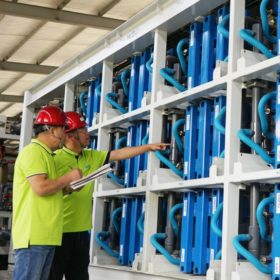
Work begins on 100 MW/500 MWh vanadium flow battery in China
The storage project is linked to a 1 GW wind and solar project portfolio, 500 MW of solar distributed generation, and the construction of a gigafactory for vanadium redox flow batteries in China.
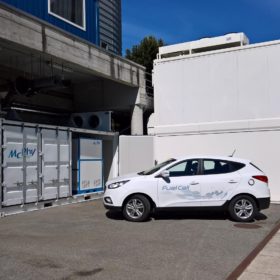
Vanadium-manganese redox dual-flow battery to store power, generate hydrogen
Conceived by Swiss researchers, the battery shows good stability over 50 cycles, with an average energy efficiency of 68% and a water-splitting voltage efficiency of 64.1%. According to its creators, the device produces pure hydrogen that only needs to be dried and compressed for optimal storage.
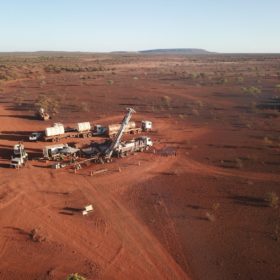
Australian Vandium to fast-track manufacture of flow batteries
Western Australian company Australian Vanadium Limited has been awarded $3.69 million in federal government funding to fast-track manufacturing of large-scale vanadium redox flow battery systems that can be used to support rooftop solar PV or in off-grid settings such as mining, agriculture and remote communities.

Enel installs 6.1 MWh vanadium redox flow battery in Spain
The battery will be provided by Canadian vanadium mining company Largo Resources. It will come online in the third quarter of next year.
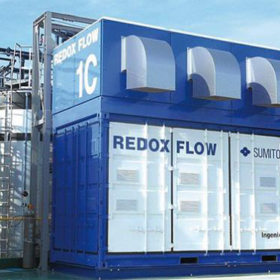
Malaysian green hydrogen project opts for Perth-based flow batteries
Australia-based TNG Limited has signed an agreement with Malaysian green hydrogen company AGV Energy which will see its vanadium redox flow batteries integrated into the HySustain project to store solar energy for green hydrogen production.
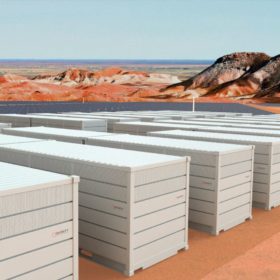
Large-scale vanadium redox flow battery takes shape in Australia
A new South Australian big battery will show the value of diverse storage deployments in the National Electricity Market.
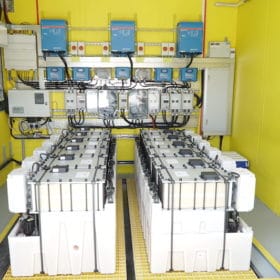
Australian vanadium companies unveil new flow-battery strategies
Australian Vanadium filed a patent application this week for its vanadium processing route, while rival TNG signed a deal to commercialize vanadium redox flow batteries.
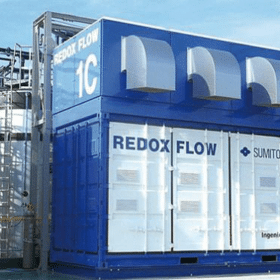
Australian government praises vanadium project
The Australian government has recognized TNG’s flagship Mount Peake Project – a mine that includes production plans for vanadium redox flow batteries and green hydrogen – as nationally significant.
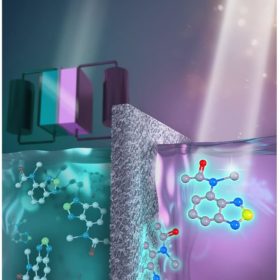
Redox flow batteries with fluorescence detection
Argonne National Laboratory researchers have found a way to use fluorescence to monitor the performance of redox flow batteries in real time. They used 2,1,3-benzothiadiazole as a redox-active molecule to store energy in the electrolytes. The molecule works as an energy carrier and signals a problem known as “crossover.”
Hybrid electrodes for cheaper redox flow batteries
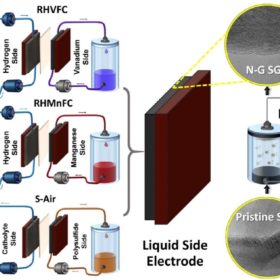
UK researchers have used standard carbon paper electrodes modified with electrophoretically deposited nitrogen-doped graphene (N-G) to improve the electrochemical performance of hybrid redox flow cells utilized in redox flow batteries. According to their findings, these electrodes are capable of meeting the harsh electrochemical requirements for these HRFCs and offer enhanced performance and operability.
