Amount of silver needed in solar cells to be more than halved by 2028, Silver Institute says


The amount of silver needed to produce conductive silver paste for the front and back of most PV cells may be almost halved, from an average of 130 mg per cell in 2016 to approximately 65 mg by 2028, according to the Role of Silver in the Green Revolution report published by CRU Consulting – a division of CRU International Limited – on behalf of the Silver Institute.
The report’s authors explain the amount of silver used in solar cell manufacturing has already decreased to a much larger extent, from 400 to 130 mg between 2007 and 2016. The authors also predict cell output will grow from 4.7 W now to 6 W by 2030, contributing to a 10.5 mg reduction in silver use per Watt, the report notes.
However CRU’s analysts state silver’s unmatched electroconductive qualities mean there is a “physical limit” on the possibility of further reducing silver loadings in cell production, as efficiency losses outweigh the benefits achieved from cheaper raw materials such as copper or aluminum.
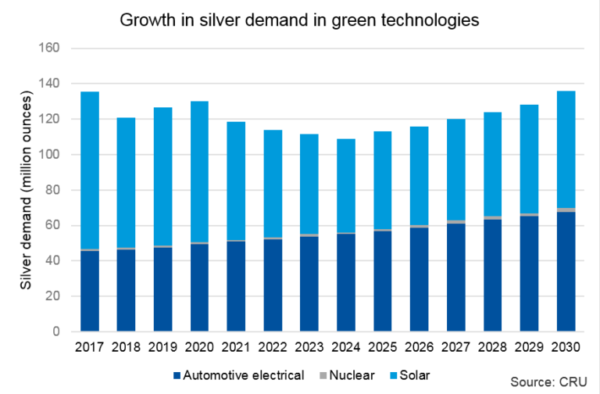
During the next decade, non-silver based PV technologies are not expeccted to gain significant market share as they tend to have shorter lifespans and the global PV market, the report states, is moving toward more compact and efficient solar panels.
CRU predicts module efficiency may rise to around 25% by 2030, which would result in a 24% reduction in the number of panels needed to produce a given amount of electricity.
“These two factors – thrifting and efficiency increases – may decrease silver loadings enough that it would take a significant increase in solar capacity’s growth rate to keep silver demand from slipping – an increase that the industry as it currently stands will not be able to deliver in the long term,” the report states.
As a consequence, CRU experts forecast silver demand for the PV industry of around 70 to 80 million ounces per year until a decline to between 50 and 55 million ounces in the mid-2020s. Only by 2030 is demand expected to recover, to approximately 66 million ounces per year.
In a separate report published in May, the World Bank forecast a significant drop in the silver price, to $13.42/toz, by 2030. Up to 2021, however, the commodity price is not expected to change by a great margin, according to the analysts. Expected to close at $16.45/toz in 2021, the more significant decline in silver prices will come later, to a predicted $15.04/toz in 2025.
According to a report published by the Silver Institute in April, global industrial demand for silver grew around 4%, from 5,768 million ounces in 2016 to 5,990 million last year. This spurt was mainly due to the record growth of the PV industry, which pushed demand for silver as a component of silver pastes for solar cells, from 79.3 million ounces in 2016, to 94.1 million ounces in 2017 – year-on-year growth of around 19%.
This content is protected by copyright and may not be reused. If you want to cooperate with us and would like to reuse some of our content, please contact: [email protected].

Please login to comment

[…] of the energy mix, due to technological advancement, the amount of silver used in solar cells is shrinking year after year. The two effects mostly balance out, and as a result, the silver demand as part of […]
[…] Detail Answer […]
[…] function with less expensive materials, this won’t happen for a while with solar panels. Experts believe alternative or lower-cost raw materials won’t replace silver in these cells for at least a […]
[…] function with less expensive materials, this won’t happen for a while with solar panels. Experts believe alternative or lower-cost raw materials won’t replace silver in these cells for at least a […]
[…] of PV producers to reduce silver content in solar cell production – a process referred to as ‘thrifting’ – had reduced since 2016 but they anticipated the average 111mg of the precious metal needed […]
[…] The results of the rate boost are presently shown with making use of silver in solar batteries reducing from 400 milligrams to 130 milligrams in between 2007 and […]
[…] The results of the cost boost are presently shown with making use of silver in solar batteries reducing from 400 milligrams to 130 milligrams in between 2007 and […]
[…] The effects of the price increase are currently reflected with the use of silver in solar cells decreasing from 400 milligrams to 130 milligrams between 2007 and […]

That’s hilarious that silver will be $13 an ounce in 2030. $13 in 2030 would be like $8 today with inflation. Give me a break. Silver has a far better chance at being $80 an ounce than $13.
[…] as a key industrial metal, the Silver Institute is predicting that use of silver in solar panels will be halved by 2028 using copper and aluminum as […]

O Yah ! everybody who predicts what silver will do in the future are always spot on right ? Dah !
Nobody has a crystal ball & especially stock brokers who tell you to buy stocks that have already been hogged out ! I say listen to your own mind & not to “so called experts”

Wow. It’s now July 22, 2020, and this article has really held up well, hasn’t it. Not at all. With fossil fuel demand and new commitments to green energy, combined with COVID-19, and every nation in the world drowning in debt, can I get some silver from you at $13 please.
[…] are small amounts of metal in a solar panel and the most valuable is silver. There’s around 8 grams in a modern panel. At 80 cents a gram that’s $6.40 per […]
[…] are small amounts of metal in a solar panel and the most valuable is silver. There’s around 8 grams in a modern panel. At 80 cents a gram that’s $6.40 per […]
[…] are small amounts of metal in a solar panel and the most valuable is silver. There’s around 8 grams in a modern panel. At 80 cents a gram that’s $6.40 per […]
[…] are small amounts of metal in a solar panel and the most valuable is silver. There’s around 8 grams in a modern panel. At 80 cents a gram that’s $6.40 per […]
[…] most expensive. Its high cost has pushed researchers to steadily decrease the silver required, from 400mg in per cell 2007 to 130mg in 2017. It is predicted to continue falling to 50 mg by 2029 [4]. According to the Silver Institute, 851 […]
[…] panels, researchers forecast that the amount of silver used for this purpose will be cut in half by 2028. Although there is a strong push towards sustainable energy, the ability to more efficiently use […]
[…] panels, researchers forecast that the amount of silver used for this purpose will be cut in half by 2028. Although there is a strong push towards sustainable energy, the ability to more efficiently use […]
[…] more economical when it comes to materials used during its construction. Smaller solar cells mean less precious metals, like silver, and other […]

Efficiency of solar cells effects the number of cells solar panel will use. Todays cells average about 17%.Mono cells get better efficiency, will cost more. Poly cells are less efficient less cost. Better cell technology is improving and will require less silver.. The Growth Chart shown above is a good picture.
Better copper purity will be s future factor in PV costs.

With increased efficiency, demand will increase and solar will become more efficient and financially viable in more northern climates greatly expanding the use of solar panels.

Well if efficiency increases, we will buy much more solar panels.

Didnt consider automotive demand. It will drive silver, plus new tech
do you know how much silver was in the first generation of solar panels und how did developed by years.