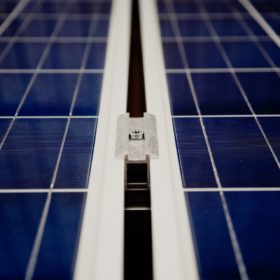
‘There is no clear best module configuration under partial shading’
A Slovenian research team has analyzed the behavior of a full-size cell PV module and several 1/6 cell panels under partial shading and has come to the obvious conclusion that the cell cut panels suffer fewer energy losses. They also found, however, that the orientation of the cells connected in series should be aligned as much as possible with the shade shape to lower the losses and to minimize reverse cell voltage.

Gambian utility seeks consultants to improve water management with solar and renewables
Gambia’s national utility is seeking proposals for an energy and water audit of its water operations. Selected consultants will assess the possibility of using solar to improve energy efficiency. The utility will consider floating PV, rooftop arrays, and solar pumps.
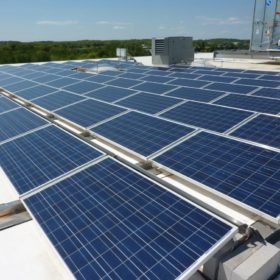
Belgium deployed 900 MW of PV in 2020
Renewable energy production increased by 31% and now represents 18.6% of the country’s electricity mix. Its cumulative PV capacity increased from 3,887 MW at the end of 2019 to 4,788 MW at the end of December.
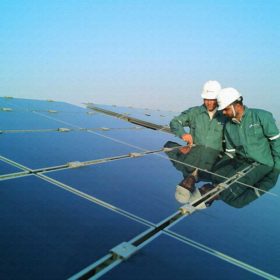
Sembcorp wins 400 MW solar project in Indian auction
With its latest victory, Sembcorp Industries has expanded its renewables portfolio to more than 3 GW across Singapore, China, and India.
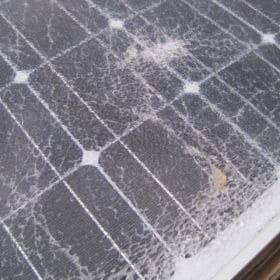
Urban land, aerosols could accelerate hail storm formation
Researchers from the U.S. Department of Energy have shown that urban landscapes and man-made aerosols have the potential to accelerate the formation of hail storms – a clear threat for PV arrays.
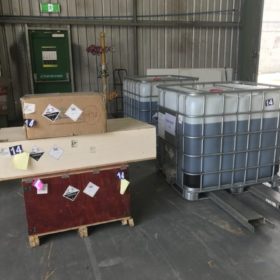
Australian Vanadium pushes ahead with plans for residential flow battery
Australian Vanadium is pushing ahead with plans to develop a vanadium redox flow battery for the Australian residential market, via its VSUN Energy subsidiary.
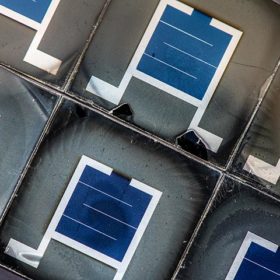
The state of the art in perovskite tandems
A new paper from scientists in China and Canada examines the recent progress in the development of perovskite-silicon tandem cells, finding a technology that’s poised for rapid commercialization, with a few research challenges still to overcome. These are primarily related to ensuring the perovskite layer can match the lifetime of the silicon cell underneath.
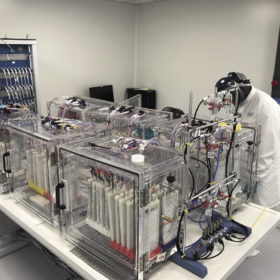
Sweden issues €5m call for battery studies
Researchers have just under four weeks to apply for backing for their projects, in areas including battery reuse and recycling, circular manufacturing and supercapacitors.

South Korea opens its renewable energy market to PPAs
Power purchase agreements will be allowed between renewable energy producers owning plants with a capacity of more than 1 MW and electricity consumers. Local utility Kepco, however, will keep serving as an intermediary.
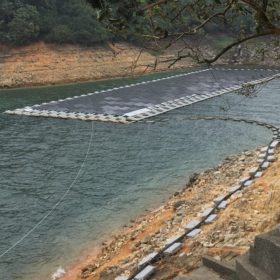
India to host ‘world’s biggest floating PV plant’ within two years
The 2,000ha installation, which will surpass in scale a 150 MW plant in China’s Anhui province, will reportedly require a INR3,000 crore ($409 million) investment.
