Australia may install 220,000 home batteries under subsidy scheme

Australia is on track to surpass 2024 home battery installation records, with July data from Melbourne-based solar consultancy SunWiz indicating up to 220,000 systems could be installed in the first 12 months of the federal government’s Cheaper Home Batteries subsidy.
SunWiz said the potential trajectory is based on 19,000 registrations in the Cheaper Home Batteries subsidy’s first 31 days.
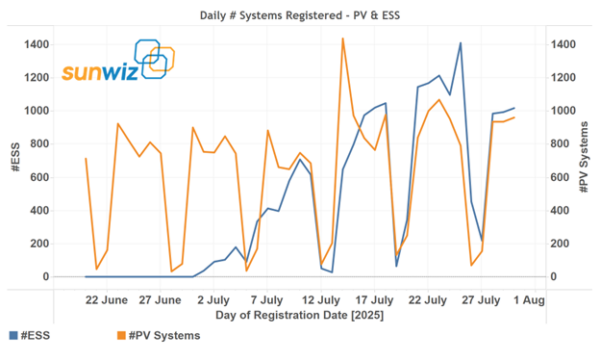
Solar households retrofitting home batteries led the charge, with battery registrations outnumbering solar on a daily basis in the second half of July.
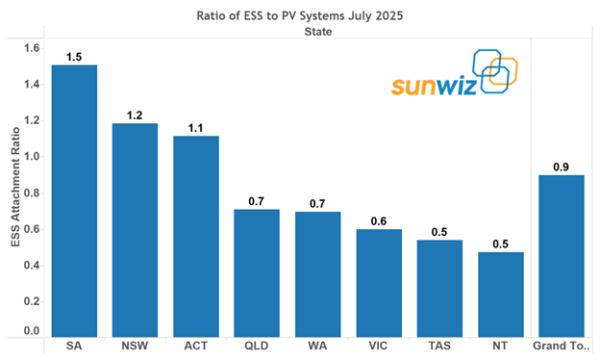
Across the month, 72 batteries were installed for every 100 new solar systems. But during the week of July 15 to 21, the ratio surged to 137 batteries per 100 solar installs, “reflecting a temporary but powerful flip in market dynamics,” said SunWiz.
SunWiz Managing Director Warwick Johnston said 19,000 home battery systems registered in the subsidy’s first month puts Australia on track to triple the 72,500 installations recorded in 2024.
“The capacity added in July alone represents more than 8% of all home battery storage ever installed in Australia,” Johnston told pv magazine. “In the week commencing July 21, Australians installed more battery capacity than in the first two months of 2024 combined.”
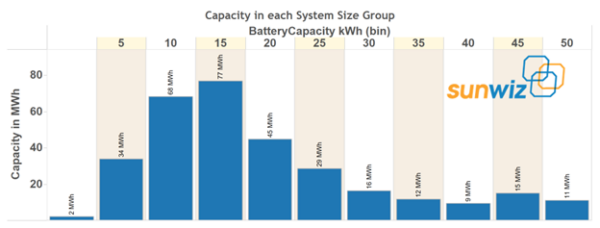
The SunWiz figures show that South Australia leads the battery -to-solar ratio of all states and territories, 150:100, and record uptake nationwide is seeing a shift to larger battery sizes, with the average battery sizes jumping from 10-12 kWh in previous years to 17 kWh in July.
This results in 300 MWh of new energy storage capacity being added in a single month, or the equivalent of 10% of the entire existing installed base of home batteries.
Over 115 MWh of battery capacity was registered during the week commencing 21 July, which SunWiz describes as astonishing figure compared to the 852 MWh installed over all of 2024, most of which came in the second half of the year.
“Many households recognise this may be a one-time opportunity to access a significant subsidy, and they’re using it to invest in larger batteries,” Johnston said. “Thanks to economies of scale, larger systems offer better value per kilowatt-hour, so the subsidy is having a strong multiplier effect.”
The figures show that the most commonly installed system sizes in July were 13 kWh, 19 kWh, 9 kWh, and 15 kWh.
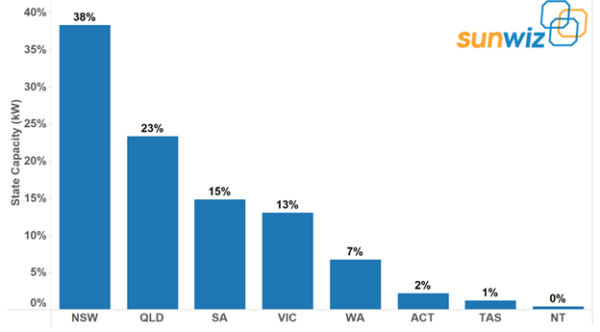
New South Wales led the nation in July battery capacity, accounting for 38% of all registered storage.
Queensland followed with 23%, then South Australia with 15%. Victoria, typically a solar leader, lagged behind at 13%.
South Australia saw the highest storage-to-solar ratio in the country, with 150 battery installations for every 100 new solar systems in July, highlighting the state’s continued leadership in energy resilience and self-sufficiency, said SunWiz.
Registrations peaked at 1,400 in a single day, before stabilizing to around 1,000 per day by the end of July, with SunWiz expecting this level to remain steady over the coming months, with further growth dependent on new stock arrivals and expanded installer training.
This content is protected by copyright and may not be reused. If you want to cooperate with us and would like to reuse some of our content, please contact: [email protected].

Please login to comment