




Researchers from Germany’s Constructor University have developed a novel unsupervised domain adaptation framework for solar power forecasting.
Their technique learns transferable features from one solar plant with abundant data, and transfers this knowledge to another solar power plant where labeled data is absent. It was presented in the paper Unsupervised domain adaptation framework for photovoltaic power forecasting using variational auto-encoders, published in Applied Energy.
Corresponding author Atit Bashyal told pv magazine that, unlike traditional supervised approaches, which rely on historical power data from all sites, “our framework enables accurate short-term forecasting even for newly-installed PV systems or systems without installed sensors.”
“We achieve this by aligning the source and target data distributions through variational auto encoders (VAE)-based adaptation, allowing the model to generalize effectively across different PV systems without requiring labeled data from the forecast target,” Bashyal explained.
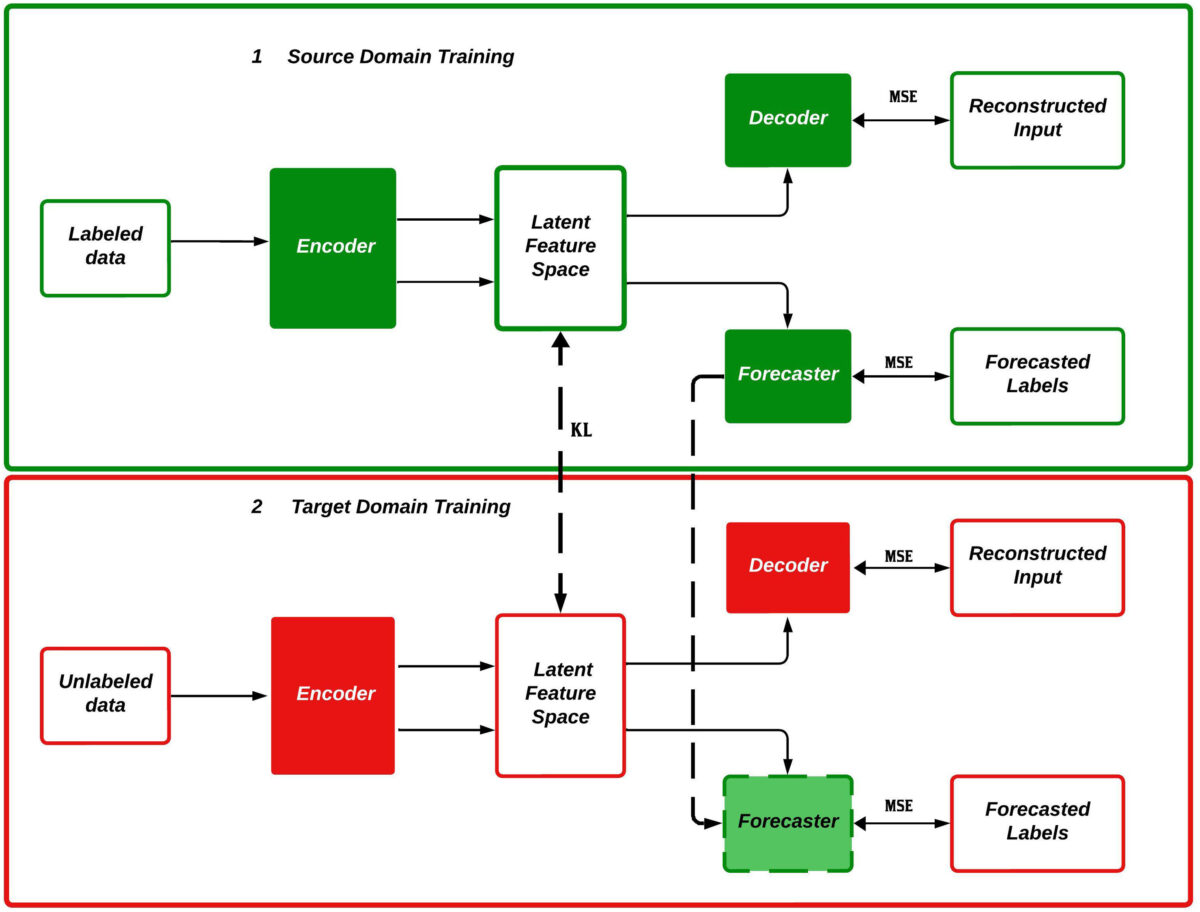
The research team has named their new architecture the Deep Reconstruction Forecasting Network (DRFN). The DRFN is first trained on a source PV plant with a lot of data, at which point it learns how to forecast solar power and reconstruct inputs using VAE.
The model then adapts its ability to a new PV plant, which has no data labels. It keeps the forecaster from the source, and only trains the encoder-decoder by minimizing the Kullback–Leibler (KL) divergence. KL divergence is a statistical measure representing the distance between two distributions.
The architecture was demonstrated on three PV plants in Germany. A 1.1 MW solar plant was used as a source plant and a 5.8 MW and a 2.5 MW plant were both used as targets. The 5.8 MW plant is located 8 km from the source plant, while the 2.5 MW plant is 600 m away.
When forecasting the operation of the 5.8 MW plant, the novel method had a root mean squared error (RMSE) of 718.8 kWh, a mean absolute error (MAE) of 393.74 kWh, and a coefficient of determination (R2) of 79.82%. The 2.5 MW target plant achieved 146.78 kWh, 78.94 kWh, and 80.49%, respectively.
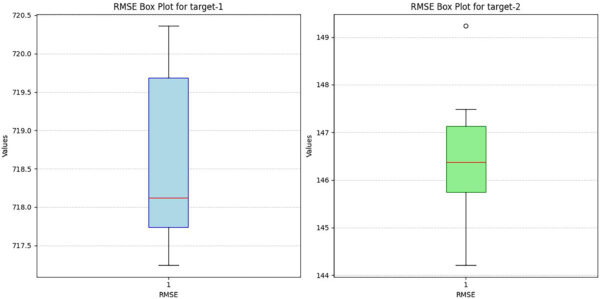
Image: Constructor University, Applied Energy, CC BY 4.0
The results were compared to the smart persistence forecast method, achieving a forecast Skill Index (FSI) of 17.37% for the first target PV plant and 20.13% for the second. In the case of the first plant, the smart persistence method achieved RMSE of 875.85 kWh, MAE of 466.17 kWh, and R2 of 66.3%. In the case of the second plant, the results were 183.78 kWh, 98.83 kWh, and 65.93%, respectively.
Bashyal said one of the most striking findings was the robustness and effectiveness of the domain adaptation methods in the face of missing ground truth data in the target domain.
“Our approach consistently outperformed the smart persistence model and baseline models, despite the absence of target labels during training,” Bashyal explained. “The ablation study further confirmed that our architectural designs materially contributed to performance gains (close to training with data), emphasizing the practical potential of our framework in real-world, data-scarce settings.”
Bashyal added that the research team is planning follow-up studies focusing on scaling up the study, integrating incremental or continual learning and jointly modeling uncertainty in forecasting. “These endeavors aim to refine robustness, extend applicability and advance the state of PV forecasting across evolving deployments and environmental conditions,” he said.
This content is protected by copyright and may not be reused. If you want to cooperate with us and would like to reuse some of our content, please contact: editors@pv-magazine.com.

By submitting this form you agree to pv magazine using your data for the purposes of publishing your comment.
Your personal data will only be disclosed or otherwise transmitted to third parties for the purposes of spam filtering or if this is necessary for technical maintenance of the website. Any other transfer to third parties will not take place unless this is justified on the basis of applicable data protection regulations or if pv magazine is legally obliged to do so.
You may revoke this consent at any time with effect for the future, in which case your personal data will be deleted immediately. Otherwise, your data will be deleted if pv magazine has processed your request or the purpose of data storage is fulfilled.
Further information on data privacy can be found in our Data Protection Policy.