




Rooftop solar could theoretically cover up to 20% of Norway’s current electricity needs, according to research.
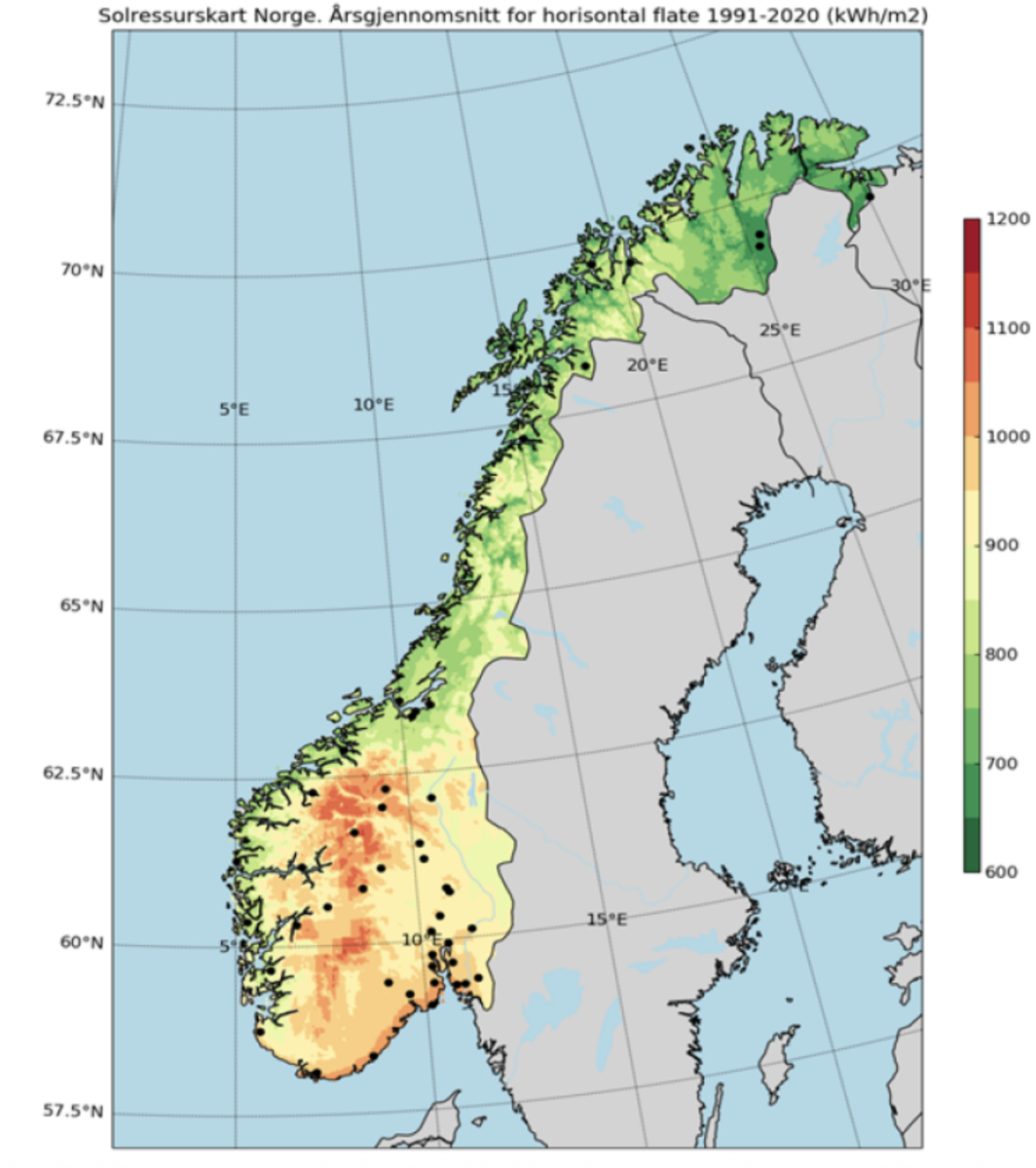
A Norwegian research paper has introduced the country’s first full solar map. The map was developed through the SunPoint project, a collaboration between the Norwegian Meteorological Institute and the Institute of Energy Technology (IFE).
IFE’s calculations of solar energy potential on existing rooftops took into consideration both the angle and direction roofs face, as well as existing structures on the roofs such as chimneys.
The research found that Norway could produce 30 TWh of solar energy by adding solar to the roofs of existing buildings. According to figures published by Statistics Norway, total electricity production in the country reached 157.2 TWh in 2024.
The best conditions for solar in Norway were identified in coastal areas, particularly in the outer Oslofjord and along the Sørland coast. Mountainous regions of southern Norway were also found to have high solar radiation but were identified as unrealistic for solar installations.
IFE’s research found that the energy produced on a rooftop solar plant in Oslo, Norway’s capital, is comparable to that of a plant in Germany’s capital, Berlin. The map calculates 8.2 TWh of electricity could be generated by installing solar on all of Oslo’s roofs, equivalent to 14% of the city’s electricity consumption.
In the southeastern city of Fredrikstad, close to the border with Sweden, rooftop solar could generate 1.1 TWh of energy, equivalent to 24% of total electricity consumption. In the neighboring city of Tønsberg solar could generate 0.7 TWh of electricity, equivalent to 26% of total electricity consumption.
“Although the figures are based on technical potential, this clearly shows how big a role solar energy can play in tomorrow's energy system,” said IFE researcher Stine Fleischer Myhre.
Myhre added that rooftop solar will be a key factor in reaching Norway’s goal of generating 8 TWh of solar energy. “By utilizing already developed areas, we can also limit the need to develop in untouched nature,” she said. “Now we hope that the map makes it easier for the public and private sectors to make informed choices about where it is worthwhile to install solar cells.”
Norway deployed 49 MW of solar during the first half of 2025, taking cumulative capacity to 763 MW.
In September, the world’s largest vertical rooftop solar installation to date was deployed in the north Norwegian city of Tromsø.
This content is protected by copyright and may not be reused. If you want to cooperate with us and would like to reuse some of our content, please contact: editors@pv-magazine.com.



By submitting this form you agree to pv magazine using your data for the purposes of publishing your comment.
Your personal data will only be disclosed or otherwise transmitted to third parties for the purposes of spam filtering or if this is necessary for technical maintenance of the website. Any other transfer to third parties will not take place unless this is justified on the basis of applicable data protection regulations or if pv magazine is legally obliged to do so.
You may revoke this consent at any time with effect for the future, in which case your personal data will be deleted immediately. Otherwise, your data will be deleted if pv magazine has processed your request or the purpose of data storage is fulfilled.
Further information on data privacy can be found in our Data Protection Policy.