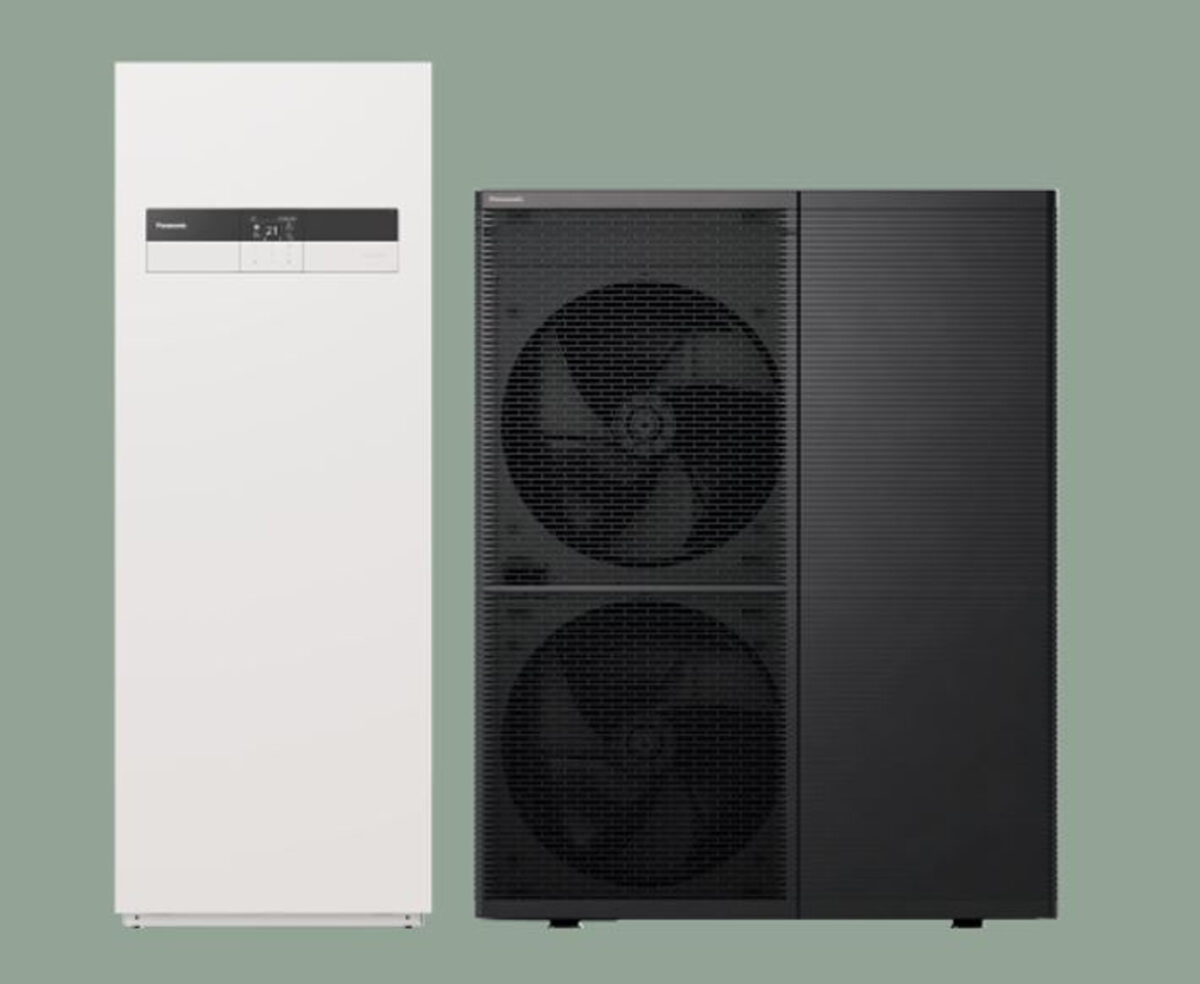





Japan's Panasonic has released a new air-to-water heat pump for deployment in centralized heating and domestic hot water installations.
The system comprises a complete propane (R290) heat pump and a domestic hot water (DHW) tank. It is available in two single-phase versions with heating capacities of 9 kW and 12 kW, as well as three three-phase models rated at 9 kW, 12 kW, and 16 kW.
All variants use a 150-liter water tank and measure 1,200 mm × 430 mm.
According to Panasonic, the systems can achieve a seasonal coefficient of performance (SCOP) of up to 4.31 at low temperatures and up to 6.47 at higher temperatures. The coefficient of performance (COP) is reportedly up to 5.23 at 7 C and 2.54 at 2 C.
The heat pumps can operate in outdoor temperatures as low as −28 C and maintain full capacity without backup heating at −20 C. Noise levels are reported to be as low as 53 dB(A).
The new products include the Panasonic Comfort Cloud app and Aquarea Service Cloud 2 CN-CNT connections.
“The installation is 100% hydraulic, with only water pipes connecting the outdoor unit to the indoor components,” Panasonic explained. “This enables easier, more flexible installation, as no additional safety measures are required inside the home for refrigerant gases or fuel piping.”
This content is protected by copyright and may not be reused. If you want to cooperate with us and would like to reuse some of our content, please contact: editors@pv-magazine.com.


Good idea. You lose efficiency with the conversions, but you have much shorter refrigerant lines and, presumably, no special HVAC tools needed. If it is ran with PEX then you’re set and simple.
How do you prevent freezing the outdoor unit lines during winter?
Will this will function as an AC unit for hot weather, making cold air and hot water as well ?
I don’t understand the marketing vs. the physics of a heat pump – the article speaks about DHW and home heating, but if the heat pump makes hot water, it will produce COLD air, or hot air and COLD water!
The use of drain water heat recovery such as ThermoDrain is a must in every home.
What happens in climate winter lows can be -30 degrees C? Don’t you still need a duel fuel supplement such as electrical resistance heater in the central duct? This can occur in Chicago when the polar vortex comes to visit in January or February. However, I like a domestic hot water tank lied to the whole house heat pump rather than another heat pump.