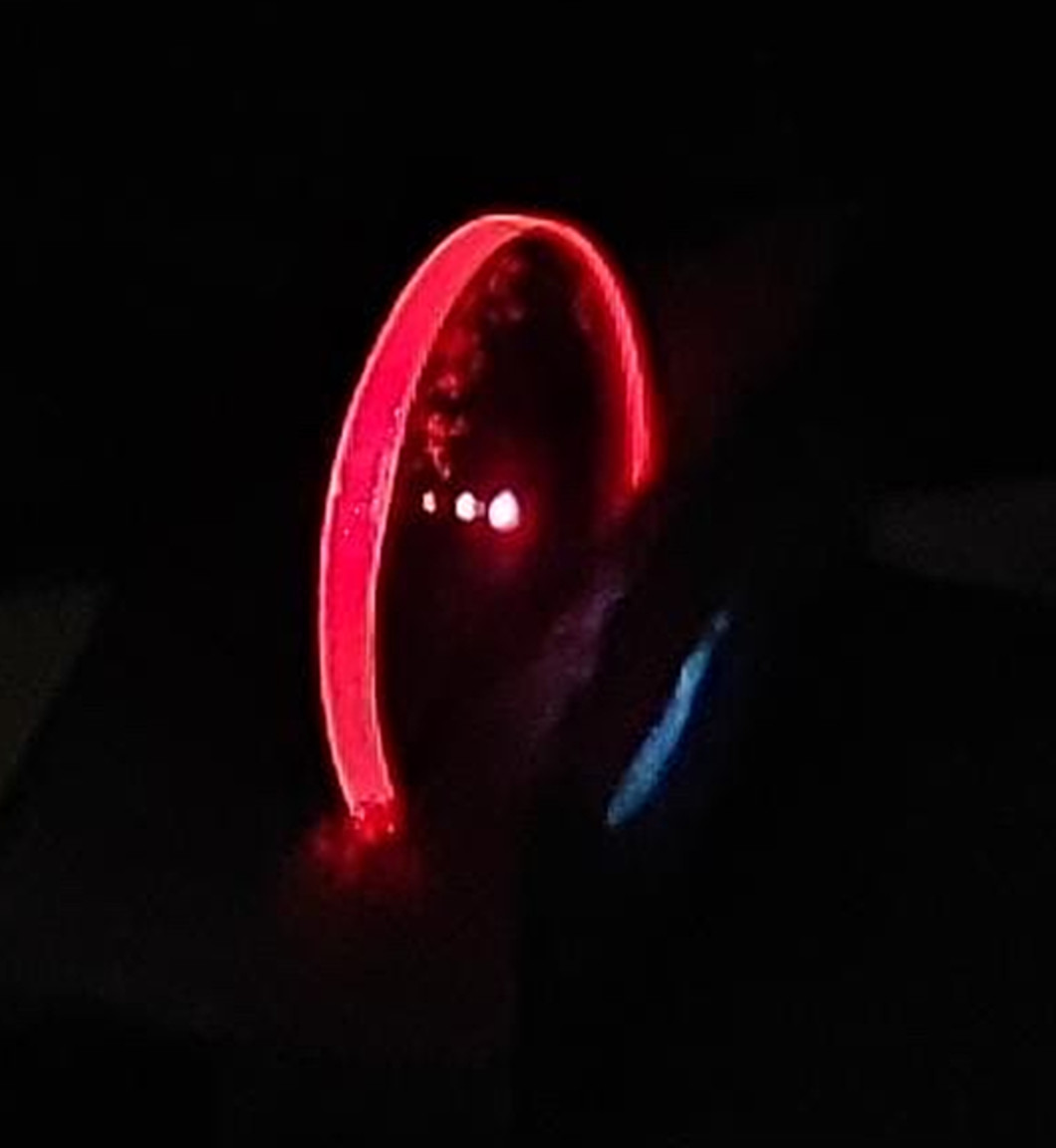





Researchers at the University of Cambridge in the United Kingdom claim to have discovered photovoltaic properties in a glowing organic semiconductor molecule known as poly(3‑triphenylmethyl‑thiophene (P3TTM).
Unlike conventional organic semiconductors, which have paired electrons, organic radical semiconductors contain at least one unpaired electron per molecule, giving them an “open-shell” character.
“In most organic materials, electrons are paired up and don’t interact with their neighbors,” said lead author Biwen Li. “But in our system, when the molecules pack together, the interaction between the unpaired electrons on neighboring sites encourages them to align alternately up and down—a hallmark of Mott-Hubbard behavior.”
Mott-Hubbard behavior arises in materials where electron-electron interactions are particularly strong. In P3TTM, each molecule can be thought of as a house containing a single electron. When light excites an electron, it can hop to a neighboring molecule. “Upon absorbing light, one of these electrons moves to its nearest neighbor, creating positive and negative charges that can be harvested as a photocurrent,” the team explained.
To test this, the researchers fabricated an experimental solar cell using a P3TTM film. The device includes a PEDOT:PSS layer on indium tin oxide (ITO), a buckminsterfullerene (C60) layer, a phenyl-C61-butyric acid methyl ester (PCBM) spacer, and an aluminum (Al) contact.
Under standard illumination, the solar cell achieved an almost-unity charge collection efficiency, the team reported.
“This means nearly every photon of light was converted into a usable electrical charge,” the researchers said. “In conventional molecular semiconductor solar cells, photon-to-charge conversion typically occurs only at interfaces between two materials—one acting as an electron donor, the other as an acceptor—limiting overall efficiency.”
“In contrast, in these new materials, after photon absorption, the energy drives an electron from one molecule to an identical neighbor, creating electrical charges,” they added. “The energy required for this—known as the ‘Hubbard U’—represents the electrostatic cost of double electron occupancy on the negatively charged molecule.”
The researchers emphasized that this breakthrough could enable the fabrication of solar cells from a single, low-cost, lightweight material.
Their findings are available in the study “Intrinsic intermolecular photoinduced charge separation in organic radical semiconductors,” published in nature materials.
“This work provides an avenue for the exploration of power generation and solar-driven chemistry in both solution and solid state using only a single component,” they concluded.
Their findings are available in “Intrinsic intermolecular photoinduced charge separation in organic radical semiconductors,” published in nature materials.
This content is protected by copyright and may not be reused. If you want to cooperate with us and would like to reuse some of our content, please contact: editors@pv-magazine.com.


By submitting this form you agree to pv magazine using your data for the purposes of publishing your comment.
Your personal data will only be disclosed or otherwise transmitted to third parties for the purposes of spam filtering or if this is necessary for technical maintenance of the website. Any other transfer to third parties will not take place unless this is justified on the basis of applicable data protection regulations or if pv magazine is legally obliged to do so.
You may revoke this consent at any time with effect for the future, in which case your personal data will be deleted immediately. Otherwise, your data will be deleted if pv magazine has processed your request or the purpose of data storage is fulfilled.
Further information on data privacy can be found in our Data Protection Policy.