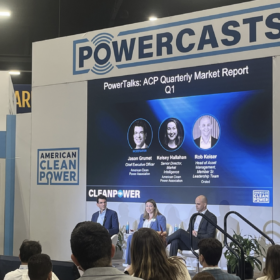
Key takeaways from CleanPower 2025
More than 8,000 people attended the recent CleanPower 2025 clean energy event held by the American Clean Power Association (ACP) in Phoenix, Arizona.

Controversial rooftop solar bill glides through California’s Appropriations Committee
The California State Assembly’s Appropriations Committee passed a bill that would renege more than a million commitments to the state’s rooftop solar customers.

Fraunhofer ISE developing InP-on-GaAs substrates for III-V solar cells
Fraunhofer ISE researchers say their newly fabricated gallium arsenide substrates (InP-on-GaAs wafers) can replace prime indium phosphide wafers and offer a scalable pathway to lower costs.

Iraq inaugurates 2 MW solar array at government palace
Iraq has installed a 2 MW solar array at a key government building as part of a broader effort to transition state facilities to renewable energy. The project supports the country’s push for sustainable power use across its public sector.

Innovation in building-integrated photovoltaics
At The smarter E Europe 2025, pv magazine Editor Mark Hutchins explored Fraunhofer ISE’s latest integrated PV innovations, including color-customizable flexible modules for buildings, and new agrivoltaic research combining solar with crop cultivation.

The rise of vertical agrivoltaics
Next2Sun AG executives spoke with pv magazine at Intersolar Europe 2025 on the growing momentum of agrivoltaics. The company doubled annual installations to 40 MW in 2024, underscoring vertical PV’s value in markets like Italy, Germany and France.

Aiko Solar wins second patent dispute against Maxeon in Netherlands
A Dutch court has rejected Maxeon Solar’s request for a preliminary injunction against China’s Aiko Solar in a dispute over EP2297788B1, a back-contact (BC) solar cell patent.
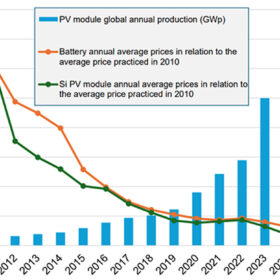
Falling Li-ion battery prices mirror solar photovoltaics trends: Is there a role for second-life batteries before recycling?
Lithium-ion batteries are everywhere, powering everything from consumer electronics to electric vehicles, residential PV storage systems, and, more recently, mitigating curtailment in large-scale wind and solar power plants. EVs are driving large-scale demand for Li-ion batteries which will result in substantial volumes of spent batteries in the near future. This scenario highlights the potential for repurposing EV batteries for second-life stationary applications, which could maximise their value before recycling. However, to fully realise this opportunity, several economic, technical, and regulatory challenges must be addressed and resolved.

Argentina publishes details of 500 MW battery tender
Argentina’s AlmaGBA tender for the Buenos Aires metro area will pay a fixed $10/MW of electricity supplied, with storage capacity bids capped at $15,000/MW per month.
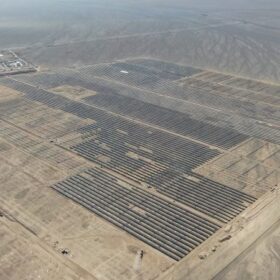
Engie breaks ground on 199 MW/995 MWh solar-plus-storage Chilean project
The site, now in its initial construction phase, will be the company’s first energy project in the Santiago Metropolitan Region.
