




A research team in Germany has developed a copper, indium, selenium (CuInSe₂) micro-concentrator solar device composed of vertically grown absorber islands on a molybdenum (Mo) films.
The scientists used laser-assisted metal-organic chemical vapor deposition (LA-MOCVD) to grow indium (In) islands in a bottom-up approach, instead of depositing a continuous thin film and subsequently patterning it. “The primary novelty of our work is the use of a LA-MOCVD method for the bottom-up growth of indium precursor islands,” corresponding author Jan Berger told pv magazine. “This approach proved to be a fast and reliable technique for simultaneous local growth, importantly offering the possibility to add gallium and copper locally using the same method.”
“The most unexpected finding was that the indium precursor islands formed distinct cluster structures that remained pinned in place, refusing to coalesce into a single large island – even after annealing above the melting temperature of indium,” he added. “Furthermore, it was surprising to see that the structural features of these precursor islands remained clearly visible even after the selenization process.”
Device fabrication begins with glass substrates coated with Mo, which are then processed by LA-MOCVD. In this step, a laser array locally heats the substrate. It decomposes the precursor gas only at defined spots, forming a 7 × 7 array of indium islands without the need for masks or patterning. A thin copper layer is subsequently deposited, and the stack is selenized to form CuInSe₂ absorber islands.
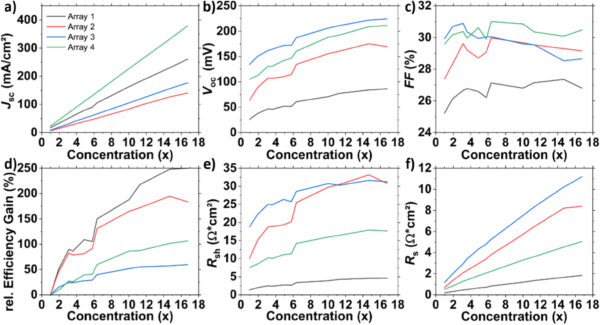
Image: Universität Duisburg-Essen (UDE), Solar Energy Materials and Solar Cells, CC BY 4.0
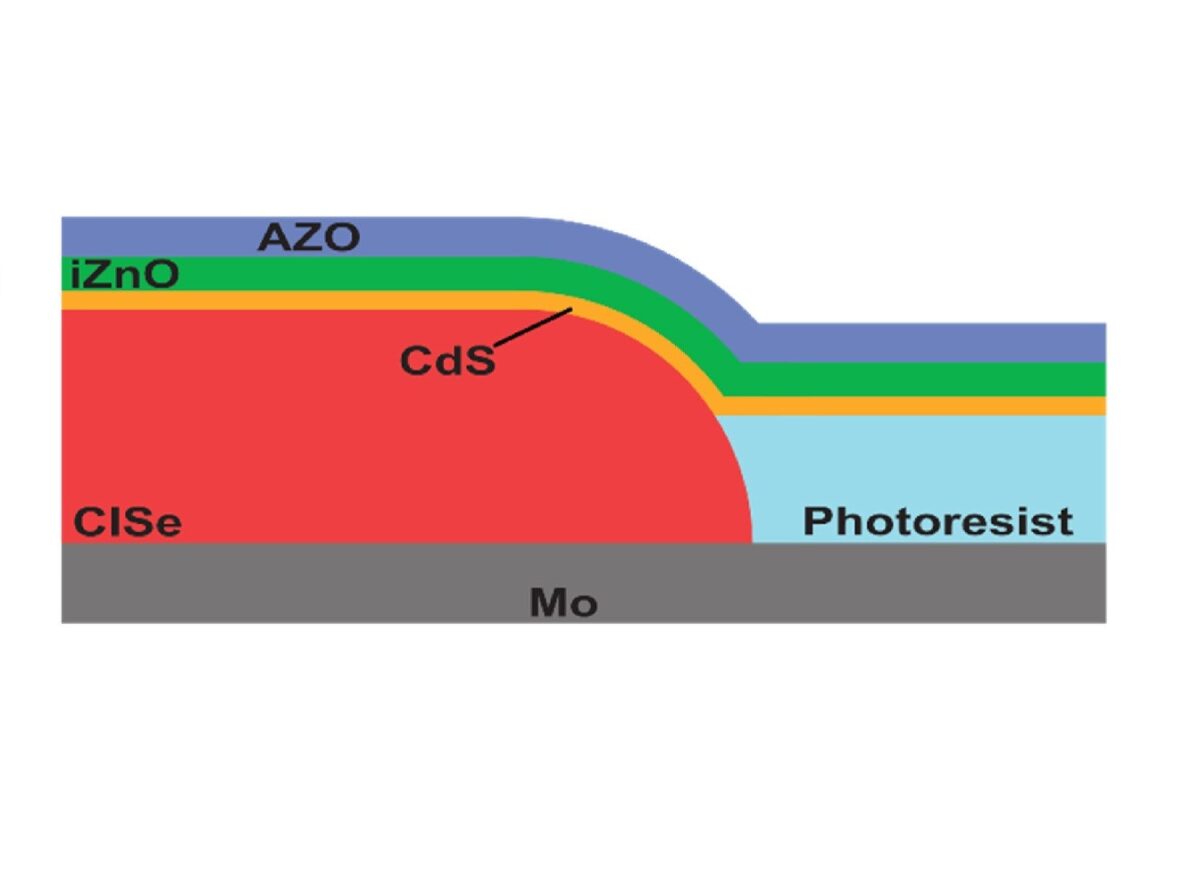
Afterward, the samples are etched to remove unwanted material, coated with photoresist for electrical isolation, and patterned with a laser to form openings. The solar cell is then completed by depositing a cadmium sulfide (CdS) buffer layer, followed by intrinsic zinc oxide (i-ZnO) and aluminum-doped zinc oxide (AZO) window layers. Finally, each array of 49 micro-cells is contacted and measured as a single module, with a device structure of glass/Mo/CIS absorber/ cadmium sulfide (CdS)/i-ZnO/AZO.
Overall, the team produced nine micro-modules and tested four of them. Initial measurements were conducted under one sun, followed by increasing intensities up to 17 suns to simulate concentrator conditions. These not-yet-optimized arrays achieved a conversion efficiency of up to 0.65% under one sun, with efficiency rising under higher illumination—gains of around 60% at lower concentrations and up to 250% at 17 suns.
“Functional devices were successfully produced, but notable key challenges were identified, particularly related to the intensity distribution of diffractive optical element (DOE), the initial morphology of indium islands, and process repeatability. Addressing these challenges in terms of material quality and process control is essential,” the team explained. “Once resolved, the LA-MOCVD method holds significant promise as a rapid and resource-efficient production technique for next-generation micro-concentrator photovoltaics.”
The new cell concept was presented in “CuInSe2-based micro-concentrator solar cells fabricated from In islands grown by laser-assisted MO-CVD,” published in Solar Energy Materials and Solar Cells. Scientists from Germany's University of Duisburg-Essen, the Leibniz Institute for Crystal Growth, the Federal Institute for Materials Research and Testing, Brandenburg University of Technology Cottbus-Senftenberg, and the engineering company Bestec have participated in the study.
This content is protected by copyright and may not be reused. If you want to cooperate with us and would like to reuse some of our content, please contact: editors@pv-magazine.com.

By submitting this form you agree to pv magazine using your data for the purposes of publishing your comment.
Your personal data will only be disclosed or otherwise transmitted to third parties for the purposes of spam filtering or if this is necessary for technical maintenance of the website. Any other transfer to third parties will not take place unless this is justified on the basis of applicable data protection regulations or if pv magazine is legally obliged to do so.
You may revoke this consent at any time with effect for the future, in which case your personal data will be deleted immediately. Otherwise, your data will be deleted if pv magazine has processed your request or the purpose of data storage is fulfilled.
Further information on data privacy can be found in our Data Protection Policy.