Span and Nvidia to develop AI data centers in your backyard, lowering electric bills

From pv magazine USA
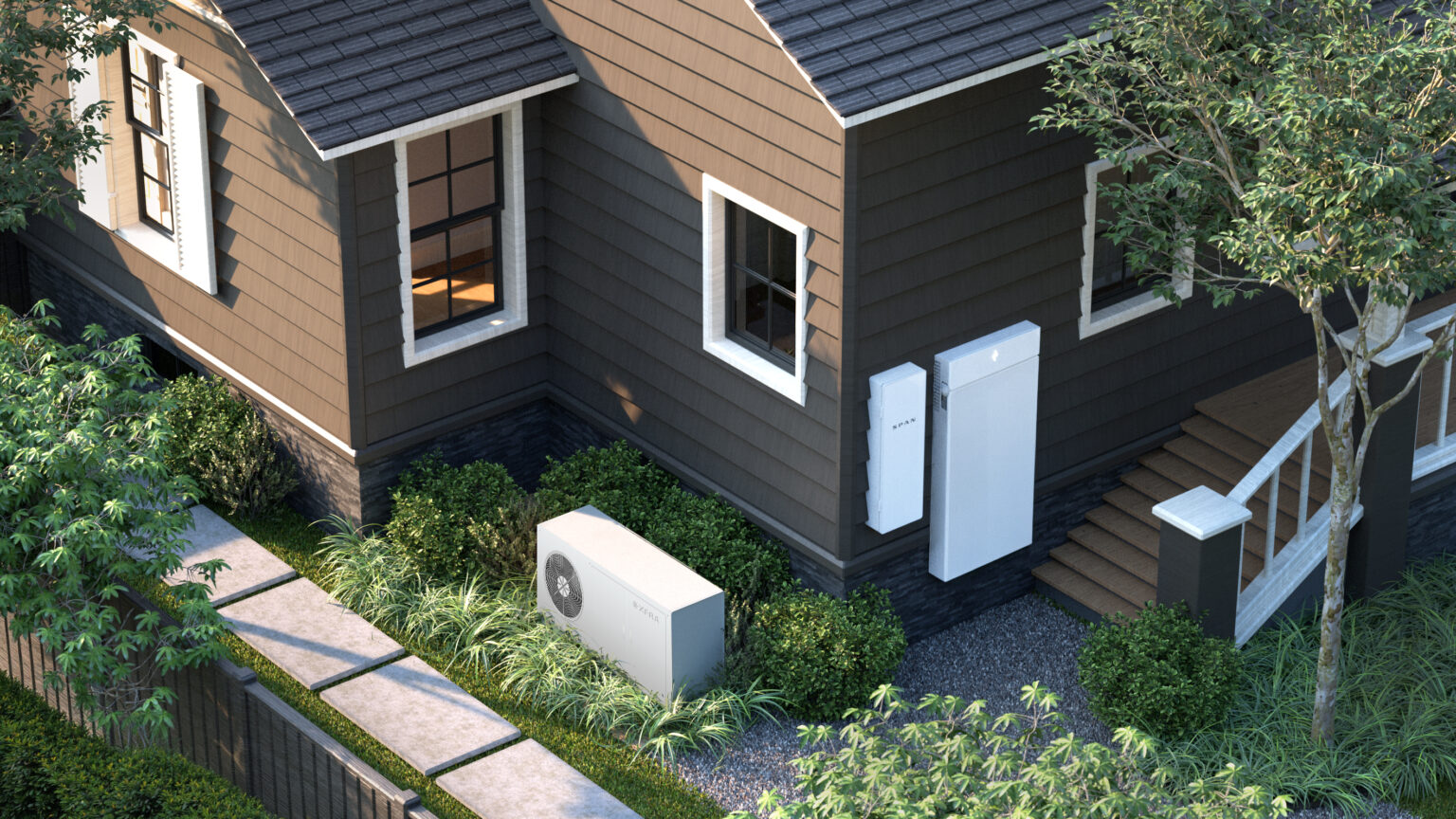
Smart electrical panel manufacturer Span has announced a new collaboration with technology and semiconductor giant Nvidia to develop XFRA, a network of devices that convert unused electric capacity in homes and small businesses into a distributed compute cloud.
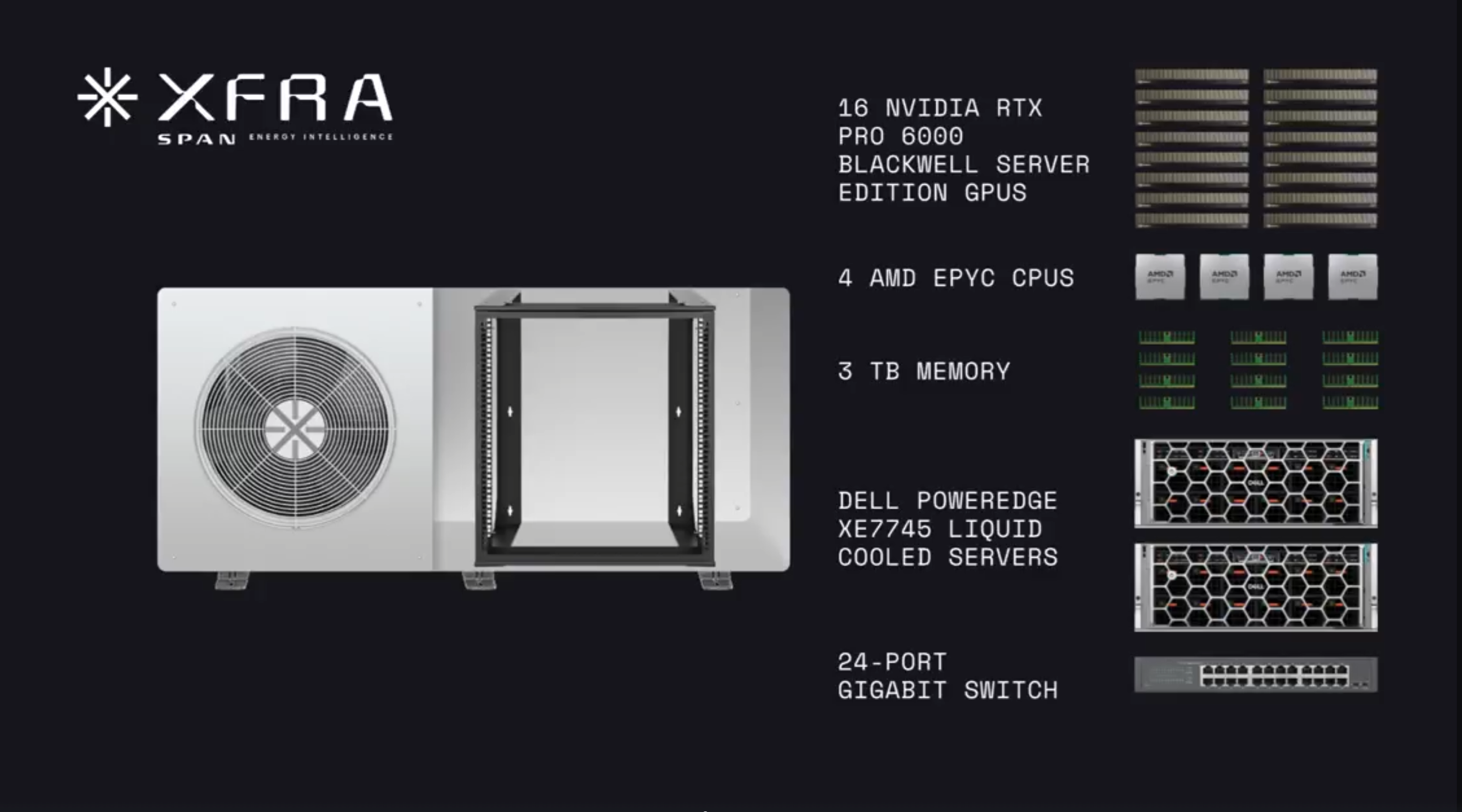
The network operates by placing XFRA Nodes at customer homes and businesses and coordinating them to serve data center workloads. According to a video posted on LinkedIn by Span CEO Arch Rao, each node contains Dell PowerEdge servers with 16 Nvidia RTX Pro 6000 Blackwell GPUs, 4 AMD EPYC CPUs and 3 TB of RAM, connected to a 24-port gigabit switch.
The nodes are connected to a customer’s building through a Span smart service panel, which detects how much energy the customer is using at any given point and manages the nodes as always-on loads.
In a white paper about the XFRA project, the company says residential homes operate at an average of just 40% of their peak power capacity, which leaves “untapped” headroom that can be utilized by the XFRA nodes. The company’s solution will allow homes to utilize closer to 100% of their rated service from the utility.
For a home with 200 A service, 40% of the potential power draw represents 80 A, or 19.2 kW at 240 V.
A whole-home battery installed alongside the XFRA nodes will serve to safeguard compute workloads, buffer short-term demand spikes and respond to utility demand response events. During a power outage, the network will transfer compute workloads away from affected nodes and provide the host customer with backup power.
The whitepaper reveals that Span has already conducted in-house testing of prototypes with paying customers, and the company is now planning proof of concept for Q3 of 2026, in which it will deploy 100 nodes in residential new-construction homes.
In an interview with pv magazine USA, Span CRO Ryan Harris revealed that the proof of concept program will take place in a southwestern state — likely Nevada or Arizona.
Beginning in 2027, the company plans to scale the XFRA network to an annual capacity in excess of 1 GW.
Providing benefits to stakeholders
As envisioned by Span, the XFRA network will provide benefits to multiple stakeholders, something it calls “a win-win-win across the energy and compute ecosystem.” For data hyperscalers, the network would offer a flexible way to access compute power that doesn’t require a central data center, meaning it avoids the need to engage in the yearslong process of securing permits, gaining utility interconnection approvals, building the project and finally receiving permission to operate.
In data center development, the time it takes a site to receive access to electricity is often referred to as “speed-to-power,” and it often represents a bottleneck in the development process. As of early 2025, the non-profit Center for Strategic and International Studies noted delays of up to 7 years in the nation’s largest data center markets.
For utilities, the XFRA solution offers a way to increase grid utilization, meaning it keeps more power flowing to more customers, more of the time. The company says this allows grid operators to make more revenue from existing grid infrastructure that often operates far below its capacity.
Homeowners and small businesses that host the nodes are slated to enjoy multiple benefits. Span says it will install the Span smart panel and battery backup at no cost to the host, and also provide them with discounted rates for electricity and internet. Harris went one step further, positing that some homeowners in places where XFRA nodes provide the most value could receive “discounted electricity up to and including free electricity and free internet access.”
How the economics work
Span anticipates the XFRA nodes will be powered under standard residential rate structures. While the initial locations for the proof of concept will be places with relatively low fixed rates, Harris said he sees XFRA as a national solution. “We think the need for inference compute is going to be geographically deployed where population centers are, or applications for AI use cases and AI workloads are,” he said.
Residential retail rates vary widely by state, which could slightly complicate the ROI of deploying XFRA nodes in high-cost markets. However, Harris notes that the company has already received inquiries from utilities who are contemplating “innovation in the tariff model” that would allow for lower rates.
The company says customers will be able to add an optional solar installation to their system, something Harris says could help the economics in high-cost markets. “The base (XFRA host) model does not require behind-the-meter solar,” he said, adding that solar could be “an aspect of the total premises-level infrastructure” that makes “the total economics of the solution more favorable and/or meet some other requirements or attributes that a compute offtaker may be looking to accomplish.”
Harris said he expects Span would work with a third-party to provide behind-the-meter as a power purchase agreement to keep the relationship between Span and the host customer simple.
Even in places with higher rates, the potential revenue from selling AI compute services offers a huge opportunity for Span.
In a social media post, Abe Yokell, co-founder of Congruent Ventures (an early and ongoing investor in Span) laid out the economics of providing 19.2 kW of power from 50,000 homes, a total of nearly 1 GW of power all told. Using an Nvidia estimate that 1 GW of data center power requires $50 billion in capital expenditures, Yokell posited that each of the 50,000 nodes could represent $1 million in asset value.
In the long term, Harris sees the possibility that a solution like XFRA could deliver broader benefits to all utility ratepayers. Citing a report by the Brattle Group called “The Untapped Grid,” he pointed out that adding new load when and where spare capacity already exists allows for utilities to better utilize the physical assets ratepayers are already required to cover the costs for, with higher revenues decreasing the relative effect the costs of these investments have on rates for all customers.
“If we can add seven to twelve kilowatts of continuous load behind the meter running within that existing distribution system, we’re taking the the numerator — the amount of kilowatt hours sold — and we’re increasing that pretty substantially over the denominator — the amount of distribution system capex that has already been built,” he said. “The principle is that we increase the utilization of the existing grid, and in doing so, that will drive down per kilowatt hour electricity prices.”
Harris described the effect as a “synergistic, virtuous cycle,” but noted it was still much too early in the process to make any promises about the knock-on effects of the XFRA program. Still, he noted that the idea that improvements in grid utilization can provide grid-wide benefits could come about within a few years.
“If we start doing the right things now, we’re going to be able to change the shape of that curve or the slope of that curve in a way that really creates value for everyone. It’s not (measured) in weeks, but it’s not a decades-long pursuit,” he said.
This content is protected by copyright and may not be reused. If you want to cooperate with us and would like to reuse some of our content, please contact: [email protected].

Please login to comment
Typical US “innovation”, put noisy, heat producing , energy sucking AI, that nobody wants, literally everywhere. In every backyard, yay!
Then as an after thought… maybe we’ll chuck some solar panels into the mix at some point in the future.
You know, environment first and all that.
Also there’s a very good reason that servers such as these are usually located in data centres, with other servers. Economies of scale covering such things as, power supply, cooling, networking, full redundancy, and ease of support.
This idea has “AI-hype fail” written all over it. Of the (quoted in article) 1GW data centre cost of $50 billion, well over half of that is just the cost of the servers. Let’s call it $30 billion. This cost is unavoidable no matter how you do it , you need servers.
The other $20 billion in data centre cost are all those services which are provided all under one roof, shared amongst all compute infrastructure and, for those reasons, are cost effective and provide economies of scale.
There’s no way they can do this economically by installing 1GW worth of individual, self contained, 20kW compute nodes in people’s back yards.
In fact a spokesperson for the company is also quoted in the article as saying, that they’re looking to install 7-12 KW of compute behind the meter. So now it’s not 50,000 x 20kW nodes, it’s 100,000 x 10kW nodes with even higher costs per node and lower economies of scale.
Using the logic in the article each one of these 10kW nodes would have an asset value of $500,000 not $1 million. Of that $500k per node, 300k is just the cost of the servers alone, and they’re still sitting in boxes in the warehouse. You’ve got $200k left for everything else. Individual, redundant systems for cooling, networking and power supply. Plus delivery, installation (how much is a crane per day?) configuration etc. Good luck with that!
You can see how the numbers simply do not add up.
$100 says this never gets past the pilot roll out phase, if it even progresses that far. However I’m sure they’ll manage to fleece a few foolish investors along the way.
All aboard, the hype train! Toot, toot!