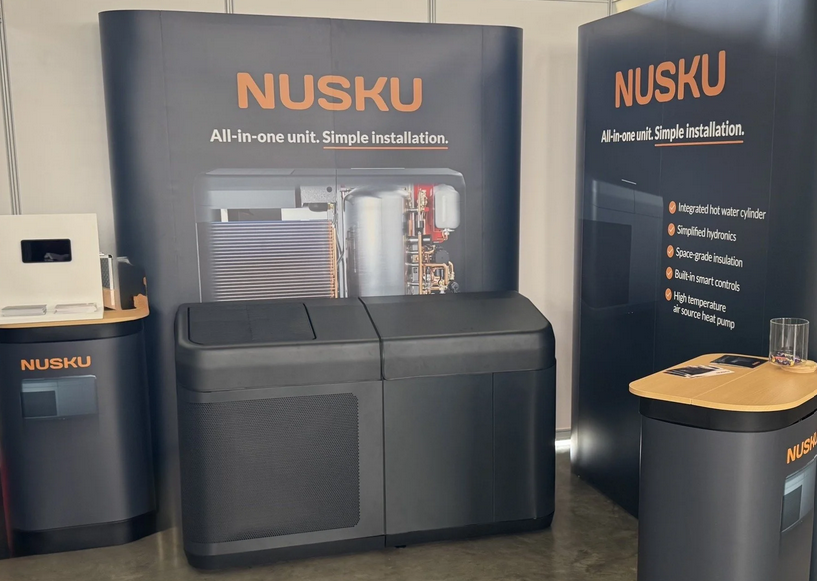
British startup Nusku has presented a prototype of a fully integrated air-source heating system that combines a heat pump, a hot water cylinder and a control system into a single outdoor unit.
The novelty of the all-in-one system lies in its integrated, pre-packaged design. Conventional heat pump systems typically require a separate outdoor unit, an indoor hot water cylinder and additional plant equipment. In contrast, Nusku’s system combines all essential components, including the heat pump and a compact hot water cylinder, into one external unit.
“We know many people are deterred by the fact they need to find space inside their home for a water cylinder, as it means losing valuable storage space,” said Russell Murchie, CEO of Nusku, in a statement. “The prospect of installing new radiators and a lengthy and disruptive installation process is also a major barrier, along with the potential noise generated by the heat pump and misconceptions around cost and performance. Our design overcomes all these issues, which will make it quicker and easier for people to replace their gas boilers and switch to renewable energy with a heat pump that meets all their needs.”
According to a document published by the UK Department for Energy Security and Net Zero, the system relies on a closed-loop controller that can significanty reduce heat pump cycling.
“Nusku’s closed-loop controller reduced power cycling by more than 25%, including defrost cycles, over a heating season compared to weather compensation, enhancing operational efficiency and extending compressor lifetimes,” the document states. “Modelling of a full heating season indicated that the Nusku heat pump can deliver equivalent levels of comfort to a gas boiler at up to 33% reduced cost using the OVO Heat Pump Plus tariff, or 8% savings when using a time-of-use tariff and some pre-heating.”
The OVO Heat Pump Plus tariff is an add-on that effectively reduces the cost of electricity used by a heat pump by providing UK customers with a monthly bill credit. Instead of changing usage patterns, customers pay their standard rate upfront and then receive a rebate based on heat pump consumption, making heating costs more predictable and lower.
The system uses an integrated hot water cylinder that is engineered to deliver 180 litres of hot water at 40 C. It achieves this by storing water at a higher temperature and blending it with cold water to reach the required output volume.
Currently progressing from prototype to pre-commercial stage, the Nusku system is at technology readiness level (TRL) 7–8. TRL is a scale used to measure the maturity of a technology, ranging from 1 (basic principles observed) to 9 (fully commercial, proven systems).
The system is currently undergoing validation, including independent testing at the Energy House Labs at the University of Salford. So far, it has been shown to deliver 65 C flow temperature capability, be installable within one day, and provide comparable comfort and cost performance to gas boilers.
“Prototype systems are now being trialled in homes across Bristol, with wider trials planned in other UK cities ahead of a commercial launch next year,” the company said, without providing further technical details.
To develop the system, Nusku secured nearly GBP1 million ($1.35 million) in funding, including a £727,000 government grant, in April 2024. It operates a workshop and office space at Future Space – the University of the West of England’s innovation center.