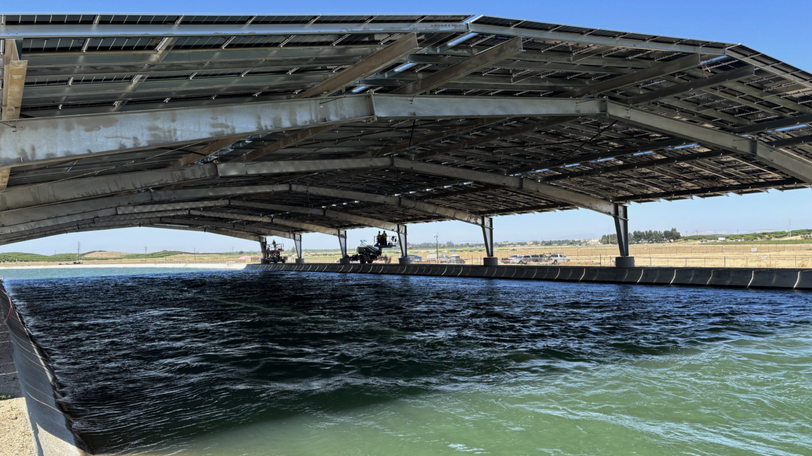





In September 2025, the Nexus pilot project in California, United States, was completed. The 1.6 MW solar installation is located on canals operated by the Turlock Irrigation District (TID) and was developed through a public-private partnership between the California Department of Water Resources, TID, Solar AquaGrid, and the University of California (UC), Merced. The project aimed to generate empirical data under real-world operating conditions.
Launched in 2022, the pilot evaluated the technical and operational feasibility of deploying PV systems on active irrigation canals. The concept enables dual use of existing infrastructure: clean electricity generation alongside reduced water evaporation and minimized land use – an approach particularly relevant in agricultural regions such as California’s Central Valley.
The project monitors key performance indicators including electricity generation, evaporation losses, water quality, aquatic vegetation growth, and canal maintenance requirements. After one irrigation season, initial results indicate measurable benefits for the water sector. Canal sections covered with PV modules showed reduced evaporation and lower aquatic weed proliferation, which may translate into reduced operating costs.
Specifically, continuous measurements over a full irrigation season recorded evaporation reductions of 50-70% beneath the solar arrays and an 85% decrease in algae growth, a result that could yield operational efficiencies in canal management. These findings are consistent with earlier research by UC Merced, which highlighted the potential of canal-based solar systems to improve water-use efficiency in open-channel infrastructure.
From a technical perspective, the project also serves as a testbed for multiple design configurations. These include large-span structures over wide canals, smaller systems on narrower channels, vertical installations along canal banks, and early-stage retractable prototypes. As previously reported by pv magazine, a battery energy storage system (BESS) was also deployed at the narrowest site, using 75 kW iron-flow batteries supplied by US manufacturer ESS.
This range of configurations is intended to assess system adaptability under varying hydraulic and structural conditions.
Project developers note that the scalability potential is significant, given California’s extensive canal network. A UC study estimates that covering approximately 4,000 km of canals could save 63 billion gallons of water annually, equivalent to irrigating 50,000 acres (20,234 hectares) of farmland or meeting the residential water demand of more than 2 million people. Beyond water savings, improved water quality through reduced vegetative growth is also of interest to TID.
This content is protected by copyright and may not be reused. If you want to cooperate with us and would like to reuse some of our content, please contact: editors@pv-magazine.com.

I am curious if anyone ever thought about generating electricity from the moving water itself using a shallow water type generator?
Please make it happen!
I wonder if they are installing bird netting around these structures to prevent the bird droppings from contaminating the water. It could be a serious problem down the road.
Did they take advantage of the shade and shovel the sand/dirt accumulation out of the irrigation ditches while crouching under the panels or nah?
This idea has been around for decades. Government regulations and “environmental studies” have delayed it much more than necessary. Did the ancient Romans have this much burocracy when they covered their canals and viaducts?
Not sure if applicable, in order to keep cycle of turning part of water bodies to water vapour through process of evaporation is to get rains sufficient and timely..,which is natural process and unless above project is obstructing it.
That’s really a great News indeed 👍🙏
We need to implement such schemes asap depending on the resources available at present 👍🙏🙏🙋