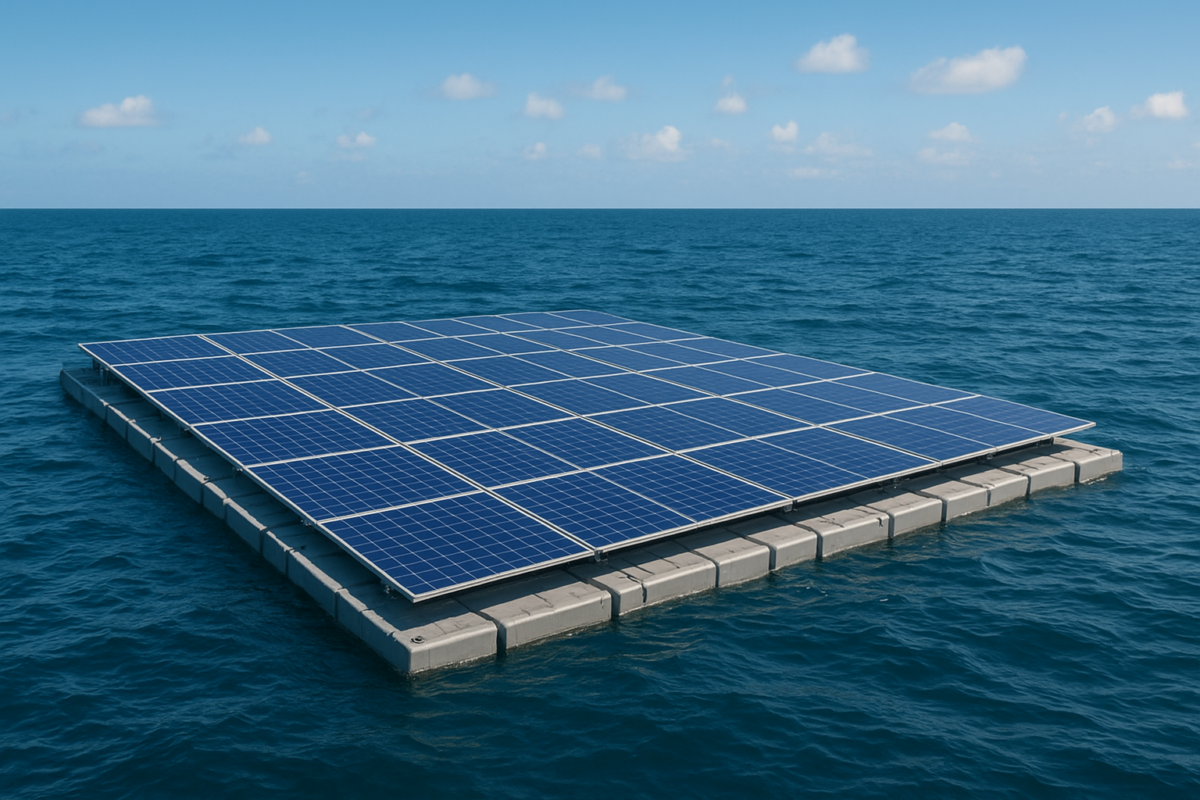





An international team led by researchers from the Australian environmental and energy-focused unit of RINA Consulting, part of Italy-based RINA, has analyzed offshore FPV (OFPV) resources worldwide based on technical feasibility, energy production, and costs in an effort to provide estimates about suitable locations, costs, and energy generation potential.
The study considered real-world engineering constraints, such as wind, waves, depth, ice, shipping lanes, and protected areas, according to Carlos D. Rodríguez-Gallegos, corresponding author of the research.
It integrated geographic, climatic, and economic datasets to model potential OFPV energy output. The calculations included ten different panel tilt and tracker configurations. The system costs and levelized cost of electricity (LCOE) were estimated globally for each country, considering the size of territorial waters and location of exclusive economic zones (EEZ).
“It provides the most detailed global LCOE mapping ever conducted for offshore floating PV (OFPV), with real project cost benchmarking and country-specific economic assumptions,” Rodríguez-Gallegos told pv magazine.
The analysis found that selected areas demonstrated “promising” cost-effectiveness, with 34% of the regions achieving an LCOE below 10 USDc per kWh. When it comes to regional advantages, Indonesia, Thailand, and Malaysia were found to be the most suitable areas for cost-competitive OFPV due to the irradiance, bathymetry, and LCOE metrics.
“The data reveal that most of the areas with very low LCOE values (below 6 USDc per kWh) are located in Malaysia and Thailand, each contributing 53% and 27% of the total available PV capacity within this range, respectively,” stated the report.
It also said, “Moreover, in 53% of the analyzed regions, the FPV water area required to satisfy the electricity demand corresponds to an LCOE below $0.15/kWh, underscoring OFPV's potential cost competitiveness.”
The researchers noted that they found that tracker-based systems offer improved performance, but added that fixed-tilt configurations with bifacial panels “remain the most practical for early-stage deployment.”
The energy modelling was validated with data from FPV systems currently operating at six locations in Singapore, Israel, Norway, and the Maldives. These FPV sites included inland reservoirs, coastal waters, and open-sea FPV. The cost model was reportedly benchmarked against existing FPV project data (2020–2025) to align offshore cost estimates with real-life tender financial figures and installed systems.
The researchers expect that the study will be used to “determine if and where OFPV can be deployed economically,” and as a starting point for more precise localized assessments. They noted the need for future research to refine the models with real-world pilot operational data, as well as ongoing technological and regulatory developments.
The work was reported in “Global assessment of offshore floating photovoltaics: technical potential, cost competitiveness, and deployment pathway,” published by Energy and Environmental Science. The team included researchers from Singapore-based Solar Energy Research Institute of Singapore (SERIS), the National University of Singapore (NUS), and Xfloat Pte. Ltd Drive, as well as Norway-based BRIZO Floating Solar Technology and Swimsol, based in Austria.
This content is protected by copyright and may not be reused. If you want to cooperate with us and would like to reuse some of our content, please contact: editors@pv-magazine.com.

I would like to see a study where floating solar panels are installed on a storage dam here in Queensland that looks at the power generated by the panels and saving in water loss through evaporation.