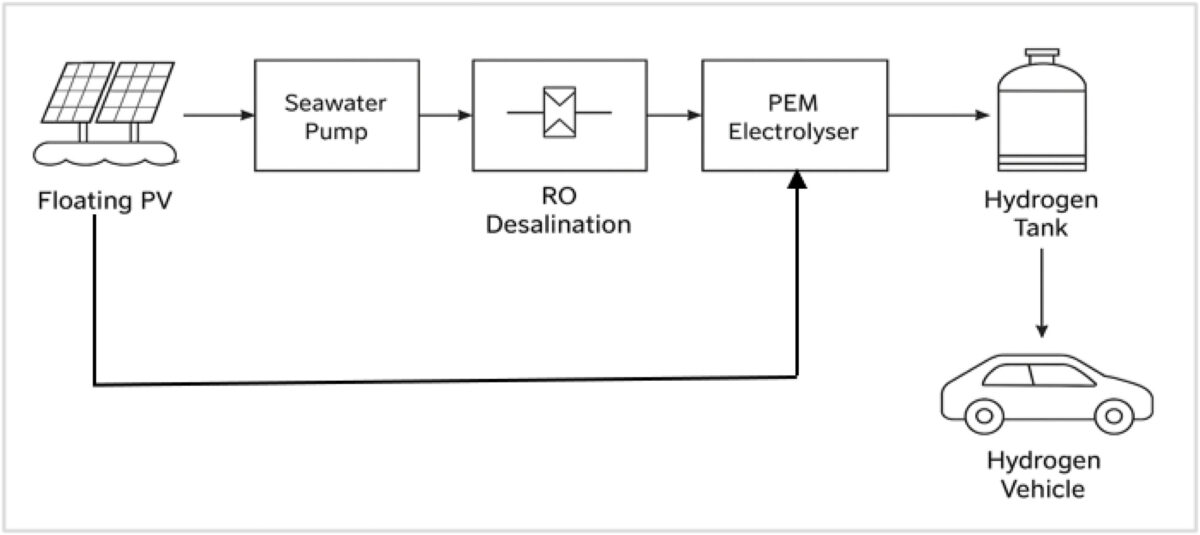





A research team from the University of Exeter in the United Kingdom has simulated an off-grid green hydrogen production system powered by floating photovoltaic (FPV) technology and seawater reverse osmosis (SWRO) desalination, designed to support green mobility in Oman.
The system was assumed to operate on the Arabian Sea, in the port town of Duqm, approximately 600 km south of Muscat.
“A key novelty of this system is the synergy between FPV, desalination, and hydrogen production, offering an alternative to ground-mounted PV, freshwater-dependent electrolysis, and battery-electric vehicles,” corresponding author Aritra Ghosh told pv magazine. “The results present a clear, practical roadmap for Gulf and other hot-climate regions to leverage abundant solar and seawater resources, enabling large-scale hydrogen production without competing for land or freshwater.”
Based on long-term meteorological data obtained from Meteonorm 8.1, the site receives an annual global horizontal irradiance (GHI) of 2,094.7 kWh/m² and an annual diffuse horizontal irradiance of 890.2 kWh/m². The average yearly ambient temperature is 26.62 C, with monthly variations ranging from approximately 22.5 C in January to 30.7 C in May.
The system generates electricity using 32,050 monocrystalline bifacial modules, each rated at 600 W and with an efficiency of 21.2%, for a total array size of approximately 20 MW. The generated electricity is distributed to seawater pumps, a reverse osmosis (RO) desalination unit, and a proton exchange membrane (PEM) electrolyser. The 122.5 kW pump is moving seawater from the coast to a 31.59 m³/day desalination unit. The freshwater is then used in a 9.9 MW electrolyser to produce hydrogen, which is stored in a Type III composite tank, from which drivers of various hydrogen-powered cars and buses can refuel their vehicles.
Using the PVsyst simulation software, the floating PV array was found to produce an annual energy yield of 33.68 GWh with a specific production of 1,751 kWh/kWp/year and a performance ratio of 78.7%. Furthermore, the system had a daily hydrogen output of 1,755 kg/day, achieving a levelised cost of water (LCOW) of $1.8/m³.
“In this study, the levelized cost of energy (LCOE) was found to be $0.05/kWh and the levelized cost of hydrogen (LCOH) $9.5/kg. For comparison, the global weighted average LCOE for solar PV is $0.043/kWh, and the targeted LCOH for green hydrogen by 2030 is $4.5–6.5/kg,” Ghosh said. “These results clearly demonstrate the viability of the proposed integrated FPV–SWRO–hydrogen system, highlighting its competitiveness and strong potential for future optimization.”
Concluding, the scientist said they are already conducting follow-up research. “We are now aiming in two directions: first, developing a more optimized strategy to reduce the LCOH, and second, assessing the long-term performance impacts on the PEM electrolyser,” Ghosh said.
The system was introduced in “Floating PV powered seawater purification using the RO process and powering electrolyser for green hydrogen production in Oman,” in Solar Compass.
This content is protected by copyright and may not be reused. If you want to cooperate with us and would like to reuse some of our content, please contact: editors@pv-magazine.com.


By submitting this form you agree to pv magazine using your data for the purposes of publishing your comment.
Your personal data will only be disclosed or otherwise transmitted to third parties for the purposes of spam filtering or if this is necessary for technical maintenance of the website. Any other transfer to third parties will not take place unless this is justified on the basis of applicable data protection regulations or if pv magazine is legally obliged to do so.
You may revoke this consent at any time with effect for the future, in which case your personal data will be deleted immediately. Otherwise, your data will be deleted if pv magazine has processed your request or the purpose of data storage is fulfilled.
Further information on data privacy can be found in our Data Protection Policy.