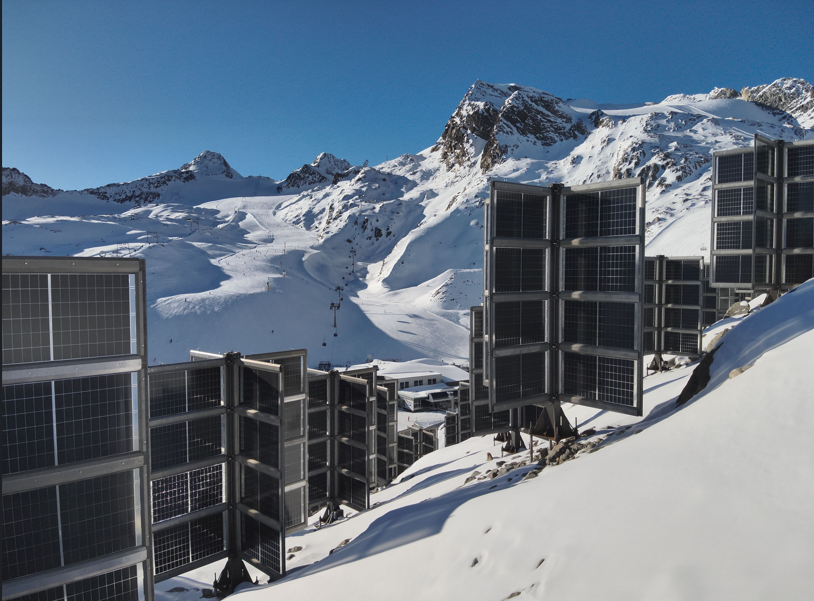





The first large-scale installation combining SolarEdge technology and Helioplant’s design is already under construction, and on completion the 6.3 MW system will power three ski resorts in Sölden, Austria.
SolarEdge and Helioplant foresee significant demand for their system from ski resorts located in snowy, mountainous areas where conventional PV installations are a challenge. Standard linear PV systems tend to lose productivity with extreme Alpine conditions, such as snow drifts caused by rapidly changing wind conditions. They are also often difficult, and therefore more expensive, to build in challenging terrain areas.
Helioplant’s cross design, which resembles a tree or a flagpole with four wings, features 15 or 16 bifacial modules depending on the slope. The cross-shaped structure creates air turbulence even at low wind speeds, which prevents snow build-up from accumulating and decreasing efficiency. Snow around the base of the tree-like structure reflects light to the underside of the modules to further boost energy yields in what is known as the albedo effect.
Helioplant piloted an installation with 12 bifacial tree-like structures at 2,850 m in Sölden underneath the Tiefenbach glacier in Austria’s Ötztal Valley in 2023. The PV system powered a ski-lift for an entire season, reducing reliance on grid electricity. It was powered by SolarEdge’s technology.
The 6.3 MW installation now under construction in Austria has around 800 of Helioplant’s structures set at an altitude of 2,850 m to 3,000 m. Completion is expected in the second half of this year, and the installation will cover around one third of the three ski resorts’ annual energy needs – approximately 28 GWh.
Patrick Janak, Head of C&I DACH at SolarEdge said that by combining Helioplant's bifacial structures with SolarEdge inverter and power optimizer technology, the two companies “are bringing superior economics to the table to unlock this largely untapped market.” He claimed that conventional PV systems would not work in this scenario.
“Bifacial PV systems are ideal for alpine regions because they can capture both direct sunlight and reflected light from snow, boosting overall energy yields. With our patented cross-shaped support structure, our solar panels stay snow-free providing maximum yields of clean solar energy to offset the high electricity demands of busy ski resorts. With around 6,000 ski resorts worldwide, there is enormous market potential,” said Florian Jamschek, Co-Founder of Helioplant.
Jamschek added that SolarEdge's technology made it possible to address the problem of shading on the panels which he said is exacerbated by the tree-like structure. “While our tree-like structure for bifacial PV addresses the challenges of solar in high-altitude alpine regions, it also is susceptible to more shading on the panels. The only solution to overcome this problem and maximize energy yields was to incorporate SolarEdge technology. This means we can deliver on our promise to supply reliable and stable clean energy that ski resorts can rely on to offset their high energy demands.”
This content is protected by copyright and may not be reused. If you want to cooperate with us and would like to reuse some of our content, please contact: editors@pv-magazine.com.


This cross-shaped bifacial design for snowy Alpine regions is genuinely fascinating. I’m particularly interested in how SolarEdge’s optimization specifically handles the shading inherent in that structure. Have they released any initial data on the performance gain achieved by mitigating that complex shading compared to a standard layout in similar conditions?
This is a terrible idea for anyone concerned about global temperatures. It’s counterproductive. You’d be turning the lowest natural albedo (0.05) regions on earth into a high albedo (0.90) zone.