




A research team from Swansea University in the United Kingdom has investigated how dusty fabrication environments affect perovskite solar cells and have found that devices exposed to dust performed similarly to those produced in clean conditions, with only minor losses in some performance metrics.
“Our findings are a major win for the future of affordable green energy,” said Kat Lacey, lead author of the study. “For a long time, we believed high-quality perovskite solar cells had to be made in expensive, ultra-sterile environments. However, our research shows that these cells are surprisingly resilient – they can still perform remarkably well even when exposed to common dust.”
Lacey called the results “game-changing,” explaining they can fast-track the development of low-cost renewable energy manufacturing facilities in new areas. “While there is still a need to test how this holds up on a larger, industrial scale, these results are a massive first step,” she said. “We've shown that the path to a sustainable future might be a lot less complicated, and a lot less expensive, than we previously thought.”
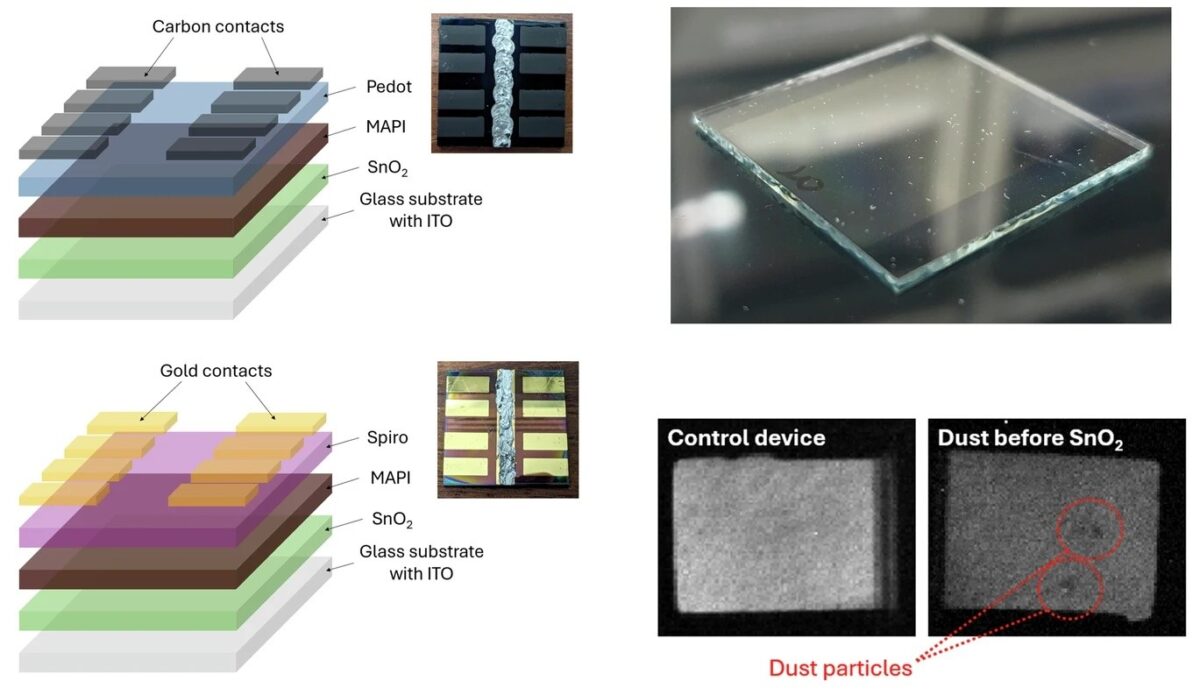
The experiments were conducted in a dust box, with test dust applied on PV devices. The test dust had a particle size distribution comparable to cleanroom standards, with about 90% by volume below 5 μm. The devices were exposed to dust for about three minutes, equivalent to dust exposure of 24-66 hours in standard laboratories and corridor areas, or 58-370 days in different classes of cleanrooms.
Two types of devices were tested. The first was a standard laboratory stack composed of tin(IV) oxide (SnO₂) as the electron-transport layer (ETL), methylammonium lead iodide (MAPI) as the perovskite light-absorbing layer, spiro-MeOTAD as the hole-transport layer (HTL), and gold as the top electrode. The second type was a future-ready stack designed for scalable manufacturing, consisting of tin(IV) oxide (SnO₂), methylammonium lead iodide (MAPI), poly(3,4-ethylenedioxythiophene) (PEDOT) as the HTL, and carbon as the top electrode, making it compatible with roll-to-roll (R2R) production techniques.
In both cases, dust was deliberately introduced at different stages of fabrication—specifically, before the deposition of the ETL, the perovskite absorber, or the HTK, to assess how contamination at each interface affects device performance. For each condition, the researchers fabricated otherwise identical devices, free of dust, in a cleanroom environment, which served as reference samples.
Results revealed that devices with dust performed similarly to clean devices, with only limited performance losses, most pronounced in short-circuit current density, resulting in small reductions in power conversion efficiency. At the same time, open-circuit voltage and fill factor remained largely unaffected.
“The perovskite crystals simply grew around and over the dust particles without significantly impacting the device's ability to generate current,” the researchers said in a statement. “Contamination did not cause the cells to degrade any faster than other mechanisms, even when exposed to high heat and humidity.”
Their findings have appeared in “Manufacturing planar perovskite solar cells in dusty environments,” published in Communications Materials.
“These findings go some way towards answering whether good quality planar perovskite solar cells can be made outside of a cleanroom environment, with results showing that even with many non-conductive dust particles present, devices can still perform well,” the academics concluded. “These findings also suggest that at research level when making lab scale devices that a cleanroom may not be essential when it comes to devices and materials suitable for upscaling, and if it is required may not need to be much more than the lowest level of control for dust particles.”
This content is protected by copyright and may not be reused. If you want to cooperate with us and would like to reuse some of our content, please contact: editors@pv-magazine.com.

By submitting this form you agree to pv magazine using your data for the purposes of publishing your comment.
Your personal data will only be disclosed or otherwise transmitted to third parties for the purposes of spam filtering or if this is necessary for technical maintenance of the website. Any other transfer to third parties will not take place unless this is justified on the basis of applicable data protection regulations or if pv magazine is legally obliged to do so.
You may revoke this consent at any time with effect for the future, in which case your personal data will be deleted immediately. Otherwise, your data will be deleted if pv magazine has processed your request or the purpose of data storage is fulfilled.
Further information on data privacy can be found in our Data Protection Policy.