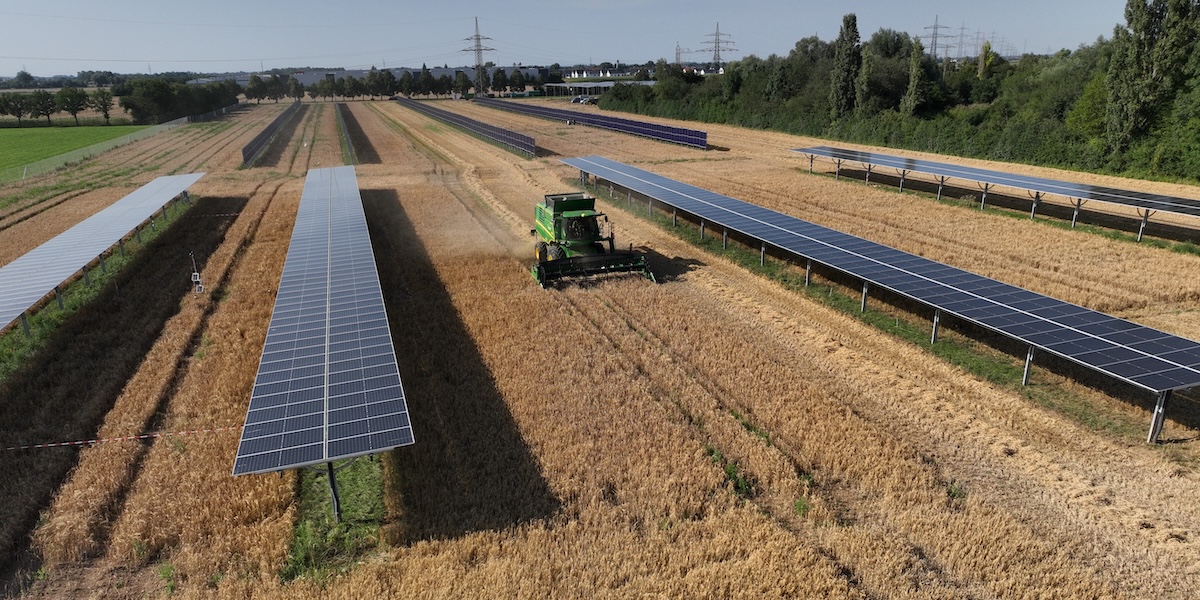





Agrivoltaics using tracking or vertical configurations can be financially viable and agriculturally beneficial when market revenues and land-use efficiency are considered, according to a new analysis by Jochen Hauff.
The argument responds to a study by Germany’s Thünen-Institut that framed agri-PV as economically questionable due to additional costs of up to 148% compared with conventional ground-mounted systems. Hauff said that figure applies only to elevated systems used in specialized applications such as orchards and does not reflect lower-cost configurations.
He also said the study focuses on levelized cost of electricity without accounting for market value – the revenue solar electricity can earn depending on when it is generated. This omission can distort project economics, as investment decisions depend on both costs and expected revenues.
According to the Thünen study’s own data, vertical agrivoltaic systems can have additional costs as low as 4%, while tracker-based systems show costs around 12% to 13% higher than standard ground-mounted plants. Tracker systems follow the sun throughout the day, while vertical systems produce more evenly in the morning and evening.
Hauff cited analysis by the Institute of Energy Economics at the University of Cologne (EWI), which found that tracker systems achieved a 43% higher market value than fixed south-facing installations in a modeled 2024 scenario in Brandenburg. The more even generation profile can also improve grid utilization and reduce peak loads.
The analysis argues that vertical systems, while offering smaller market value gains than trackers, benefit from lower additional costs, potentially making both configurations competitive with conventional solar when revenues are included.
Land-use efficiency is another key factor. According to the Thünen-Institut study, a standard ground-mounted solar plant can remove 1 hectare of agricultural land per unit of generation. Vertical agri-PV reduces this to 0.4 hectares, while tracker-based systems reduce it to 0.2 hectares, allowing 60% to 80% of land to remain in agricultural use.
Additional benefits cited include improved resilience against wind erosion, heavy rainfall, and excessive solar radiation, as well as better soil moisture retention.
Hauff concluded that agrivoltaics should be seen as a tool to strengthen both economic and physical resilience in rural areas, rather than a high-cost niche technology.
The views and opinions expressed in this article are the author’s own, and do not necessarily reflect those held by pv magazine.
This content is protected by copyright and may not be reused. If you want to cooperate with us and would like to reuse some of our content, please contact: editors@pv-magazine.com.

By submitting this form you agree to pv magazine using your data for the purposes of publishing your comment.
Your personal data will only be disclosed or otherwise transmitted to third parties for the purposes of spam filtering or if this is necessary for technical maintenance of the website. Any other transfer to third parties will not take place unless this is justified on the basis of applicable data protection regulations or if pv magazine is legally obliged to do so.
You may revoke this consent at any time with effect for the future, in which case your personal data will be deleted immediately. Otherwise, your data will be deleted if pv magazine has processed your request or the purpose of data storage is fulfilled.
Further information on data privacy can be found in our Data Protection Policy.