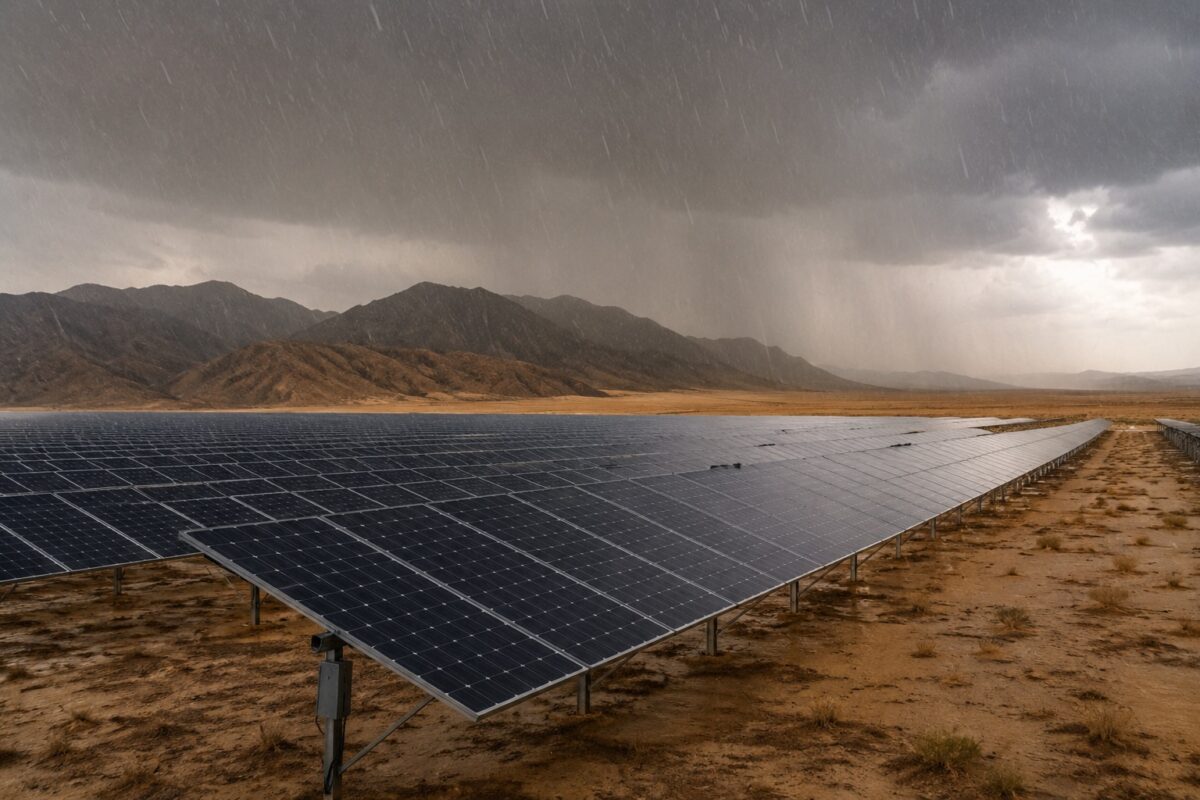





Photovoltaic parks of sufficient scale and appropriate design could influence climate processes in coastal desert regions and potentially enhance rainfall.
This hypothesis underpins a research project led by the University of Hohenheim in Germany. The initiative, to be carried out on the Arabian Peninsula, is funded by the UAE Research Program for Rain Enhancement Science (UAEREP), an international scheme that invests $5 million annually in technologies aimed at increasing precipitation in arid regions. The project was selected from around 120 international proposals and will receive funding over three years.
The research is led by Oliver Branch and Volker Wulfmeyer, specialists in Earth system science and meteorology who have spent more than a decade studying desert climate dynamics.
The central hypothesis builds on observed effects in large-scale photovoltaic installations. Dark solar module surfaces absorb solar radiation, increasing near-surface air temperatures and generating thermally driven updrafts. In coastal desert environments, these updrafts may interact with moisture-bearing sea breezes, potentially promoting convective cloud formation and precipitation.
According to the researchers, the effect could be amplified at very large scales and with optimized plant design. Differential heating above photovoltaic fields could force moist air upward into higher atmospheric layers where condensation occurs, potentially triggering localized rainfall and storm development.
The project will also examine artificial dunes several hundred meters high, which could act as man-made orographic barriers. Similar to natural mountain ranges, they may induce orographic lift, enhancing condensation and precipitation processes.
To test these hypotheses, the team will deploy high-resolution LiDAR systems and conduct measurements near large solar installations in the United Arab Emirates, including the Mohammed bin Rashid Al Maktoum Solar Park, which had around 3.8 GW of installed capacity by the end of 2025 and is expected to reach 7.2 GW. The instruments will capture three-dimensional profiles of temperature, humidity and wind up to cloud-forming altitudes.
The observational data will be used to drive ultra-high-resolution meteorological models simulating atmospheric dynamics over different photovoltaic and artificial dune configurations. These simulations will run on the Hunter and HoreKa supercomputers operated by the University of Stuttgart and the Karlsruhe Institute of Technology.
The goal is to determine optimal size, placement and design parameters for such infrastructures to maximize their potential impact on precipitation formation. The researchers also suggest future integration into energy and agricultural systems in arid regions, combining solar power generation with drought-resistant crops and water management strategies.
In addition, the concept explores energy and thermal synergies: part of the electricity generated by photovoltaic plants could power irrigation and pumping systems for resilient crops such as jojoba or jatropha. The vegetation could in turn reduce local temperatures, potentially improving photovoltaic performance.
Another recent research from China assessed the impact of using up to 50% of the Sahara desert for the deployment of large scale solar power plants and found these may impact the global cloud cover through disturbed atmospheric teleconnections. This, in turn, would impact solar power generation itself in North Africa, Southern Europe, the Southern Arabian Peninsula, India, North Asia, and even Eastern Australia.
This content is protected by copyright and may not be reused. If you want to cooperate with us and would like to reuse some of our content, please contact: editors@pv-magazine.com.

By submitting this form you agree to pv magazine using your data for the purposes of publishing your comment.
Your personal data will only be disclosed or otherwise transmitted to third parties for the purposes of spam filtering or if this is necessary for technical maintenance of the website. Any other transfer to third parties will not take place unless this is justified on the basis of applicable data protection regulations or if pv magazine is legally obliged to do so.
You may revoke this consent at any time with effect for the future, in which case your personal data will be deleted immediately. Otherwise, your data will be deleted if pv magazine has processed your request or the purpose of data storage is fulfilled.
Further information on data privacy can be found in our Data Protection Policy.