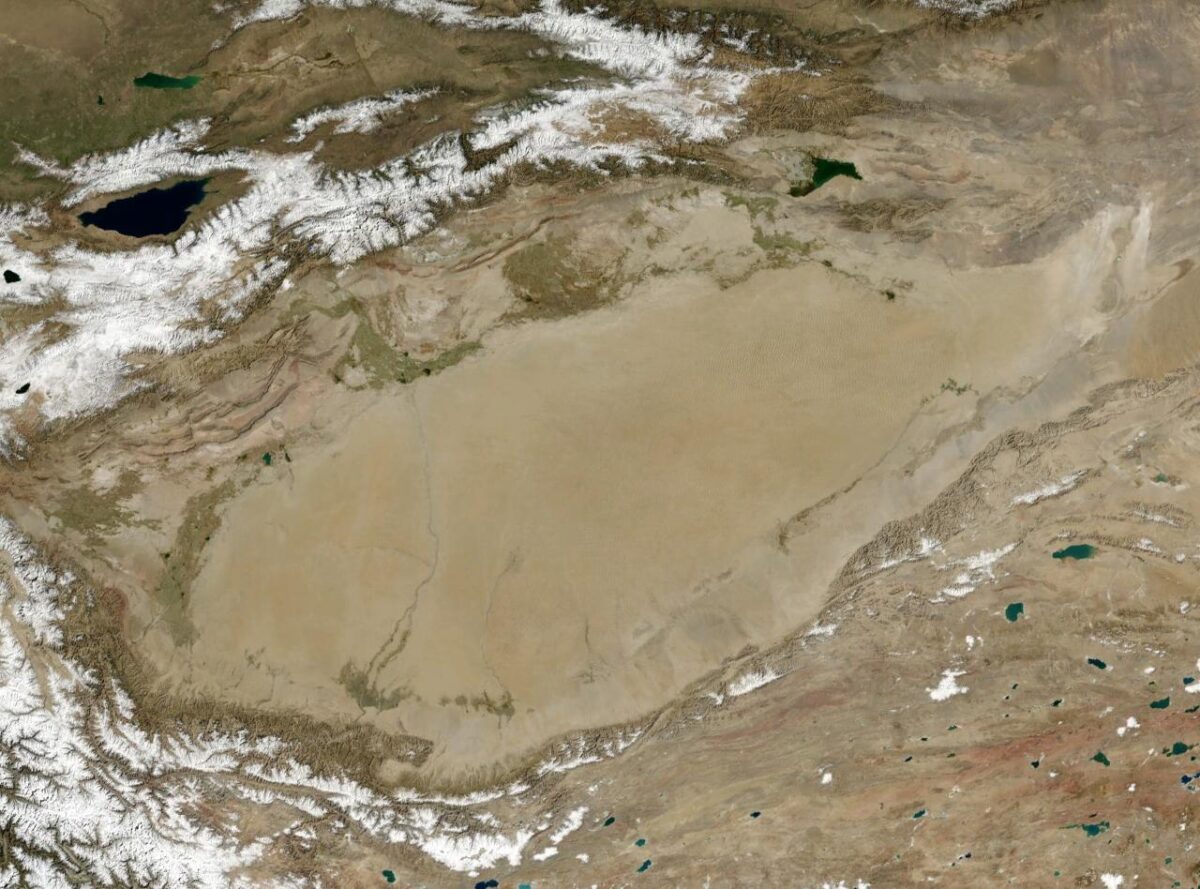





A research team is China has assessed the climatic impact of a huge PV deployment across the Tarim Basin's Taklamakan Desert, which is one of the driest large deserts in the world, characterized by extremely low precipitation and very high evaporation rates. Water availability in the region depends heavily on meltwater from surrounding glaciers and seasonal snow, which feed the river systems of the Tarim Basin. However, as regional glaciers continue to retreat, the long-term reliability of this water supply is increasingly under pressure.
The researchers assumed a scenario in which most of the basin would be covered by utility-scale PV installations, with total electricity generation exceeding current global demand. Despite this extreme setup, their results indicate that even much smaller-scale deployments in the region could intensify existing water stress.
“The novelty of our approach lies in the use of a high-resolution of 9 km, process-based modeling framework that combines the regional climate system with dynamic vegetation cover,” said corresponding author Zhengyao Lu to pv magazine. “With that, we can explicitly resolve the complex surface-vegetation-atmosphere feedbacks at a regional scale in the Tarim Basin associated with massive PV deployment.”
“The most striking finding is that large-scale high-efficiency PV deployment in the Taklamakan Desert could intensify regional water stress, particularly in the populated areas along the desert edges,” the researcher added. “We are currently working on a new paper focusing on the interactions of wind and solar energy deployment through local climate-ecosystem feedbacks in the same study region.”
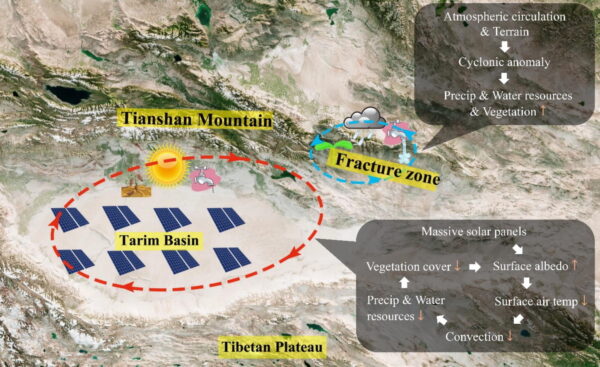
Image: Tarim University, Science Bulletin, CC BY 4.0
For their assessment, the research group used four climate datasets and one vegetation dataset covering the period 2016–2020: CN05.1 and CRU TS4.05 (Climatic Research Unit Time-Series version 4.05) for temperature and precipitation; the Global Precipitation Climatology Centre (GPCC) dataset to evaluate precipitation patterns; the ERA5 reanalysis from the European Centre for Medium-Range Weather Forecasts (ECMWF) to provide the primary atmospheric forcing data; and the Global Land Surface Satellite (GLASS) Leaf Area Index (LAI) product to characterize vegetation cover and plant dynamics.
They also employed two main numerical models: the Weather Research and Forecasting (WRF) model to simulate regional climate processes, and the Lund–Potsdam–Jena General Ecosystem Simulator (LPJ-GUESS) to represent vegetation dynamics and ecosystem responses.
Within this framework, WRF simulated key climate variables across the Tarim Basin, including temperature, precipitation, wind fields, runoff, and soil moisture. These outputs were then used to drive LPJ-GUESS, which simulated vegetation cover, LAI, and ecosystem responses to changing environmental conditions. The resulting vegetation changes were subsequently fed back into WRF, enabling the model to capture how shifts in plant cover further influence local climate and hydrological processes.
This coupled modeling approach allowed the researchers to assess both the direct climatic effects of PV installations and the additional indirect impacts mediated through vegetation–climate feedbacks.
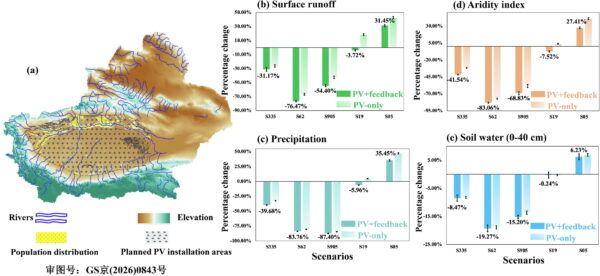
Image: Tarim University, Science Bulletin, CC BY 4.0
The simulations assumed that the entire Tarim Basin was covered with PV panels, excluding legally protected areas, forested land, and terrain with slopes steeper than 30 degrees. To evaluate the climatic impacts of large-scale solar deployment, the researchers defined six effective albedo scenarios representing different levels of sunlight reflection and energy conversion by PV installations.
These scenarios included a control case without PV deployment (Ctrl); a present-day PV case with an effective albedo of 0.1925 and an estimated conversion efficiency of around 15% (S19); a future high-efficiency scenario with an effective albedo of 0.335 and roughly 30% efficiency (S335); two extreme high-efficiency cases with effective albedos of 0.62 and 0.905, corresponding to approximately 60% (S62) and 90% (S905) conversion efficiency; and an extreme low-albedo “black panel” scenario with an effective albedo of 0.05 and around 5% efficiency (S05).
The researchers found that the higher-efficiency PV scenarios, including the more realistic future case S335 as well as the extreme S62 and S905 scenarios, reflected more incoming solar radiation and reduced surface heating inside the basin. According to the simulations, this produced surface cooling of up to 1.5 C across the desert region.
The cooling effect weakened moisture transport into the basin, enhanced downward air movement, and stabilized the lower atmosphere, ultimately suppressing rainfall formation. Reduced precipitation subsequently led to declines in vegetation cover and Leaf Area Index (LAI), particularly around the basin margins. As vegetation cover decreased, evapotranspiration and low-level cloud formation also weakened, further reducing atmospheric moisture availability and reinforcing the decline in rainfall.
“We find that large-scale PV installations may significantly reduce water resources in populated areas, with over 30% reductions in runoff, precipitation, and aridity index, alongside an 8.5% decline in soil moisture,” the academics. “These results highlight the critical need to incorporate vegetation feedback in future studies to fully evaluate PV's hydrological impacts and stress the importance of careful planning to mitigate environmental risks associated with large-scale solar projects in Northwest China.”
They added future studies should further investigate the hydrological effects of large-scale PV deployment and emphasized the need for careful project planning to minimize potential environmental impacts associated with utility-scale solar development in Northwest China.
Their findings were published in “Large-scale photovoltaic deployment in the Taklamakan Desert could intensify regional water stress” in Science Bulletin. Researchers from China's Tarim University, Xiamen University, Beijing Normal University, Tsinghua University, the Chinese Academy of Sciences, the University of Chinese Academy of Sciences, Sweden's Lund University, the University of Gothenburg, and Denmark's University of Copenhagen have participated in the research.
Another recent research from China assessed the impact of using up to 50% of the Sahara desert for the deployment of large scale solar power plants and found these may impact the global cloud cover through disturbed atmospheric teleconnections. This, in turn, would impact solar power generation itself in North Africa, Southern Europe, the Southern Arabian Peninsula, India, North Asia, and even Eastern Australia.
This content is protected by copyright and may not be reused. If you want to cooperate with us and would like to reuse some of our content, please contact: editors@pv-magazine.com.

By submitting this form you agree to pv magazine using your data for the purposes of publishing your comment.
Your personal data will only be disclosed or otherwise transmitted to third parties for the purposes of spam filtering or if this is necessary for technical maintenance of the website. Any other transfer to third parties will not take place unless this is justified on the basis of applicable data protection regulations or if pv magazine is legally obliged to do so.
You may revoke this consent at any time with effect for the future, in which case your personal data will be deleted immediately. Otherwise, your data will be deleted if pv magazine has processed your request or the purpose of data storage is fulfilled.
Further information on data privacy can be found in our Data Protection Policy.