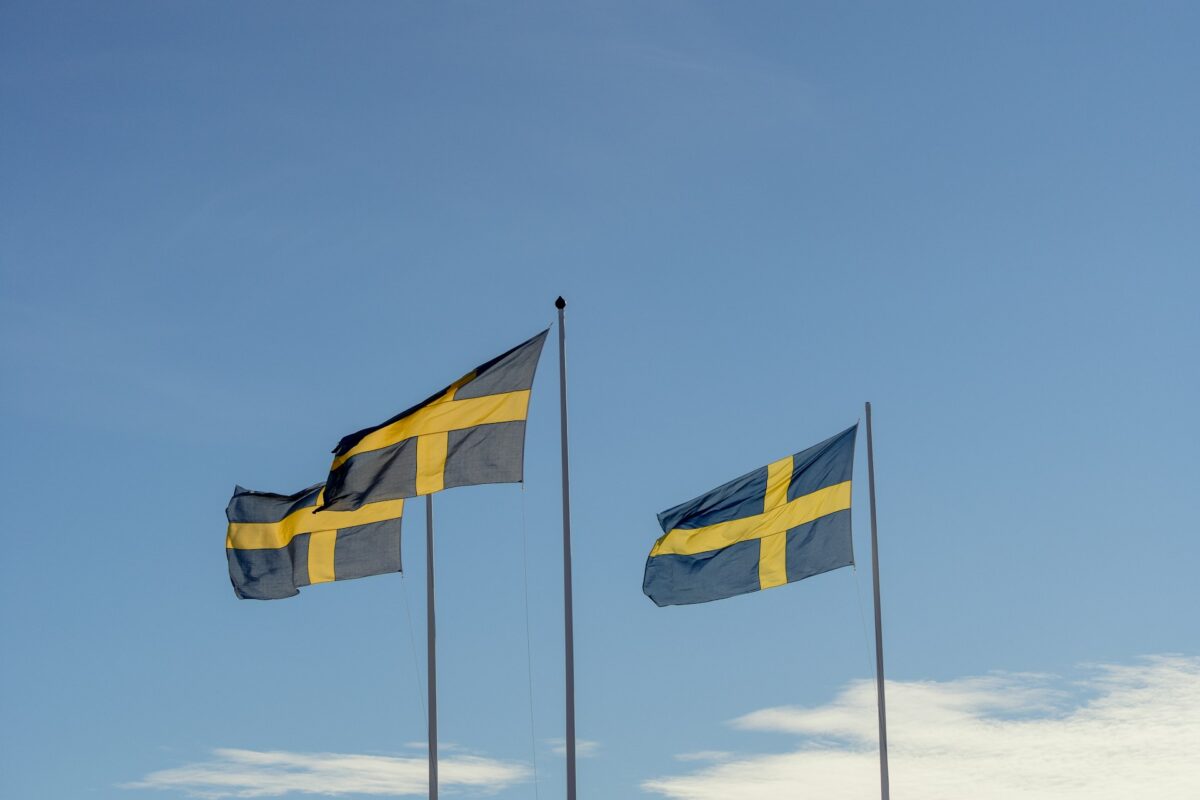





Sweden’s utility-scale solar market is growing without a national strategic vision covering its role, scale or spatial distribution, according to new research.
Researchers Georgios Pardalis and Jenny Palm, from Sweden’s Lund University, used document analysis and interviews to examine how actors in Sweden’s solar sector are expanding utility-scale solar in the absence of a nationally-articulated vision. Their findings are presented in the research paper The Grid, the Land, and the Void: Sweden's Utility-Scale Solar Expansion under Strategic Absence, available in the journal Advanced Sustainable Systems.
Pardalis and Palm told pv magazine that they found Sweden’s utility-scale solar build out is happening without a national strategy covering where it should go, how it should connect to the grid and how to balance it against farmland and other land uses.
“Deployment is happening anyway, because developers, county authorities and grid operators are filling the gap themselves, but they are doing it in very different ways across the country,” Pardalis and Palm explained. “The result is a patchwork. A project that gets approved in one county might be rejected in another under similar conditions. That works in the short term, but it creates uncertainty for investors and uneven outcomes for communities.”
Their analysis adds that coordination of efforts relies increasingly on procedural workarounds, informal harmonization and intermediary actors.
Some of the workarounds outlined by interviewees include conducting pre-consultations with municipalities and county boards to identify conflicts early, while some county boards have created internal coordination routines across units that handle measures including spatial planning and environmental assessments.
The research paper says such workarounds help to reduce friction but remain discretionary and do not constitute a coherent government framework. It adds that interviewees repeatedly called for clearer national guidance on how to assess solar parks relative to agricultural protection, biodiversity and energy-system needs.
Pardalis and Palm's research also features analysis of how Sweden’s neighbours are adopting approaches to utility-scale solar. They found Denmark articulated a proactive government vision for large-scale renewables. Norway has formulated a clear strategic position for solar than Sweden has not, despite not prioritizing large-scale solar, leaving Sweden to be described as a “Nordic outlier” in the research paper.
“The Nordic comparison is telling,” Pardalis and Palm told pv magazine. “Denmark has introduced clearer rules for siting, faster permitting, and compensation schemes for neighbors. None of this dictates where projects go, it just makes the conditions more predictable. Sweden could learn from that.”
Pardalis and Palm suggested that their findings could be useful for national authorities that shape most of the conditions for solar development, such as the Swedish Energy Agency and electricity transmission system operator Svenska Kraftnät, as it covers where the system is under strain, grid access, land-use decisions, and permitting, and where informal practices are holding things together.
When asked by pv magazine how they assess the outlook for utility-scale solar expansion in Sweden, Pardalis and Palm said they expect growth will continue, but added they expect it to become more uneven.
“Grid congestion in southern Sweden is already a hard limit, and connection queues run into the 2030s. Land-use conflicts are also intensifying,” they said. “Without clearer national direction, projects will cluster where conditions happen to be favorable, and stall elsewhere.”
The pair suggested a few changes they said could make a real difference.
“First, a proper regulatory framework for agrivoltaics. Right now, dual-use projects risk being treated as a change of land use, which can cost farmers their agricultural subsidies. Second, national guidance on siting, similar to what already exists for wind power. Third, clearer rules for conditional and curtailable grid connections, so developers know what to expect when capacity is tight.”
“The point is not to centralize decisions,” Pardalis and Palm concluded. “It is to give the people already doing this work a clearer set of shared rules to work from.”
Sweden deployed 652 MW of solar last year, taking cumulative capacity to around 5.4 GW. Large-scale solar accounted for 30% of new solar power in 2025, compared to 7% in 2024. New installations were led by Sweden’s largest solar plant to date, the 100 MW Hultsfred solar farm.
This content is protected by copyright and may not be reused. If you want to cooperate with us and would like to reuse some of our content, please contact: editors@pv-magazine.com.


By submitting this form you agree to pv magazine using your data for the purposes of publishing your comment.
Your personal data will only be disclosed or otherwise transmitted to third parties for the purposes of spam filtering or if this is necessary for technical maintenance of the website. Any other transfer to third parties will not take place unless this is justified on the basis of applicable data protection regulations or if pv magazine is legally obliged to do so.
You may revoke this consent at any time with effect for the future, in which case your personal data will be deleted immediately. Otherwise, your data will be deleted if pv magazine has processed your request or the purpose of data storage is fulfilled.
Further information on data privacy can be found in our Data Protection Policy.