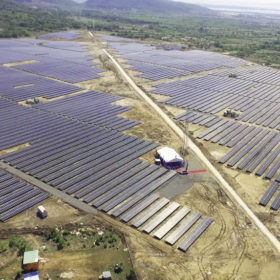
India could add 2.5 GW of big solar in second half
Some 1 GW of utility scale project capacity was added to the end of June.

India’s PV capacity tops 37 GW
Newly installed PV capacity for the second quarter was just 205 MW. This compares to around 1.5 GW a year earlier.
Tender launched for 279 MW of solar in India’s Maharashtra state
Bids are invited to install solar power generating systems ranging from 2 MW to 10 MW at various locations in Maharashtra. Bidding closes on September 25.
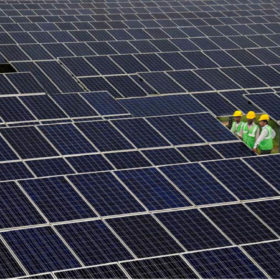
Indian hydropower company seeks EPC bids for 25 MW of floating PV
Bidders have until Aug. 25 to show interest in an engineering, procurement, and construction contract for a 25 MW floating solar plant in Khandwa district, in the Indian state of Madhya Pradesh.

Low-cost, durable catalyst for hydrogen production
Researchers from India’s Centre for Nano and Soft Matter Sciences have developed a coordination polymer-based catalyst for hydrogen production that exhibits exceptionally high durability for 70 hours at a high current density of −300 mA/ cm2.
India’s NTPC 1.2 GW solar auction sees aggressive tariff of INR 2.43/kWh
Low tariff trends can be attributed to developers’ desperate attempt to take advantage of the current situation wherein only a safeguard duty of 14.9% is applicable, according to JMK Research.

Indian EPC Sterling and Wilson: Europe will be our next stop
Having bagged large orders in the U.S. and Australia, Indian multinational engineering, procurement and construction (EPC) services provider Sterling and Wilson Solar is bidding for tenders in new regions, Europe among them. Kannan Krishnan, S&W’s chief operations officer for solar in India and the South Asian Association for Regional Cooperation area, speaks to pv magazine about the impact of Covid-19 on the solar EPC business and the company’s expansion plans.
India to hit large-scale PV target of 60 GW by 2022
India’s cumulative renewables capacity will hit 120 GW to 125 GW by December 2022, with solar to account for about 50% of the total, according to a new report by ICRA.
India confirms one-year extension of solar cell import duty
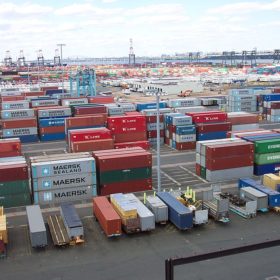
The ‘safeguard’ duty will be levied on Chinese, Vietnamese and Thai solar cells – whether assembled into modules or not – at 14.9% from today and falling to 14.5% in six months’ time. Malaysian products are exempted as their imports have fallen dramatically since the duty was introduced, in July 2018.

Indian utilities contemplate coal – rather than energy storage – to balance renewables
The Ministry of New and Renewable Energy has specified how grid back-up capacity procurement will work for Indian electricity distribution companies. The rules consider energy storage solely as part of the 51% clean energy requirement, and instead use coal – with a variable price tariff element – as necessary for evening out supply.
