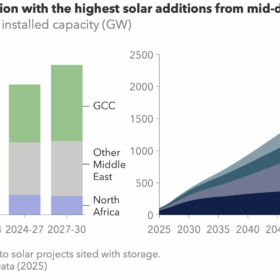
MENA region to add 860 GW of solar by 2040, says DNV
The Middle East and North Africa (MENA) region is projected to install 860 GW of solar capacity by 2040, led by utility-scale projects, with a further 2.2 TW of solar and wind expected between 2040 and 2060.
California batteries sustain near 24-hour solar run
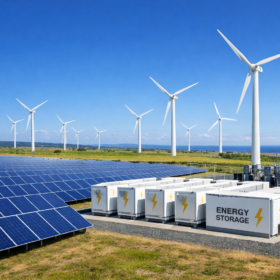
On Feb. 1, California’s batteries bridged the solar gap with seamless precision. After discharging through the night until sunrise, they spent the daylight hours charging, then pivoted back to exporting power well past midnight – effectively sustaining the state on solar energy for a full 24-hour cycle.
Pexapark records 12 European PPAs for 724 MW in January
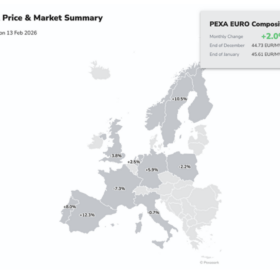
Swiss analytics firm Pexapark finds January recorded roughly half the deal count and volume in new European power purchase agreements than the month prior.
An ever-changing market: Delving into the heart of power purchase agreements
Cross-border VPPAs expose corporates to Basis Risk, causing settlement price gaps and weakening confidence in these hedging tools, contributing to a 35% drop in European PPA signings in 2025 amid complex market conditions. The market is shifting toward more structured, domestic, and hybrid PPAs, supported by BESS and modern IPPs, to better manage risk and realign buyers, sellers, and lenders.
Spain’s behind-the-meter storage grows 119% in 2025
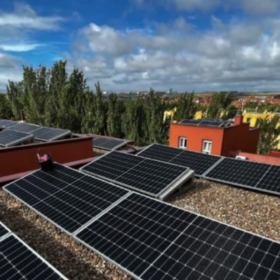
Spain installed 339 MWh of storage linked to PV self-consumption in 2025, up 119% year on year, according to APPA Renovables. The country added 1,214 MW of new self-consumption capacity, bringing the total to 9.6 GW.
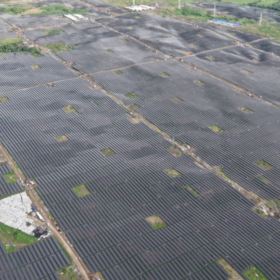
World’s largest solar-plus-storage project completes initial grid synchronization
The first phase of the MTerra solar project in the Philippines, set to be the world’s largest solar-plus-storage site once completed, has achieved initial synchronization and energization to the Luzon grid. Project developers are anticipating the project to being exporting power by the end of the month.
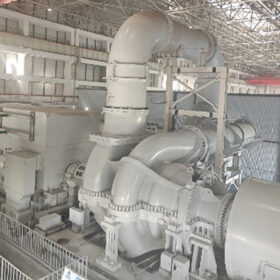
Chinese Academy of Sciences unveils 101 MW compressor for compressed air energy storage
The new compressor is described as the world’s most powerful single-unit compressed air energy storage (CAES) system, with a maximum discharge pressure of 10.1 MPa and an efficiency of 88.1%.
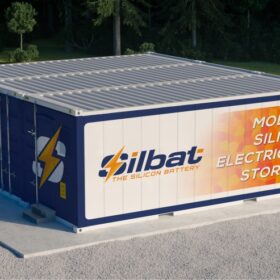
Silbat silicon batteries guarantee uninterrupted power supply for 14 days
The silicon batteries developed by the Spanish startup Silbat are spearheading the Research and Analysis of Long-Duration Energy Storage for Operational Resilience in Critical Military Infrastructures (ARMIC) project, covering Technology Readiness Levels (TRL) 7 to 8.

The prospects for ultra-high-temperature heat pumps
An international research team has reviewed emerging solid-state and gas-cycle heat pumps capable of reaching temperatures of up to 1,600 K, assessing their challenges, applications, scalability, and technology readiness levels. The researchers say these systems could outperform conventional high-temperature heating technologies by achieving coefficients of performance above 1.

Brazil targets 107 GW of solar by 2035 under energy plan
Brazil has opened consultations on its PDE 2035 energy plan, which projects 107 GW of solar by 2035 – including 78 GW of distributed generation – with battery storage reaching 7 GW, or 2% of the power mix.
