Tunisia launches 200 MW solar tender
Tunisia’s Ministry of Industry, Mines and Energy has kicked off a new procurement exercise for large-scale solar.
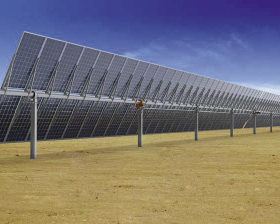
Chinese PV Industry Brief: Arctech secures 2.3 GW tracker order in Saudi Arabia
Arctech Solar says it has signed a 2.3 GW tracker order from Saudi Arabia, where it will supply trackers designed for the region’s desert terrain and high winds.
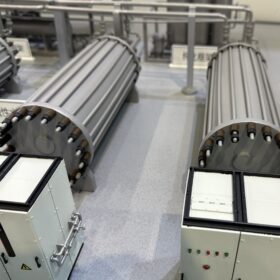
The Hydrogen Stream: US researchers explore trapped geologic hydrogen
US researchers have started studying hydrogen formation in the Midcontinent Rift in the United States, while Dutch scientists have discovered that hydrogen emissions from industrial complexes are higher than previously estimated.

Nepal’s 800 MW grid-tied solar tender oversubscribed
The Nepal Electricity Authority (NEA) has received proposals from 134 companies for a total of 3.6 GW. It says that 259 projects from 127 developers passed the technical bid evaluation and will be considered when financial proposals are opened on Oct. 22.
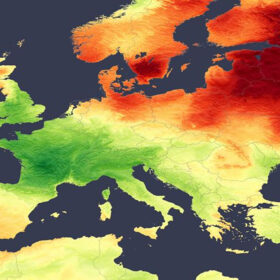
Western Europe sees September solar slump
In a new weekly update for pv magazine, Solcast, a DNV company, reports that low-pressure systems caused cloudier skies and reduced irradiance in Southern and Western regions in September, while areas further north and east enjoyed sunnier weather. A series of low-pressure systems centered over France led to the biggest drop in irradiance by up to 25%.
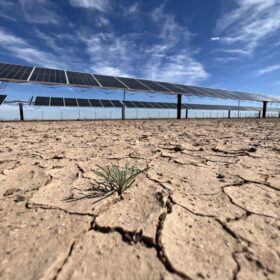
California farmers developing 20 GW solar-plus-storage plan
The Golden State recently signed AB 2661, granting the Westland Water District authority to develop transmission lines that will enable solar energy and storage projects on 130,000 acres of drainage-impaired farmland.

Serbia signs deal for 1 GW of solar, 200 MW of battery storage
An implementation agreement is in place between Serbia’s Ministry of Mining and Energy, utility company Elektroprivreda Srbije (EPS) and a consortium of Hyundai Engineering and UGT Renewables for six new solar plants totalling 1 GW. Up to 200 MW of battery storage will be developed across the sites.

IFC, Raiffeisen Bank provide €90 million for 225 MW of solar in Bulgaria
International Finance Corp. (IFC) and Raiffeisen Bank International have signed off on a €90 million ($97.8 million) debt package to support the development of a 225 MW facility in northeastern Bulgaria.
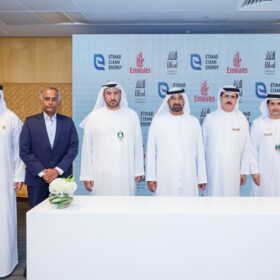
Emirates announces plans for 23 MW solar project
Emirates is partnering with Etihad Clean Energy Development to bring a large-scale solar energy project to the Emirates Engineering Centre in Dubai. It will have a capacity in excess of 23 MW – enough to generate more than one-third of the facility’s annual energy consumption.

JinkoSolar supplies 3 GW of modules in Saudi Arabia
JinkoSolar says it has supplied 3 GW of modules for two Acwa Power projects in Saudi Arabia, using its n-type Tiger Neo series 78 and series 66 solar modules.
