
Key takeaways from Solar + Storage España
RE+ held the Solar + Storage España event in Barcelona on May 10 and 11, in collaboration with pv magazine. Our team of editors curated and hosted the two-day “Sun of Spain to Lead Europe” conference.
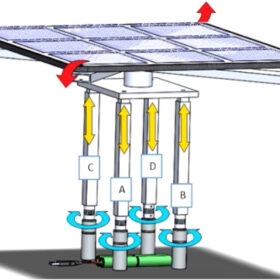
Low-cost, portable sun-tracker for offgrid solar
Mauritian researchers have developed a solar tracker prototype that increases current by around 37%. The device uses a simplified and mechanical tracking system.
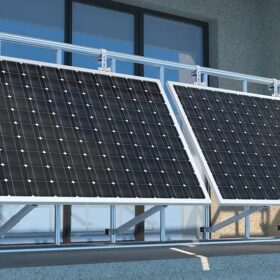
Mibet unveils new balcony solar mounting structure
China’s Mibet has developed a mounting system for PV modules installed on balcony railings, terraces, gardens, and garage rooftops. It offers a maximum title angle of 30 degrees and can withstand wind loads of 30 meters per second.

Inflation Reduction Act triggered plans for 46 factories, says industry group
Since the passage of the US Inflation Reduction Act (IRA) last August, the utility-scale clean power sector has announced $150 billion in funding, 46 new manufacturing facilities, and nearly 20,000 new jobs, according to the American Clean Power Association.
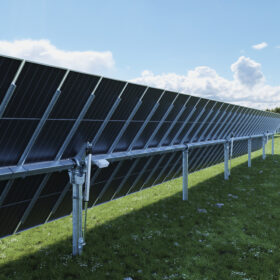
Trina Tracker unveils 2P tracker solution with new features
Trina Solar’s tracker subsidiary has launched a new version of its Vanguard single-axis two-in-portrait (2P) tracker. It uses multiple motors on one tracker row, reportedly allowing it to withstand higher wind loads and reduce tilt angle misalignment. The new solution is compatible with large modules up to 685 W.
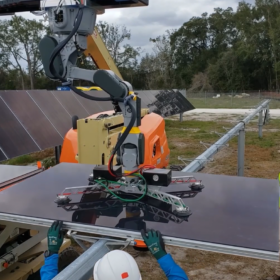
US company develops robotic solution to address installer shortage
Sarcos has designed a robotic PV construction solution that delivers, detects, lifts, and places PV modules in large-scale solar plants. It has recently field tested and validated the prototype solution in a pilot project funded by the US Department of Energy.
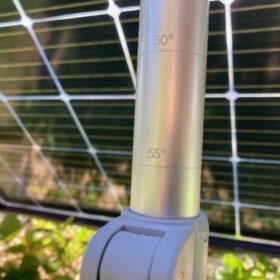
French startup offers ‘manual’ solar tracker for residential PV systems
France-based Luciole & Basilic has developed a tracking system that can be manually oriented according to the zenith every 15 days. The startup recently introduced the first prototype and is now looking for distributors.
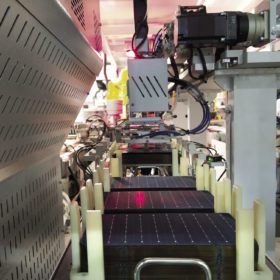
India’s solar module manufacturing capacity could hit 110 GW by 2026
India could become the world’s second-largest solar manufacturer by 2026. It will also have a notable presence in all upstream components of PV production, such as cells, ingots/wafers, and polysilicon, according to a new report.

US manufacturer releases new dual solar optimizer
Enteligent, a residential PV solutions specialist, has introduced an optimizer model that can be paired with two solar panels. It claims that it features rapid shutdown and monitoring capabilities.

Australia to earmark $10 billion fund to support clean energy manufacturing
Both houses of the Australian parliament have approved plans to establish an AUD 15 billion ($10 billion) national reconstruction fund to support domestic manufacturing in future industries and reduce the nation’s dependence on imports.
