
Carbon scraps solar module gigafactory project in France
Carbon’s gigafactory project in Fos-sur-Mer, designed to build a 5 GW integrated solar manufacturing chain in France, has been abandoned due to insufficient regulatory visibility and investor guarantees. Despite attempts to scale down and pursue partnerships, including with Chinese manufacturer Longi, the project collapsed amid uncertainty over EU industrial policy and market preference mechanisms.
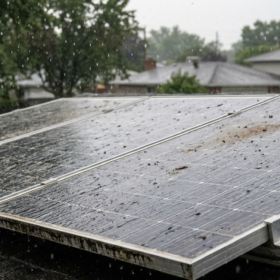
The impact of rain on PV module antisoiling coating lifetime
Researchers in India developed a predictive framework combining degradation experiments, weather data, and environmental stress models to assess how rain affects anti-soiling solar coatings. They found that coating lifetime strongly depends on local climate, installation tilt, and rainwater pH.
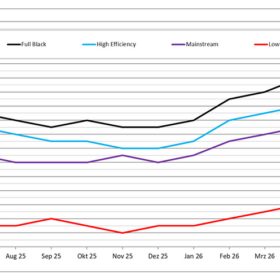
Banning China: Are we overreacting again?
PV systems and distributed energy assets require stronger cybersecurity and controllability, but measures to protect critical infrastructure should be based on careful, expert assessment rather than rushed policy decisions.
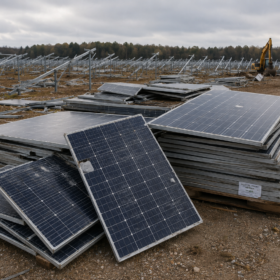
EU solar recycling only viable under strict policy, say researchers
TU Wien researchers say binding EU policy targets are essential to make solar module recycling economically viable, with exports to third countries remaining the cheapest option for member states in their absence.
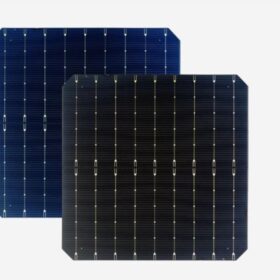
Toyo denies Ethiopia duty evasion, confirms 4 GW ramp and US cell plant
Toyo Co. says a new anti-circumvention petition targeting its Ethiopian solar cell facility is “riddled with misinformation.” The Japanese manufacturer tells pv magazine that the site reached 4 GW of capacity last year and that it is planning a U.S. onshore cell plant.
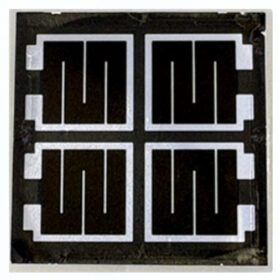
Japanese scientists achieve world record 25.14% efficiency for perovskite-CIGS tandem solar cell
The result was certified by Japan’s National Institute of Advanced Industrial Science and Technology (AIST).

Glass frit chemistry explains EVA-driven degradation mechanisms in TOPCon solar cells
Researchers from University of New South Wales and Jolywood found that corrosion-induced degradation in TOPCon solar cells is primarily governed by glass frit chemistry in low-aluminum silver metallization. Their findings show that barium-zinc-modified frits significantly improve resistance to acetic-acid and damp-heat stress, enabling more stable silver-silicon interfaces and reduced module-level power loss.
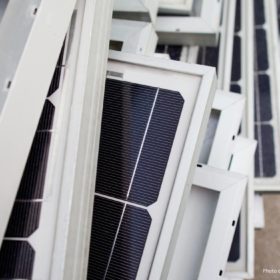
Upcycling silicon from end-of-life solar modules via palladium nanoparticles
Researchers in Italy have developed a Pd/Si catalyst for upcycling silicon from end-of-life PV panels. The system showed performance comparable to commercial-silicon catalysts and stable recycling over six cycles.
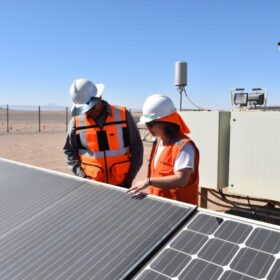
Heterojunction PV modules with low silver content tested in world’s sunniest region
Chilean company Atamostec is testing low-silver heterojunction solar modules under real desert conditions at the Atacama Desert Solar Platform (PSDA) in partnership with France’s CEA-Ines. The ALPACA project has so far achieved up to 70% silver substitution with copper.
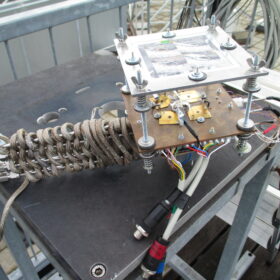
Fraunhofer ISE achieves 31.3% record solar-to-hydrogen efficiency in CPV electrolysis
Researchers at the German institute built a photovoltaic water electrolysis system based on micro-concentrator photovoltaics coupled to proton exchange membrane electrolysis. Outdoor testing demonstrated a record solar-to-hydrogen efficiency of 31.3%, achieved by a four-junction CPV system driving two PEM cells in series under real operating conditions.
