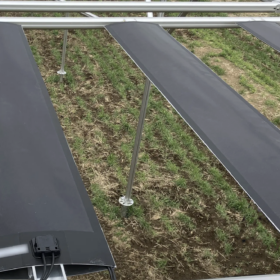
Sekisui-led consortium testing film-type perovskite solar for agrivolatics
A Japanese consortium is piloting agrivoltaics using film-type perovskite solar cells over rice paddies to study energy generation alongside crop production. The three-year project will assess impacts on rice yield, land use, and emissions while testing the technology’s performance and commercial viability.

Smart meters are vulnerable gateways to cyberattacks
Researchers found that widely deployed smart meters pose a “massive” cybersecurity risk, potentially enabling data manipulation, energy theft, and service disruption. They propose a new detection method using state estimation and statistical boundaries to more accurately identify cyberattacks, outperforming traditional techniques despite higher computational demands.

Waaree approves INR 39 billion solar glass factory investment
Waaree Energies has approved a capital expenditure of INR 39 billion ($415 million) to build a solar glass manufacturing facility with a capacity of 2,500 metric tons (MT) per day through its subsidiary Waaree Green Glass.
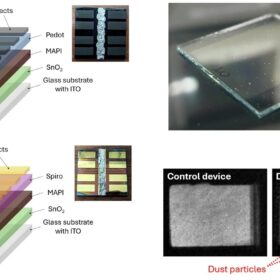
Perovskite solar cells can be made without expensive cleanrooms
Swansea University researchers found that perovskite solar cells can tolerate dusty fabrication environments, performing almost as well as those made in cleanrooms. The findings suggest low-cost, scalable production may be possible without ultra-sterile conditions, potentially accelerating cell and module manufacturing.
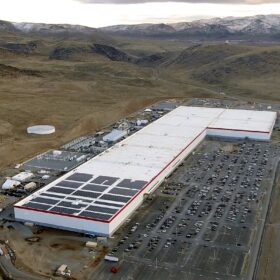
Tesla advances plan to build 100 GW of U.S. PV manufacturing capacity by 2028
Job advertisements on Tesla’s website outline the 100 GW ambition and follow reports the company is in talks with Chinese firms for the purchase of $2.9 billion worth of equipment for solar manufacturing.
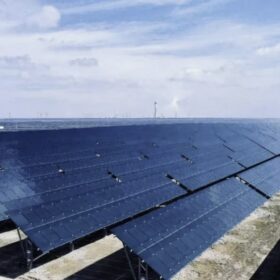
GCL Optoelectronics wins China’s first commercial perovskite-silicon tandem PV module order
GCL Optoelectronics has won a 1.2 MW commercial perovskite/silicon tandem solar module tender held by China’s Huaneng. The procurement required mass-producible, IEC-certified modules with over 26% efficiency, a 25-year performance warranty, and delivery by June 2026.

Solar cyber threats expand, but inverters still stay in the crosshairs
In an interview with pv magazine, Jay Johnson, the CTO of US-based cybersecurity firm DERSec, explains that PV systems face cybersecurity risks that extend far beyond inverters, as demonstrated by a December attack on Polish solar plants where wiper malware targeted substation equipment rather than the inverters themselves. Vulnerabilities often lie in backhaul communication channels like APIs and mobile apps, making layered defenses, network segmentation, and vigilant monitoring essential to safeguard distributed energy resources.
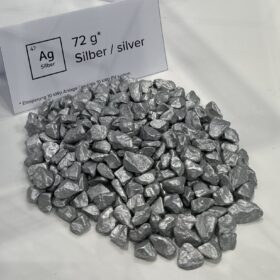
Silver prices find new floor around $70 an ounce
Silver prices have fallen by more than 40% since early January, when they reached an all-time peak of about $120/oz.
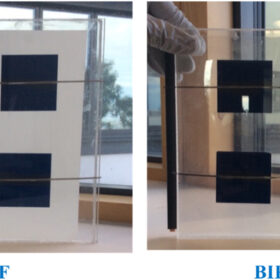
New solar window concept integrates polymer-dispersed liquid crystal to enable switchable transparency
Researchers in the United Kingdom have developed a smart window that combines switchable polymer-dispersed liquid crystal with integrated PV cells, offering controllable transparency and electricity generation. The system balances light, heat, and solar protection while maintaining high visual quality and stable performance, according to its creators.
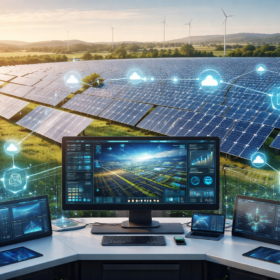
German startup offers team of 22 specialized AI workers for PV plant O&M operations
Invertix has launched 22 specialized AI “workers” to automate O&M tasks for renewable energy assets, targeting inefficiencies in data handling, alarm management, and reporting. The startup says its system enables PV plant operators to scale portfolios more efficiently by reducing manual workloads, while keeping humans in the loop for critical decisions.
