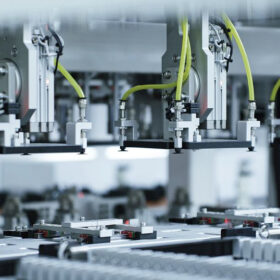
JinkoSolar achieves 34.76% efficiency for perovskite-silicon tandem solar cell
JinkoSolar says it has increased the efficiency rating for its perovskite-silicon tandem solar cells from 34.22% to 34.76%, confirmed by China’s National PV Metric & Testing Center (NPVM).
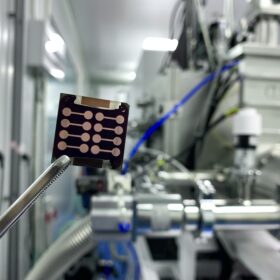
All-perovskite tandem solar cell with dipolar passivation achieves 30.1% efficiency
Researchers in China have developed a dipolar passivation method that reduces defects and improves charge transport in solar cells based on narrow-bandgap tin lead perovskite. The approach has enabled the fabrication of all-perovskite tandem solar cells with efficiencies of around 30% and enhanced stability,

Historic icons, modern energy: Why heritage buildings need solar roofing
Heritage buildings face mounting pressure to cut carbon emissions, but traditional solar panels often clash with their historic appearance and face public resistance. Building-integrated photovoltaics (BIPV) offer a discreet alternative, blending solar technology into roofing materials and enabling wider adoption across protected sites. As UK policy increasingly supports solar on historic buildings, BIPV presents a scalable solution that reconciles climate action with architectural preservation.

Chinese PV Industry Brief: January-October solar additions reach 252.87 GW
China’s National Energy Administration (NEA) says developers installed 252.87 GW of new PV capacity from January to October 2024, including 12.6 GW in October alone.
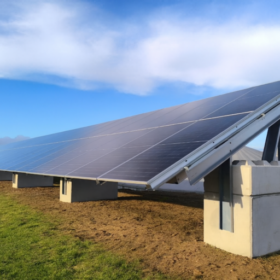
French startup offers modular, demountable ground-mounted solar systems
Enowatt says its modular, demountable photovoltaic structures allow companies to deploy solar capacity on existing sites without major building reinforcement, using ballasted units that install directly on asphalt.

Rescue bid for German solar glass maker GMB fails
The solar glass manufacturer started insolvency proceedings in July. An investor’s bid has now failed, leaving over 200 employees facing layoffs.

Japan pilots low-weight solar panels, perovskite windows for buildings
Mitsui Home and Tokyo Gas have revealed plans to deploy Japan’s first combined on-site and virtual solar power purchase agreement (PPA), cutting factory emissions and maximizing rooftop energy use.

N-type wafer prices extend four-week slide amid weak demand, rising inventory concerns
In a new weekly update for pv magazine, OPIS, a Dow Jones company, provides a quick look at the main price trends in the global PV industry.
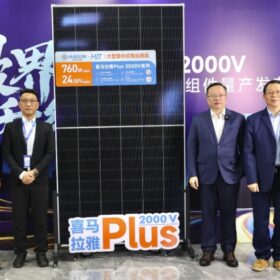
Huasun unveils 770 W, 2,000 V heterojunction solar module
The Chinese manufacturer said the higher-voltage design of the new module reduces cable, combiner, pile-foundation, and land-use requirements, delivering balance-of-system savings of up to CNY 0.15 ($0.012)/W in western China. The module offers a power output of 730 W to 770 W and a conversion efficiency of up to 24.8%.
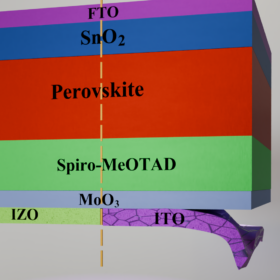
Highly transparent perovskite solar cell achieves 18.22% efficiency
A research team in India has investigated the use of highly conductive transparent electrodes based on amorphous indium zinc made with a room temperature process in perovskite solar cells. The devices could be used in tandem and building-integrated PV applications.
