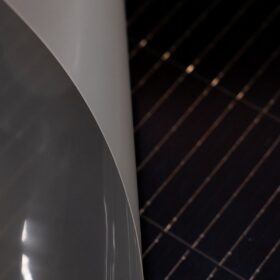
Endurans Solar launches transparent backsheet for utility-scale bifacial modules
The U.S. based manufacturer has completed certification of its latest adhesive-free, fluorine-free backsheet.

Chinese researchers build 31.71%-efficient perovskite-silicon tandem solar cell based on new interfacial engineering
The two-terminal perovskite–silicon tandem solar cell was fabricated through a chemical polishing method that selectively removes residual lead(II)iodide from the perorvskite film in the top cell. This targeted interfacial engineering improved uniformity and stability, enabling a certified 31.71% efficiency and enhanced long-term performance.
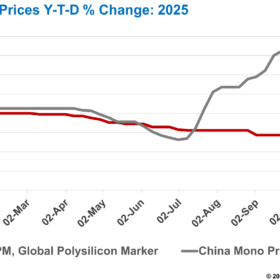
OPIS Global Polysilicon Marker holds firm as trade barriers continue driving fragmentation
In a new weekly update for pv magazine, OPIS, a Dow Jones company, provides a quick look at the main price trends in the global PV industry.
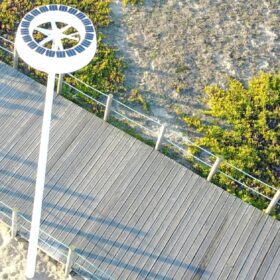
Hybrid solar-wind streetlight offers multiple functions
Omniflow has developed a line of hybrid solar-wind streetlights. It offers optional solutions to integrate for security, phone recharging, and Internet of Things applications.

French startup unveils solar canopy for motorhomes
France’s Genelios has developed an 8 kW modular solar canopy for motorhomes, offering manufactured-in-France construction, multiple installation options, and services that include design, monitoring, and maintenance for users across France, Belgium, Switzerland, and Luxembourg.

Fraunhofer ISE achieves 30.6% efficiency for perovskite-silicon tandem based on industry-standard bottom TOPCon cell
Researchers at Fraunhofer ISE have developed a perovskite-silicon tandem solar cell using a TOPCon bottom cell with standard textured front surfaces. Their results show that TOPCon bottom cells can perform comparably to heterojunction cells in tandem devices in terms of shunt resistivity, supporting scalable, cost-effective industrial production.

Longi publishes global field data for Hi-MO 9 back-contact modules
Chinese module manufacturer Longi says its Hi-MO 9 series with HPBC 2.0 cells achieved watt-for-watt power gains of 1.21% to 3.92% in real-world tests across multiple countries and climates, lowering the levelized cost of electricity (LCOE) compared with mainstream tunnel-oxide passivated contact (TOPCon) modules.

Sweden backs indoor solar cell technology
A Swedish government agency is investing SEK 130 million ($13.8 million) in the next-generation indoor solar cell technology belonging to Exeger. The company’s Powerfoyle solar cells are an evolution of dye-sensitized solar cells and are said to offer 1,000 times better conductivity.
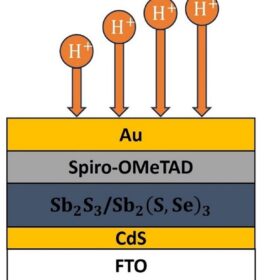
New research shows antimony chalcogenide solar cells are suitable for space use
Researchers in the US tested the degradation of antimony chalcogenide solar cells exposed to proton radiation. The result indicated a robust tolerance and potential for use in space.

Panasonic glass-based perovskite solar panels tested in office windows
The Japanese electronics manufacturer is testing its glass-based perovskite solar PV technology in office windows made by YKK AP, a construction and building materials company.
