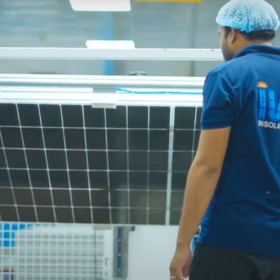
Insolation Energy to add 3 GW solar panel, 1.4 GW cell capacity by March
The Indian manufacturer is expanding its solar panel production capacity to 4 GW annually, up from a current 1 GW. It is also setting up manufacturing capacities for 12,000 MT of aluminum framing and 1.4 GW of PV cells. The new capacities will be commissioned during fiscal year 2024-25.
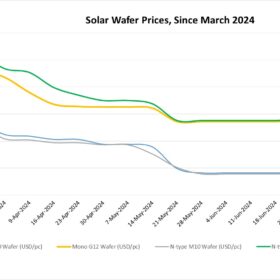
Wafer prices near bottom, size evolution and capacity globalization continue
In a new weekly update for pv magazine, OPIS, a Dow Jones company, provides a quick look at the main price trends in the global PV industry.
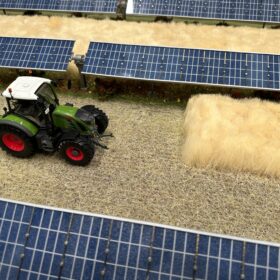
Researchers find agrivoltaics have LCOE of $0.039/kWh, 7-year payback time in India
Indian researchers have compared the performance of an agrivoltaic system to monofacial and bifacial rooftop PV systems, and have found that the agrivoltaics setup had a shorter payback time and lower levelized cost of energy. Their analysis of performance considered panel temperature, power output, land equivalent ratio, and reliability.
Critical mineral report highlights Australia’s solar panel recycling potential
A new report published by the CSIRO says Australia’s research into solar recycling is second in the world, outside China, but suggests the establishment of mid-stream activities such as the production of metallurgical silicon and polysilicon have big potential.
Heliene, Premier Energies announce U.S. solar cell factory
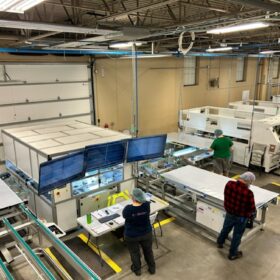
Heliene is a solar module provider operating in North America, while Premier Energies is the second largest solar cell manufacturer in India.

US engineers develop ChatGPT algorithm to design solar cells
OptoGPT is a new algorithm that harnesses the computer architecture underpinning ChatGPT. Its creators say that it will enable researchers and engineers to design optical multilayer film structures for a wide range of applications, including solar cells.

Comal plans 500 MW solar module factory in Italy
Comal says it has acquired an industrial building near L’Aquila in central Italy for a 500 MW solar module factory. Production is scheduled to start in 2025.

Sinovoltaics shuffles PV module manufacturer financial stability ranking
The third edition of the Sinovoltaics financial stability report ranking lists India-based Insolation Energy, Waaree Renewable Technologies, and Solex Energy, all based in India, as the top three. Six additional manufacturers entered the global ranking.
Two-terminal perovskite-CIGS tandem solar cells have technical potential to achieve 26.69% efficiency
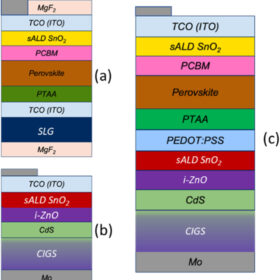
A Dutch and U.S. research team performed optical and electrical simulations to understand loss mechanisms in two terminal (2T) tandem cells based on perovskite and commercially available copper-indium-gallium-selenide (CIGS) cells, and subsequently established a roadmap to increase efficiency via four key modifications.

India imposes 10% customs duty on solar glass imports
The Indian authorities will introduce a 10% customs duty on solar glass imports from October. The government has also expanded the list of exempted equipment for solar cell and panel production to support domestic manufacturing.
