
First attempt to build antimony photovoltaic modules
An Italian research team claims a first for solar modules based on air stable lead-free and tin-free antimony-based light absorber, a perovskite-inspired material. The mini modules have a 1.2% power conversion efficiency over a 2.52 cm2 active area.
Stacking algorithm for PV module fault diagnosis
Researchers in Norway have created a PV module fault diagnosis technique based on a stacking algorithm. It utilizes augmented digital images of PV modules collected by unmanned aerial vehicles and is able to detect snail trails, delamination, glass breakages, discoloration, and burn marks.

Construction starts on polysilicon production facility in Oman
Construction has begun on a $1.35 billion polysilicon production facility in Oman, billed as the first project of its kind in the Middle East. It is scheduled to start operations next year, producing 100,000 metric tons of metallurgical silicon per year.
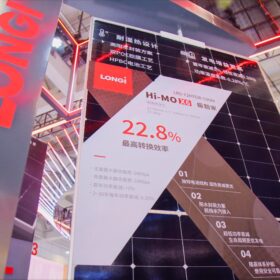
Longi introduces HPBC photovoltaic modules with 22.8% efficiency
The Chinese panel manufacturer said its new products have a temperature coefficient of -0.28%/C and a power output ranging from 565 W to 590 W. They rely on the company’s proprietary hybrid passivated back contact (HPBC) cell technology.

TOPCon solar module production hits cell bottleneck in India
The Indian solar industry’s transition to tunnel oxide passivated contact (TOPCon) and heterojunction (HJT) underscores the need for technological upgrades and more investment in cell manufacturing capabilities.

PV-powered cars and the parking dilemma
Researchers in Portugal have addressed the so-called ‘parking dilemma’ of electric cars incorporating photovoltaic modules. They looked into the tradeoff between charging the car and raising its inside temperature. They calculated the critical time as a function of the car’s solar capacity.
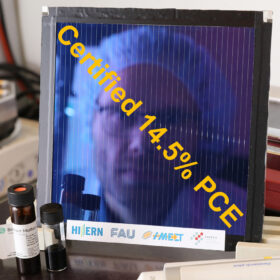
Large area organic PV module achieves world record efficiency of 14.5%
The module has a size of 143 mm x 143 mm and an active area of 204.11 cm². The result was certified by the Fraunhofer Institute for Solar Energy Systems (Fraunhofer ISE).
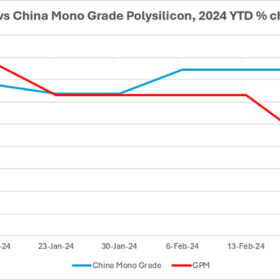
Polysilicon prices further decouple, adverse factors thwart contract negotiations
In a new weekly update for pv magazine, OPIS, a Dow Jones company, offers bite-sized analysis on solar PV module supply and price trends.
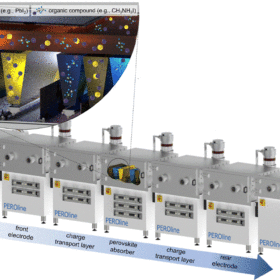
Vapor-based deposition key to commercialize perovskite solar
Researchers from ten countries assessed the prospects of using vapor-based deposition processes to put perovskite thin film processing on the fast track to commercialization, drawing attention to its merits and key areas to research and develop.
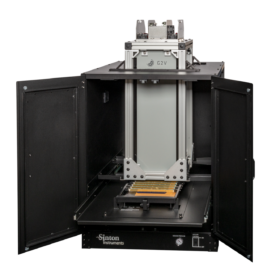
Solar simulator for perovskite-silicon tandem PV cells, modules
A new measurment and solar simulator instrument designed for perovskite-silicon tandem cells and encapsulated mini-modules is the latest product from a collaboration between Canadian solar simulator supplier G2V Optics and U.S.-based measurement instrumentation company Sinton Instruments.
