
Addressing socio-economic challenges will advance solar
In its latest monthly column for pv magazine, the European Technology and Innovation Platform for Photovoltaics (ETIP PV) presents the main findings of a recent whitepaper it published on the nexus of the socio-economic and technological challenges of solar deployment.

Merida Aerospace developing perovskite PV cells for space
Merida Aerospace, a US aerospace company, is developing perovskite solar cells for low-Earth-orbit satellites. It says perovskite solar cells could be a more cost-effective and efficient option than traditional cells.
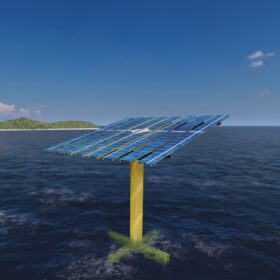
Offshore floating PV system based on dual-axis tracker, tension leg platform
Developed by scientists in Spain, the HelioSea system is reportedly able to ensure structural reliability in challenging marine environments. The research group proposed to use tension leg platforms that have been successfully applied to offshore drilling platforms, where stability is also paramount.
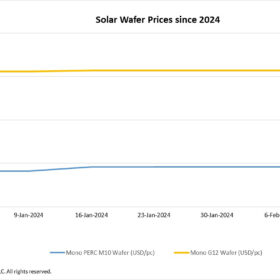
Solar wafer prices momentarily stable, masking turbulence of industry consolidation
In a new weekly update for pv magazine, OPIS, a Dow Jones company, provides a quick look at the main price trends in the global PV industry.
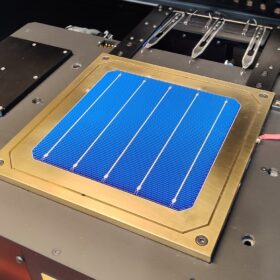
Netherlands reveals details of incentive scheme for PV manufacturing
The Dutch government has submitted a public proposal to support the production of heterojunction and perovskite-silicon tandem modules, as well as building- and vehicle-integrated PV panels, with a maximum allocation of €70 million ($75.1 million) per solar manufacturing project.
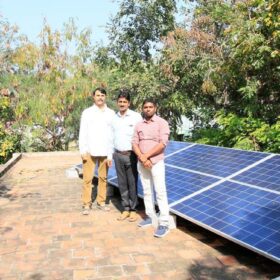
UK-led project explores PV module production in Africa, Asia, Indo-Pacific
Universities and businesses from the United Kingdom, Africa, Asia, and the Indo-Pacific are assessing the potential to set up sustainable PV module manufacturing hubs across the Global South.
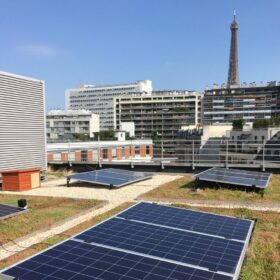
French consortium unveils multi-functional solar roofing solution
A French consortium has developed a roofing solution that integrates solar, storage, rainwater management, and the protection of vegetation. The group says plants under the PV modules can increase solar power generation by more than 10%.
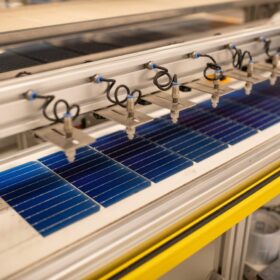
Australian PV manufacturing should start immediately, viability study finds
The Silicon to Solar (Roadmap) study has found Australian PV supply chain manufacturing is viable and calls for immediate action to establish it as a strategic priority industry and set up a solar manufacturing taskforce.
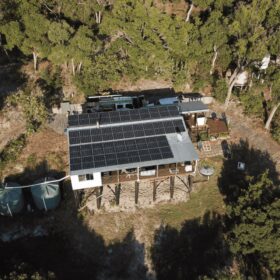
Australian off-grid project upgrade shows power of modern PV
An off-grid residential system on a secluded island in Australia has received a new tech upgrade. The additional capacity highlights the new era of off-grid living available to remote households in the country.
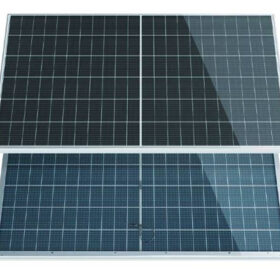
SEG Solar unveils 700 W TOPCon solar modules with 22.53% efficiency
SEG Solar says its new panels have a temperature coefficient of -0.30% per C. They come with a 30-year power output guarantee for 87.4% of the initial yield.
