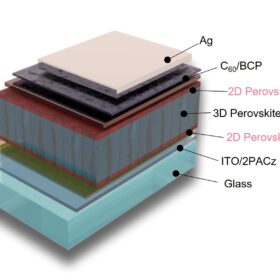
Inverted perovskite solar cell with 2D/3D heterojunctions achieves 25.6% efficiency
An international research team claims to have achieved optimal passivation in inverted perovskite solar cells by applying thin layers of low-dimensional perovskite on top of a 3D perovskite film. The resulting cell achieved an open-circuit voltage of 1.19 V, a short-circuit current density of 24.94 mA cm2, and a fill factor of 85.9%.

New research analyzes performance ratios of bifacial PV
A comparison between monofacial and bifacial PV systems in Ghana showed how changes in system parameters can affect the bifacial gains. The researchers found that changing the albedo of a land-based system can increase the bifacial gain from 5.25% to 14.5%.
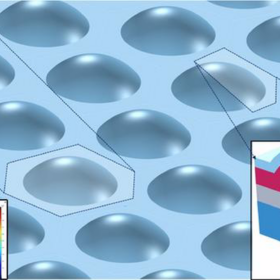
Researchers develop hemispherical organic solar cells
A Turkish research team has tested a hemispherical shell-shaped organic active layer for photovoltaic applications. The group found the shape maximizes light absorption and angular coverage when compared to flat-structured cells, suggesting the structure would be beneficial for applications requiring flexible light capture such as wearable electronics.

US residential solar prices falling amid surging interest in storage
The 18th edition of the EnergySage Marketplace Report indicates that the US residential solar segment faces persistent inflation, the California NEM 3.0, and rising loan fees, but prices have fallen and consumer interest in storage is strong.

New bifacial agrivoltaic solar panels from Greece
Brite Solar, a Greek specialty module manufacturer targeting the agrivoltaics greenhouse and PV canopy segments, is building a 150 MW production line. Marketing its modules to farming cooperatives, integrators and installers since the end of 2022, Brite solar has pilot installations in North America, Southeast Asia, and Europe. In January it announced raising $9.26 million in venture capital.
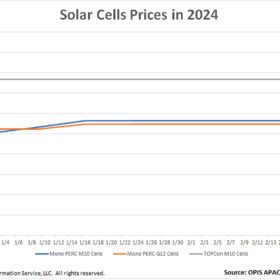
Solar cell prices hold steady as market weighs feasibility of increasing prices
In a new weekly update for pv magazine, OPIS, a Dow Jones company, provides a quick look at the main price trends in the global PV industry.

Vikram Solar displays new 725 W bifacial heterojunction PV modules
Vikram Solar has developed new glass-glass bifacial PV modules based on n-type heterojunction (HJT) G12 half-cut solar cells. The modules are available in power ratings ranging from 700 W to 725 W, with efficiencies between 22.53% and 23.34%, respectively.
Future Solar to ramp up PV module capacity to 1.2 GW
India’s Future Solar is expanding its solar module manufacturing capacity to 1.2 GW, from 500 MW at present.

Inverted perovskite solar cell with antimony-doped tin oxides achieves 25.7% efficiency
Researchers in Singapore have built an inverted perovskite PV device with a p-type antimony-doped tin oxides (ATOx) interlayer that reportedly reduces the efficiency disparity between small and large-area perovskite cells. According to their findings, ATOx may easily replace commonly used nickel oxides (NiOx) as a hole transport material.

Fraunhofer ISE opens module lab in old Solar Fabrik factory
The Fraunhofer Institute for Solar Energy Systems (Fraunhofer ISE) has opened a PV module production lab for new product ideas in a former Solar Fabrik factory in Germany. It is equipped with systems for cell interconnection, laminators, and a range of materials and solar cell technologies.
