
Chinese PV Industry Brief: Total residential PV capacity hits 105 GW
China’s National Energy Administration (NEA) says the nation deployed 33 GW of new residential PV capacity between January and September, bringing cumulative installations to 105 GW, while Flat Glass says it will invest $290 million in new glass factories in Indonesia.

Armor Group acquires 20% stake in French solar panel maker HoloSolis
Armor Group has acquired a 20% stake in French solar panel maker HoloSolis, marking its entry into perovskite-silicon tandem panel production, a mere week after abandoning organic solar module production.
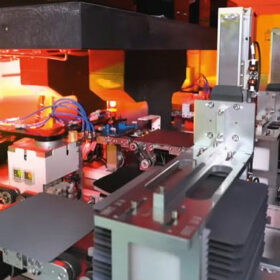
The overproduction conundrum
Solar manufacturing capacity has been ramping up so quickly that even impressive installation growth cannot keep pace. Molly Morgan, senior research analyst at UK-based research firm Exawatt, explores the relationship between PV supply and demand and assesses the likelihood of overproduction.
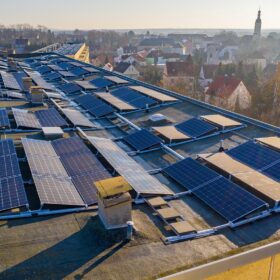
Collectively owned PV systems improve energy community performance
Researchers have looked into the impact of potential regulated charge exemptions on two types of energy communities in 39 European countries. They have found that communities with collectively owned PV systems achieve greater savings.
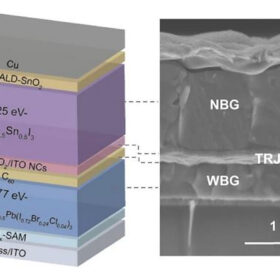
All-perovskite tandem solar cell with 2D/3D heterostructure achieves 28.1% efficiency
A Chinese research team has built an all-perovskite tandem solar cell with a 19.6%-efficient wide bandgap top cell relying on a 2D/3D heterostructure and narrow bandgap bottom cell with a 21.3% efficiency. The tandem device showed remarkable stability by retaining 90% of its initial efficiency after 855 h of continuous operation.
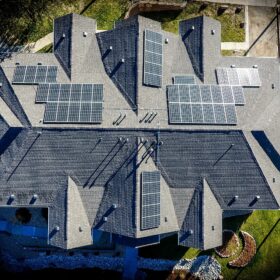
Residential photovoltaic panels with high partial shading tolerance, high voltage
Scientists from South Korea have designed new photovoltaic modules with both rectangular and triangular shapes and solar cells connected in parallel, which they said have higher partial-shading tolerance compared with cells connected in strings. The panels are reportedly less sensitive to partial-shading geometries than shingled modules.
India’s solar installations surpass 72 GW
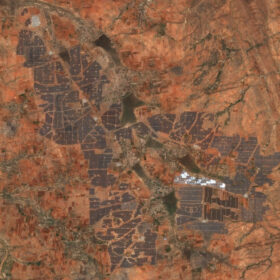
India’s cumulative solar installations hit 72.02 GW as of Oct. 31, 2023. Grid-connected solar rooftops account for 15.38% of all installed capacity, according to the Ministry of New and Renewable Energy (MNRE).

Message framing techniques to boost solar sales
A Dutch-German research team has tested how a series of framed messages may be used to boost PV system sales, addressing both self-interest and environmental concerns, and has found that all the proposed messages are effective at promoting the purchase of solar panel installations.

New dichalcogenide solar cell architecture promises 25% efficiency
Stanford University researchers have explored the efficiency of a single-junction solar cell using transition metal dichalcogenides such as MoS2, MoSe2, WS2, and WSe2 as absorbers. The device has shown substantial light absorptance in ultra-thin 5-nanometer (nm) films, achieving high short-circuit current levels.
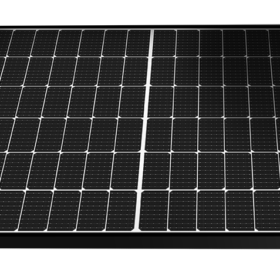
Huasun claims 24.16% efficiency, 750 W output for heterojunction solar panel
The Chinese manufacturer said TÜV SÜD confirmed the results. It launched the G12 series of heterojunction solar modules, with a focus on utility-scale projects, in the second half of 2022.
