
Axitec to set up 600 MW of pilot solar module lines in India
Axitec Energy India has announced the establishment of 600 MW of pilot solar module lines in India. CEO Tanmoy Duari told pv magazine that 300 MW of the planned capacity in Gujarat and another 300 MW in Tamil Nadu will produce n-type TOPCon solar modules. Production will start in the first quarter of 2024.

Storing concentrated solar thermal energy via ‘falling’ ceramic particles
Australia’s Commonwealth Scientific and Industrial Research Organisation (CSIRO) has harnessed sub-millimeter ceramic particles to store energy in a concentrated solar thermal system. Its pilot plant in the state of New South Wales has successfully reached temperatures of 803 C through this method.
Downward trend for PV module prices losing momentum
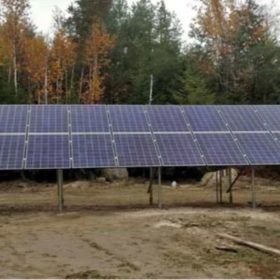
If demand picks up again toward the end of the year due to the current price situation, the downward trend for PV module prices could be stopped, according to pvXchange’s Martin Schachinger.
German firm offers 400 W solar table
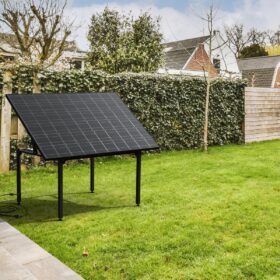
Technaxx, a German firm, has developed a 400 W solar table that combines the functionality of an outdoor table with a power generation unit, using PERC technology for its solar modules.

New research helps identify optimal cleaning cycle to reduce soiling in MENA region
Researchers in Oman have investigated the effects of soiling on solar module performance and have found that between 8 and 12 cleaning cycles may be enough to ensure higher energy yields.
Chinese PV Industry Brief: Haitai, TCL Zhonghuan advance PV factory plans
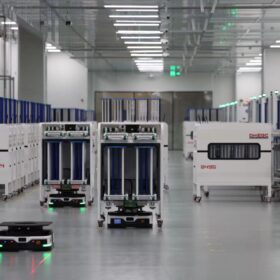
TCL Zhonghuan has raised funds to build a polysilicon and cell factory, while Haitai Solar has changed the location of its 10 GW TOPCon factory from Yancheng, Jiangsu province, to Chuzhou, Anhui province.
India’s Swelect unveils 595 W mono PERC solar panels
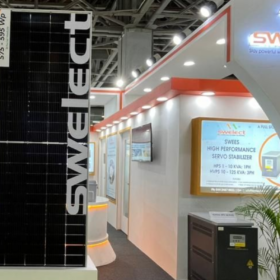
Swelect, an Indian manufacturer, has launched a new line of mono PERC solar panels, with power outputs ranging from 575 W to 595 W and efficiency ratings of up to 21.17%.
Novel algorithm for ultra-short term forecast of PV system faults
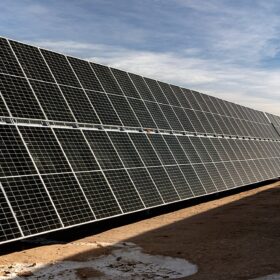
A research group in Pakistan has developed a PV system fault forecasting technique that can reportedly detect faults at the inceptive stage. The scientists claim their new algorithm is able to extract cell parameters and use the data to forecast fault conditions.
New software tool unlocks BIPV design
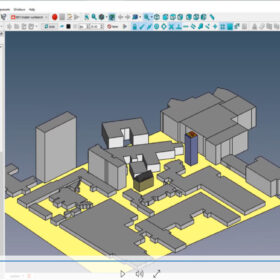
RMIT University in Australia has developed new software that integrates product, regulation, technical, economic, and construction data. It helps architects and engineers to estimate the cost of building-integrated photovoltaics (BIPV) during the conceptual design phase.
New system design for spectral-splitting concentrator agrivoltaics
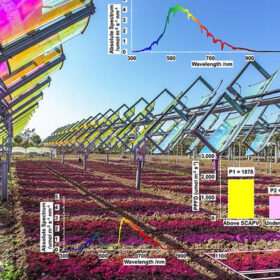
Researchers in China have build a 10 kW spectral-splitting concentrator agrivoltaic system that accomodates small farming equipment below it. The installation relies on 128 concentrator modules integrating each an ultra-white and toughened concentrating curved glass (CCG), a multilayer polymer film (MPF) and 23%-efficient interdigitated-back contact (IBC) crystalline silicon solar cells provided by Sunpower.
