
October 14 eclipse to cost US states up to 17% of daily solar generation
In a new weekly update for pv magazine, Solcast, a DNV company, reports that North and South America are set to experience an annular eclipse on October 14, which means that some regions could lose a significant portion of their daily solar energy production. The path of the eclipse tracks across the southwestern United States, from Oregon to Texas, before continuing through Mexico, Central America and ending in Brazil, though impacts will be seen across all of the contiguous US and the top of South America.

While solar is thriving, European manufacturers are concerned they won’t be able to survive without protective measures
The current module oversupply market dynamic has coincided with efforts to bolster manufacturing outside of China by national governments and manufacturers alike. pv magazine consultant and contributor Götz Fischbeck was a part of discussions regarding made-in-Europe production, to find that protectionist measures are being called for by some.

TotalEnergies acquires French agrivoltaics specialist Ombrea
TotalEnergies has become the sole shareholder of French agrivoltaics specialist Ombrea, in a transaction that builds upon the partnership they started in 2019.
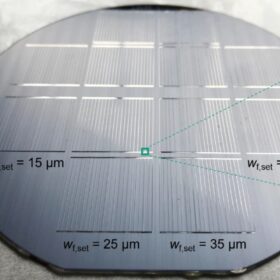
III–V triple-junction solar cell with mask, plate front metallization achieves 31.6 % efficiency
Fraunhofer ISE researchers utilized a new front metallization technique to produce a III-V gallium arsenide solar cell. For mask and plate front metallization, they used a new two-step printing scheme that reportedly allows for the realization of extremely narrow mask openings.
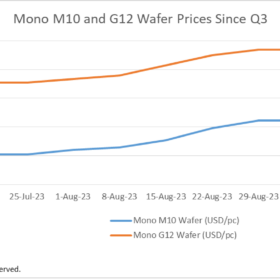
Solar wafer prices fall for first time in 3 months
In a new weekly update for pv magazine, OPIS, a Dow Jones company, provides a quick look at the main price trends in the global PV industry.

Solarstone opens 60 MW BIPV module factory in Estonia
Solarstone, an Estonian producer of building-integrated photovoltaic (BIPV) solar roofs, has opened a 60 MW manufacturing facility in Viljandi, Estonia, to produce a broader range of design and performance specifications.
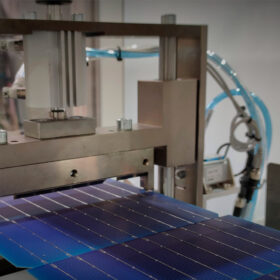
Mondragon Assembly wins patent litigation case in China
Mondragon Assembly says it has won a patent dispute in China, marking its second successful case in the country in relation to its patented continuous string process.
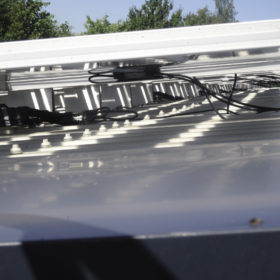
Solar geometry-based model to assess performance of bifacial PV systems
Scientists in India utilized solar geometry to create a novel energy estimation model that reportedly accurately predicts both the front and back irradiance of bifacial PV modules. The model achieved correlation coefficients of 1.04 and 1.40 for the front and rear side, respectively.

Low-temperature processes to reduce silver use in tandem perovskite-silicon solar cells
Researchers from Germany’s Fraunhofer ISE developed new techniques to reduce silver consumption in tandem perovskite silicon solar cells and heterojunction silicon PV devices. The new processes relate to cell metallization and module interconnection.
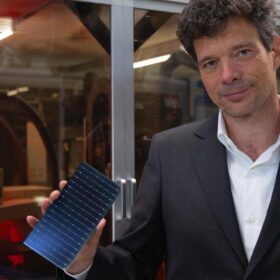
SolarWatt launches TOPCon module production
SolarWatt has started production of TOPCon modules, with plans to manufacture both glass-glass and glass-backsheet versions. It says it aims to make its first shipments in January 2024.
