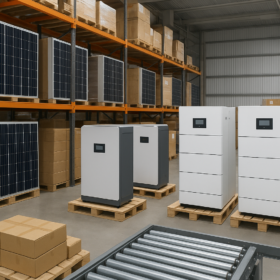
S&P Global unveils 2025 Tier 1 module, inverter, battery supplier list
S&P Global’s first 2025 Tier 1 Cleantech Companies list ranks 63 solar, wind, inverter, and battery suppliers by technology, financial health, and sustainability to guide investors and developers.
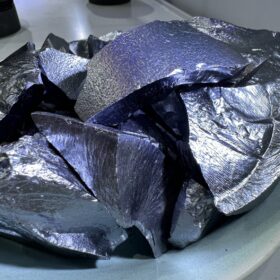
Chinese PV Industry Brief: Tongwei, GCL and Daqo post steep H1 losses
Tongwei, GCL Technology and Daqo New Energy all reported steep first-half 2025 losses on weak polysilicon prices, with rising n-type output and cost controls failing to offset margin pressure.
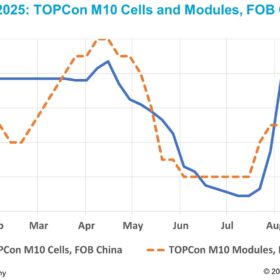
China’s TOPCon cell prices rise on tighter downstream oversight
In a new weekly update for pv magazine, OPIS, a Dow Jones company, provides a quick look at the main price trends in the global PV industry.

US authorities warn of hidden radios in PV-powered highway infrastructure
The US Federal Highway Administration (FHA) has warned that cellular radios have been found in unspecified foreign-made inverters and batteries used in PV highway infrastructure, according to Reuters. pv magazine speaks with cybersecurity expert Uri Sadot about the risks.
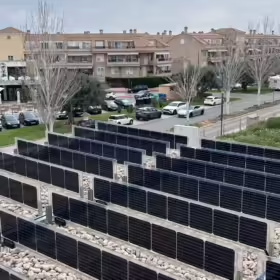
Vertical rooftop PV deployed in Spain with east-west orientation
Norwegian vertical PV specialist Over Easy is developing several vertical rooftop PV projects in Spain. It said one of the projects, a 2.4 kW vertical, has an east-west orientation and is located in the Elche business park, near Alicante, in the southern part of the country.
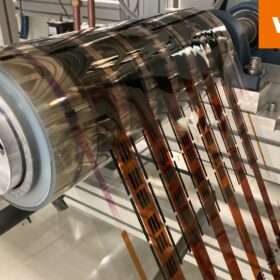
European consortium achieves 21.6% efficiency in flexible perovskite solar cell
Half way through its three-year research program, the Pearl consortium of European research institutes has surpassed 21% efficiency on its flexible perovskite solar cells featuring bendable substrates and has demonstrated scalable roll-to-roll processes.
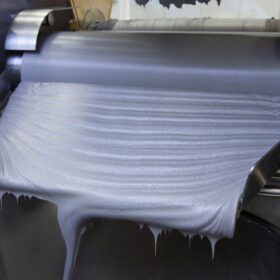
PV industry could account for 40% of global silver demand by 2030
New research from Europe shows that the global PV industry may require up to 14,000 tonnes of silver per year in 2030, with global supply being only 34,000 tonnes. The scientists said more efforts should be made to reduce silver content in TOPCon and heterojunction solar cells.

China’s intelamp sets world record for solar-powered LED display
Chinese solar lighting company intelamp set a new world record for the largest display of solar-power LEDs with an array of 36,862 of its solar lights in the Mingsha Mountain dunes of western China.

Vehicle integrated PV potential measured over a million km in Netherlands, Germany
Researchers have collected data from solar sensor-equipped vehicles, racking up over a million km mainly in the Benelux and German region, to be able to make more accurate efficiency and yield predictions. The research project is part of an ongoing three-year European assessment of VIPV.
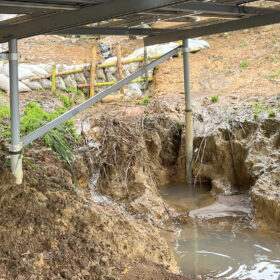
Solar floodplains and fault lines
With the early expiration of key US solar tax credits in 2026 and 2027, solar developers from the United States and Europe are looking to diversify, and the Asia-Pacific (APAC) region represents attractive prospects for many. But unpredictable site conditions can defy even the most experienced developers’ assumptions, causing delays and cost hikes. Upfront due diligence is vital, argue Clean Energy Associates engineers Nicholas Hudson and Evan Woolard.
