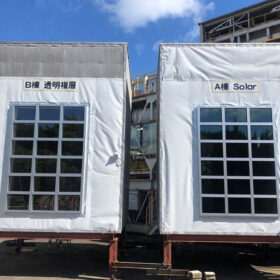
Japanese consortium demonstrates transparent PV windows in indoor environment
Nippon Sheet Glass (NSG), Japan’s largest glassmaker, plans to show photovoltaic windows developed by its US unit, Ubiquitous Energy, at a train station in Japan. The windows feature a transparent photovoltaic coating with an invisible element of power generation, capable of absorbing non-visible wavelengths.
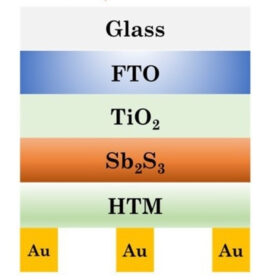
Antimony trisulfide PV cell hits 4.9% efficiency with fluorene-based HTMs
An international research group used the ultrasonic spray pyrolysis (USP) method to fabricate an antimony trisulfide PV cell with high power conversion efficiency and remarkable average visible transmittance. The cell has an active area of 7.06 mm2.

Study shows n-type bifacial TOPCon cells more prone to degradation than p-type
Dutch scientists have reported higher degradation risk for n-type TOPCon cells with EVA encapsulant due to potential moisture degradation. Front-side metallization makes n-type cells more vulnerable than p-type cells, according to damp heat tests.
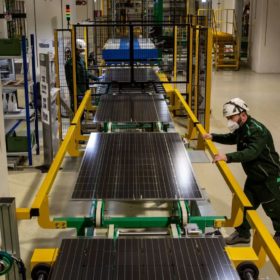
Enel finalizing site for 3 GW solar panel and cell factory in Oklahoma
The U.S. manufacturing site will start with 3 GW of production capacity, with plans to double to 6 GW.
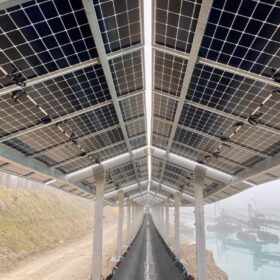
Photovoltaics for conveyor belts
Sinn Power and Recom have installed a 1 km-long PV system on a conveyor belt at a German gravel plant, using Sinn Power’s custom aluminum structure for conveyor belt applications.
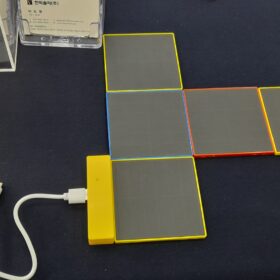
South Korean startup offers portable, combinable solar chargers
Hanvixolar says four solar modules require about 5 hours of charging time to fully charge a smartphone. The mini panels use interdigitated back-contact solar cells from US manufacturer Maxeon.

India’s Cosmic PV Power builds 600 MW solar module factory
India’s Cosmic PV Power says it expects to start production from its second 600 MW factory by June, bringing its total solar panel manufacturing capacity to 850 MW.
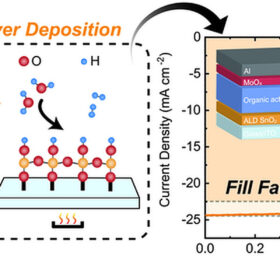
Tin oxide-based organic solar cell hits 17.26% efficiency, 79% fill factor
Dutch scientists have used atomic layer deposition to build an organic solar cell with a tin oxide electron transport layer. This improved electron mobility and transparency, resulting in a record fill factor.

Aiko Solar expands solar cell, module capacity by 30 GW
China’s Aiko Solar plans to build a new factory in three 10 GW phases over the next five years. Construction of the first phase is expected to begin in early 2024.
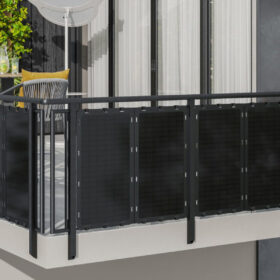
TÜV offers guidance on plug-in balcony solar panels
Balcony solar modules are becoming increasingly popular. TÜV, a technical inspection association in Germany, has come up with tips to safely install and operate them.
