
US startup secures funding for window mini-split air conditioner
Gradient’s first-generation heat pump heating and cooling system is available for preorder, and ships this summer.

Polysilicon price rebound continues
Polysilicon prices started to rise in the second half of January, according to new data from the China Nonferrous Metals Industry Association (CNMIA).
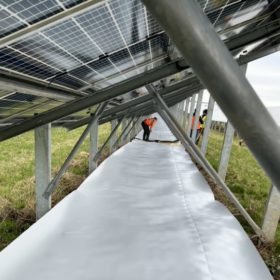
Reflective membrane to increase albedo, power yield in bifacial PV projects
Germany-based Solmax has developed a reflective membrane made of polyethylene resins and coated with a thin white polyethylene layer that reflects ultraviolet (UV) rays. The company claims the membrane can increase the energy yield of a bifacial PV project by between 5% and 20%, depending on the plant configuration.
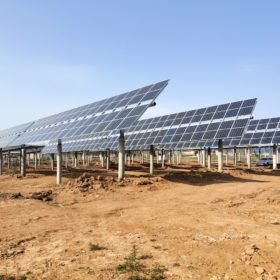
Big wafer benefits extend to n-type, says Trina Solar
China’s Trina Solar has published a white paper on its latest n-type TOPCon modules, with cost calculations and figures from demonstration projects. The Chinese PV manufacturer claims better performance from its 210 mm cells than with other n-type products based on smaller, 182 mm cells.
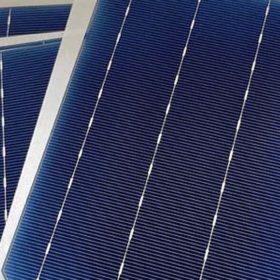
European PV equipment makers pitch machines to US solar manufacturers
A $1 billion to $1.5 billion US market opportunity awaits PV equipment manufacturers through 2030, a McKinsey & Company consultant said at a recent event for potential equipment buyers and sellers in Washington, DC.

India confirms focus on green hydrogen, solar and battery manufacturing
India’s 2023-24 budget shows the government’s plans to support the domestic production of lithium battery cells.
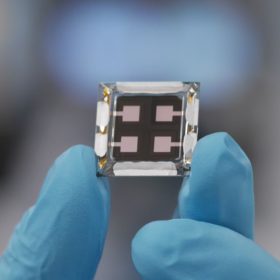
Inverted perovskite solar cell with 24.1% efficiency
An international research group has developed an inverted perovskite solar cell with an active area of 9.6 mm2 by using polymer dipoles for interfacial engineering. It retained 96% of its initial power conversion efficiency after continuous maximum power point (MPP) tracking for 1,000 hours.
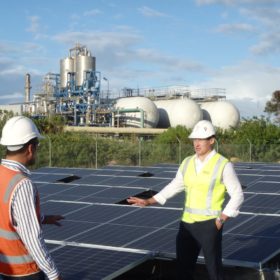
Japanese oil giant opens PV-powered hydrogen pilot in Australia
Japan’s largest oil company, Eneos, has opened a green hydrogen demonstration plant in Brisbane, Australia. The project is relatively small, producing just 20 kilograms of green hydrogen per day, but Eneos Senior Vice President Yuichiro Fujiyama says the company will expand it in the “near future.”

Only5mins! – Standards in agrivoltaics might limit innovation
Makoto Tajima, an agrivoltaics analyst for Japan’s Institute for Sustainable Energy Policies (ISEP), speaks to pv magazine about the growth of agricultural PV in Japan, as well as cost considerations and the pace of technological development.
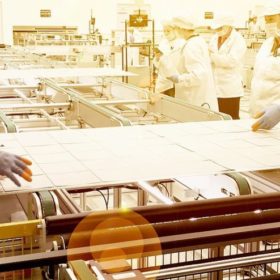
Canadian Solar reveals plans to set up 14 GW of solar cell, module capacity
Canadian Solar says its cell and module capacity will reach 50 GW by the end of this year.
