The weekend read: Catalyst for an EU solar cell, module comeback
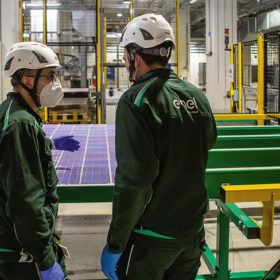
Plans for Europe’s largest-ever PV cell and module factory are taking shape, with equipment orders placed and a projected start date in mid-2024. Enel Green Power has received €118 million ($116.36 million) in funding from the EU Innovation Fund to support the project, out of a total €600 million investment. The EU is hoping it will catalyze further investment in similar projects, and start a high-tech comeback for European solar manufacturing.
Pairing batteries with rooftop solar
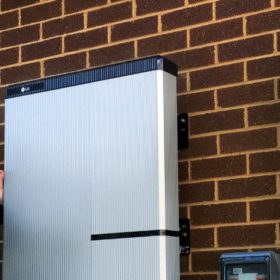
A growing number of residential solar projects include energy storage batteries. In the first part of this series, we look at the backup power feature of batteries.

Waaree Energies raises $122.4 million to expand solar manufacturing
Indian solar manufacturer Waaree Energies has raised INR 1,000 crore ($122.4 million) from a number of private investors to support its module capacity expansion to 9 GW and its new cell line to 5.4 GW.
Maxeon shuts down French solar module factory
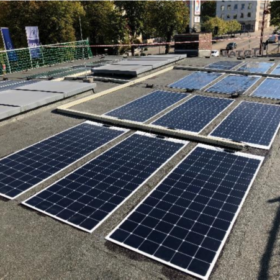
Maxeon has closed its last PV module factory in Europe, as it cannot remain competitive due to its small size and high raw material costs.

Fraunhofer ISE develops direct metallization tech for heterojunction solar cells
Germany’s Fraunhofer ISE is applying its FlexTrail-printing technology to the direct metallization of silicon heterojunction solar cells. It said the technique reduces the use of silver, while maintaining high efficiency levels.
New solar tiles from Germany
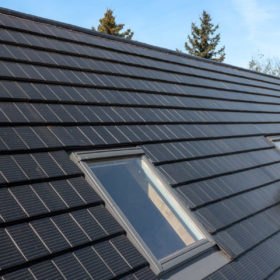
Creaton and Autarq have developed a modular solar tile for complex rooftops. The product is reportedly compatible with all common PV inverters.
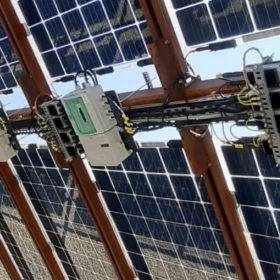
Enel Green Power, INES develop DC/DC MPPT converter for solar panels
Enel Green Power’s initial tests show that the addition of DC/DC MPPT converters to a pilot PV plant has driven a 1% energy production gain. It now plans to deploy the solution on a 1 MW power plant in Italy.
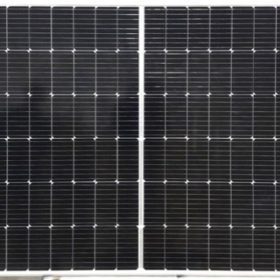
NeoSol unveils 550 W mono PERC solar modules
Indian solar manufacturer NeoSol has unveiled its Black Pearls series of mono PERC modules. The power outputs range from 535 W to 550 W, with power conversion efficiency ratings between 20.7% and 21.33%.

Aptera’s solar car to use Maxeon PV cells
Aptera’s solar electric vehicle, equipped with almost 700 W of PV cells, can drive up to 40 miles (64 km) on solar alone, or 1,000 miles on batteries.
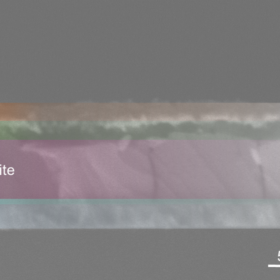
Perovskite solar cell with copper electrode hits 20.1% efficiency
Chinese researchers have developed a new solar cell with a planar n-i-p structure and an indium tin oxide (ITO) substrate. It also has a tin(IV) oxide (SnO2) buffer layer, a perovskite layer, a hole transport layer (HTL), and a layer made of copper. It was able to retain around 92% of its initial efficiency after 1,000 hours.
