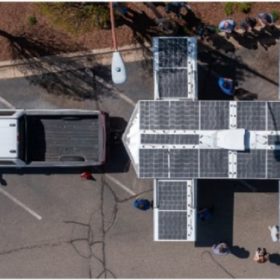
Mobile nanogrids powered by solar, green hydrogen
Climate resilience solutions come prefabricated to generate clean, off-grid power for essential services and emergency response needs.

New in-roof PV system design from India
Ornate Solar’s engineering team designed, engineered and manufactured the new 530 kWp InRoof solar system in India. It serves as the primary rooftop for Pangaea Natural Stone’s factory in the Indian state of Rajasthan.
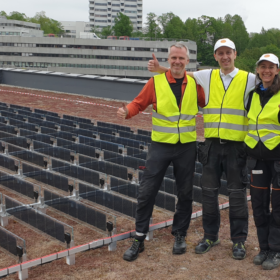
Vertical rooftop PV pilot goes online in Norway
Over Easy Solar AS has developed a rooftop PV system with two generation peaks – one in the morning at 11 am, and one in the evening at 7 pm. It has been deployed on a school building.

Longi to use French patent success against Q-Cells in Netherlands
The patent litigation dispute between Hanwha Q Cells and Longi is heating up in Europe.
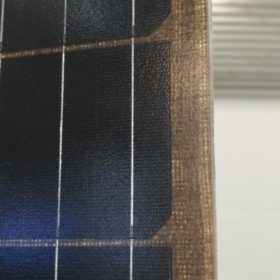
Solar panels based on biosourced materials
French solar energy institute INES has developed new PV modules with thermoplastics and natural fibers sourced in Europe, such as flax and basalt. The scientists aim to reduce the environmental footprint and weight of solar panels, while improving recycling.

Amorphous carbon nitride anti-reflection coating for solar cells
Scientists in Iraq have applied an amorphous carbon nitride (CNx) thin film as an anti-reflective layer in commercial crystalline silicon solar cells. They claim they were able to improve their efficiency from 5.52 to 13.05%.
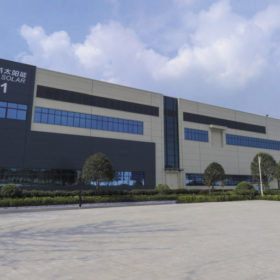
Chinese PV Industry Brief: China’s solar cell capacity exceeds 361 GW
Tongwei has also secured another massive polysilicon order and Golden Glass has invested in more heterojunction solar cell capacity. Furthermore, China’s National Energy Administration (NEA) said 23.7 GW of new solar was deployed in China in the first five months of the year.

Four-terminal tandem perovskite/CIGS solar cell with 25.5% efficiency
Researchers in China have developed a four-junction tandem perovskite/CIGS cell. They claim it is the most efficient device of its kind with an n-i-p structure thus far. They used a novel surface passivation strategy to improve the perovskite cell efficiency and fill factor.

Biden halts solar tariffs for two years. What’s next?
Paul Wormser and Christian Roselund of Clean Energy Associates joined pv magazine to discuss the moratorium on solar tariffs and other executive actions taken by the White House.
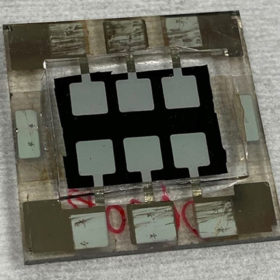
Tandem tin-lead perovskite solar cell with 25.5% efficiency
The US National Renewable Energy Laboratory has made a tandem perovskite solar cell that can retain 80% of its original efficiency after 1,500 hours of continuous operation, or more than 62 days. To improve its stability, they used a hole-transporting material made of phenethylammonium iodide and guanidinium thiocyanate.
