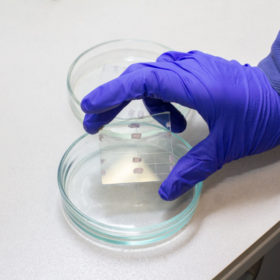
Russian scientists achieve 21.1% efficiency in perovskite solar cell via Mie-resonant silicon nanoparticles
A Russian-Italian research group has developed resonant silicon nanoparticles that are claimed to improve the performance of perovskite solar cells. These particles serve as nanoantennae – they catch light and it resonates inside them, which amplifies the cell’s light absorption.
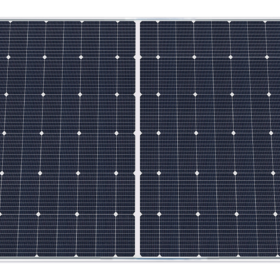
Indian solar manufacturers go big on high-output modules
Adani Solar, Jakson, Premier Energies, Vikram Solar, Waaree and other Indian manufacturers are showcasing their high-output modules ranging from 500 W to over 600 W at this year’s Renewable Energy India Expo 2021.
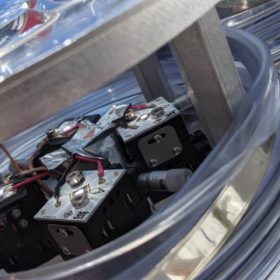
CPV module with improved short-circuit current via microstructured encapsulant coatings
A Canadian consortium led by the Sherbrooke University has developed a CPV panel with improved light absorption through a microstructured anti-reflecting coating consisting of a monolayer of silica beads, which they claim can improve the device’s short-circuit current by up to 3.7%. The module is based on III-V solar cells.

Chinese PV Industry Brief: Work begins on 3.3 GW solar-CSP project linked to 500 MW of storage, in Qinghai
China Green Development Group is building a giant project consisting of 3 GW of photovoltaics and 300 MW of concentrating solar power. The plant is scheduled for completion in 2025 and is part of China’s 14th five-year plan.
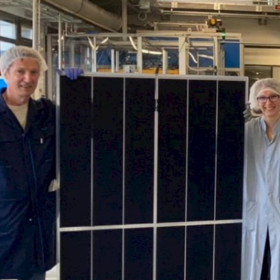
CEA-INES unveils shingled heterojunction PV panel with 21.41% efficiency
The module is claimed to be one of the top five most performant heterojunction solar modules, in terms of power density, with the champion panel achieving 214.15 W/m² and the average device 209.5 W/m². The panel showed an efficiency ranging from 20.95% to 21.41%.
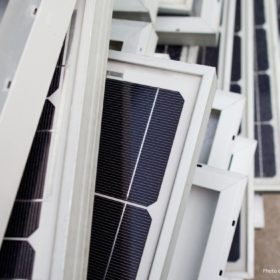
NREL model shows current incentives for PV module recycling are insufficient
Analysts at the US research institite modeled PV recycling strategies and found that current incentives are not well-aligned to drive recycling.

Goldi Solar plans 210 mm module production from next year
Indian PV manufacturer Goldi Solar will start producing its HELOC̣ Pro series M10 (182 mm) modules in November, and will add G12 (210 mm) panels to its lineup next year.
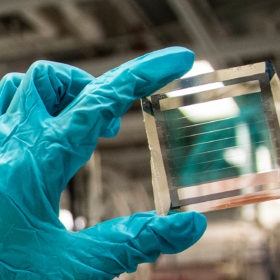
Semi-transparent organic solar cell for window applications
Developed by U.S. scientists, the 10%-efficient device is intended for applications in solar windows and promises efficiencies close to 15%. According to its creators, the cell retained 80% of its efficiency after 1,900 hours at 55 degrees Celsius.

PV-powered mobile home with 730km range
Solar Team Eindhoven has developed an experimental mobile house that is powered exclusively by vehicle-integrated PV and is claimed to achieve a range of 730km, on a sunny day and at a, moderate speed of up to 85kph. The vehicle is equipped with a foldable PV system that can be unfolded and produce more power when the vehicle is not in motion.
Legal dispute over South African content rules in 2 GW tech-neutral tender
The South African Department of Mineral Resources launched a tech-neutral procurement process for 2 GW of capacity in August 2020, in response to a chronic short-term electricity supply gap in the country.
