
Australian research prompts rethink on silicon heterojunction cell production
Defect engineering for silicon heterojunction solar cells has come a long way. But Matthew Wright, a solar researcher at the University of New South Wales, asks whether these proven efficiency gains could be applied more effectively.

The weekend read: PV manufacturing meets big data
As PV manufacturing lines continue to get larger, keeping track of the measurement data that’s vital for quality and process control becomes an ever more herculean task. Flashing equipment supplier h.a.l.m. has developed a software solution that keeps all of this data in one place and provides operators with a real-time view of production line performance and quality. pv magazine caught up with Managing Director Michael Meixner to discuss the latest on big data in PV manufacturing.

New PV products, strategic agreements unveiled on day 1 of SNEC
The first day of the world’s biggest solar trade show and conference saw new PV products and strategic agreements unveiled by some of the biggest names in the industry. pv magazine China reporter Vincent Shaw and photographer Dave Tacon were on the ground to catch up with the companies and bring you the latest solar news from Shanghai, China.
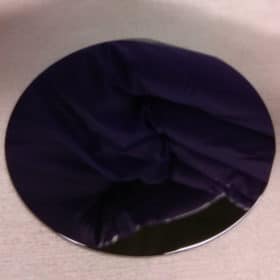
Four-terminal III-V solar cell with 32.57% efficiency
Scientists at the US National Renewable Energy Laboratory have simulated a III-V solar cell by stacking gallium arsenide films onto interdigitated back contact silicon solar cells with a glass interlayer. The scientists have already done some initial mini-module integration work, but significant size scaling will ultimately be needed to reach commercialization. The cell currently has an active area of 1 cm2.
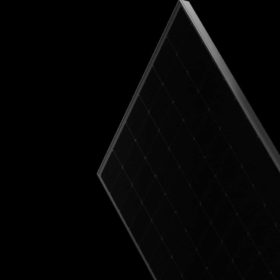
Longi unveils n-type, TOPCon bifacial module with 22.3% efficiency
The 144-cell module is available in six versions with power ratings ranging from 545 W to 570 W and efficiency between 21.3% and 22.3%. The product measures 2,256×1,133x35mm and weighs in at 32.3kg.
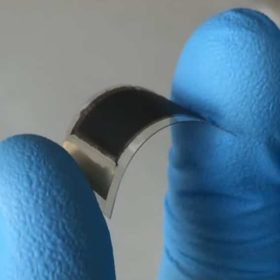
Perovskite stability, and the effects of defects
An international team of scientists fabricated perovskite solar cells which retained almost all of their initial 21% efficiency after 1,000 hours under continuous operation at their maximum power point. The researchers credit this performance to their discovery of an additive that served to ‘block’ ions that cause device degradation, and also hope their work will contribute to an improved understanding of the relationship between efficiency and stability in perovskite PV.
Nano-micro-scale cooler for solar modules
The proposed technique is based on radiative cooling and consists of a glass coating made with a two-dimensional subwavelength nanostructured grating, which is imprinted in soda-lime glass and has enhanced mid-infrared emissivity, and a micro-structured grating. The temperature decrease provided by the nano-micro-grating coating was found to be approximately up to 5.8 degrees Celsius.
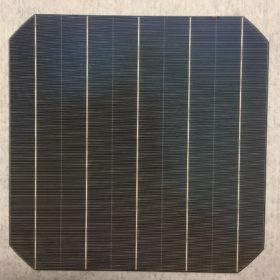
Bifacial n-type TOPCon cell with 22.6% efficiency
The device also showed an open-circuit voltage of 702 mV, a short-circuit current of 40 mA/cm2, and a fill factor of 79.7%. It has a large area of 239 cm².
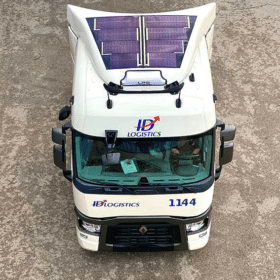
Flexible PV fabric for heavy transport
France’s Solar Cloth has announced that Renault Trucks has listed it as a supplier for its factories.
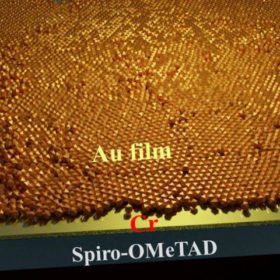
A touch of gold for a 19.8% efficient perovskite cell
Scientists in the U.S. fabricated a semitransparent perovskite solar cell that reached 19.8%, and 28.3% in a tandem cell stacked on top of a silicon-heterojunction device. The device relies on a film of gold just a few atoms thick, grown using an innovative seeding method, which has the valuable properties of being both highly conductive and transparent.
