
Sinovoltaics tracks 86.5 GW of module output capacity for Southeast Asia
PV module manufacturing capacity in Southeast Asia has reached 86.5 GW across 61 active sites, according to Hong Kong-based quality assurance firm Sinovoltaics. The figures come from the company’s latest “Southeast Asia Solar Supply Chain Map” report.

GCL Optoelectronics finishes 1 GW perovskite PV module factory in China
GCL Optoelectronics has commissioned a 1 GW perovskite solar module facility in China, and says it may increase capacity to 2 GW per year depending on market demand.

The best tilt angle to improve PV system performance on low-cost buildings
Researchers have demonstrated that the theoretical optimal tilt for rooftop solar energy production in low-cost buildings in Nigeria is approximately 5.67°. Their modeling suggests to adopt south-facing roofs for PV generation in the Global South.
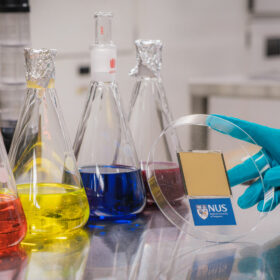
SERIS achieves world record efficiency of 26.7% for perovskite-organic tandem solar cell
The tandem device is based on a bottom organic cell that can achieve a remarkable power conversion efficiency of 17.9% and a high short-circuit current density of 28.60 mA cm2. Furthermore, it uses a top perovskite solar cell with an open-circuit voltage of 1.37 V and a fill factor of 85.5%.

Ikea begins offering balcony solar kits
Swedish furniture retailer Ikea is selling plug-in solar kits in Germany, with storage-inclusive systems starting at €1,229 ($1,425) and reaching €2,800 for versions featuring four 520 W panels. The kits are designed for residential self-consumption and vary by capacity and configuration.
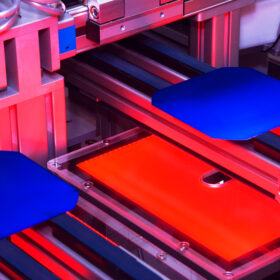
EU adopts state aid framework for cleantech industry
The European Commission has developed a new state aid framework under the Clean Industrial Solutions Act for Europe (CISAF) to support clean technology manufacturing across the European Union.
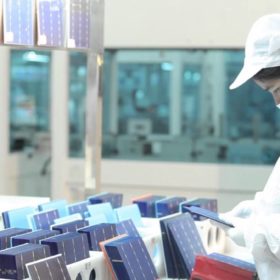
JinkoSolar achieves world record efficiency of 27.02% for TOPCon solar cell
The Chinese manufacturer said the result was certified by China’s National Photovoltaic Industry Measurement and Testing Center (NPVM).

New research sheds light on voltage deficit in selenium solar cells
An international research team has investigated the impact of intrinsic point defects in selenium solar cells and has concluded that these defects are not responsible for voltage deficit. The scientists rather believe interfaces and extended defects may be the cause of this well-known issue for this kind of PV device.
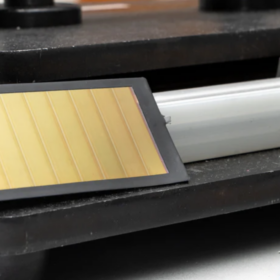
Australian cell manufacturer launches perovskite module series
Australian solar cell developer Halocell Energy has launched its first perovskite-based product line with the flexible Ambient Modules series purpose-built for low-light conditions.
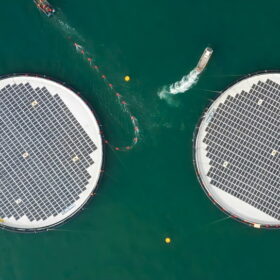
GCL SI presents 480 W solar modules for offshore projects
GCL System Integration (GCL SI) introduced its NT10/60GT floating solar module at the recent SNEC 2025 trade show in Shanghai. It developed the seawater-resistant solution in collaboration with Norway’s Ocean Sun.
