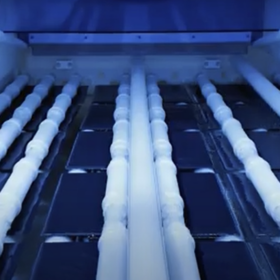
RENA Technologies warns of patent infringement in US, Indian markets
RENA Technologies GmbH says it plans to take legal action against unauthorized use of its water cap patent in the United States and India, amid evidence of infringement by unspecified Chinese suppliers manufacturing equipment for solar cell production.

Solarium Green Energy to restart solar module production with new 1 GW plant
Solarium Green Energy will resume solar module manufacturing with a new 1 GW fully automated facility in India, scheduled to begin commercial operation in the fourth quarter of fiscal 2025-26.

China’s SNEC 2025 show highlights PV industry resilience, storage growth
Chinese solar manufacturers showed resilience at the 2025 SNEC PV Power Expo in Shanghai despite a deepening supply glut, as strong demand for energy storage and emerging technologies offset a steep drop in new PV module launches. Tunnel oxide passivated contact (TOPCon) stayed dominant, while back-contact, perovskite, and lithium iron phosphate (LFP) storage solutions gained traction.

Longi unveils 700 W back-contact PV panel with world record silicon solar cell
Chinese solar manufacturer Longi unveiled a new PV module with 25.9% efficiency at the 2025 SNEC trade show this week in Shanghai, produced using both low- and high-temperature passivation techniques.
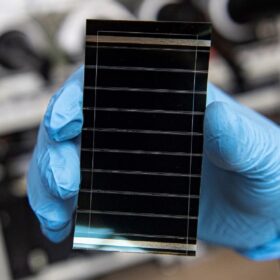
Perovskite solar cell based on chalcogen-molecules achieves 25.37% efficiency
An international research team has used Lewis molecules to improve efficiency and stability of a perovskite solar cell built with a fully encapsulated trapping tactic aimed to reduce perovskite surface defects. The cell achieved a certified power conversion efficiency of 25.18% and a champion efficiency of 25.37%.

Top solar modules in reliability, quality and performance testing
The Renewable Energy Test Center (RETC) has released its 2025 PV Module Index, assessing solar module reliability, quality, and performance across industry benchmarks. The report highlights manufacturers that meet high standards in long-term durability and energy yield.
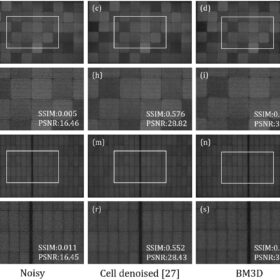
Denoising outdoor electroluminescence images of PV panels through deep learning
Researchers in Australia have developed a simplified residual network-based architecture method to filter out noise from electroluminescence images of PV modules. The proposed technique reportedly enhance the accuracy and efficiency of automated inspection systems for utility-scale PV plants.
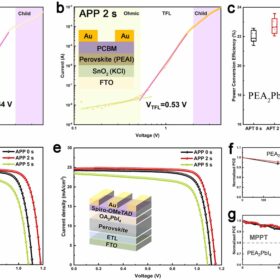
Perovskite solar cell built through Argon plasma treatment achieves 23.55% efficiency
Researchers in China have used an argon plasma polishing pre-treatment (APP) to remove surface defects and increase passivation effectiveness in perovskite solar cells. The result is a perovskite device with a 2D interface that significantly improves stability and performance.

Hail risk remains top issue faced by solar projects
Hail damage remains a top risk to large-scale solar assets, according to an annual report from kWh Analytics.

Collaboration key to scaling new technology
Both the solar module and battery manufacturing industries have been dealing with excess production capacity in recent years, and each is undergoing its own set of market adjustments in 2025. This has meant challenging conditions for manufacturing equipment suppliers in either sector. But there is still plenty of opportunity to deploy the latest technologies at scale, and to assist suppliers moving into new regions. The long-term outlook for both sectors is strong, as pv magazine heard from Wang Yanqing, Chairman of solar and battery production equipment supplier Lead Intelligent, headquartered in Wuxi, China.
