
French city favors domestic modules in 6.8 MW solar carport tender
The city of Grand Nancy, France, awarded a 6.8 MW solar carport tender to Holosolis, tying the 2027 project to its planned 5 GW factory in the Grand Est region.

Researchers identify main source of wide-bandgap solar perovskite degradation
Scientists in Belgium have investigated how perovskite absorbers used in solar cell degrade under three different stress test types and have found that the interface between the perovskite layer and the electron transport layer suffers from weak thermomechanical stability, which creates the conditions for performance losses.

Encapsulant delamination behavior in PV glass recycling
Researchers in Spain investigated effective separation of encapsulants from PV glass with a focus on melting behavior and resistance to the hot knife-method of delamination. The results indicated that thermoplastic polyolefin encapsulants were the easiest to remove from the PV glass.
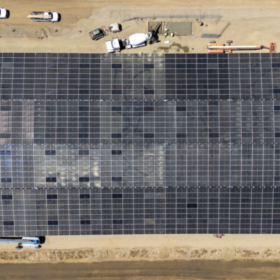
California now hosting canal top solar-plus-storage plant
California has completed the 1.6 MW Nexus canal-top solar pilot, adding a 75 kW iron-flow battery system as part of a $20 million state-funded project to test water and energy benefits.
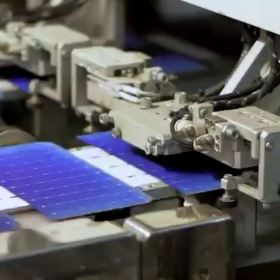
IB Solar plans 4 GW TOPCon cell and module factory in India
IB Solar will build a 4 GW tunnel oxide passivated contact (TOPCon) solar cell and module facility in Uttar Pradesh, India, with an investment of about INR 30 billion ($340.2 million). The project has secured land allocation from the Yamuna Expressway Industrial Development Authority and is scheduled for commissioning by 2027.
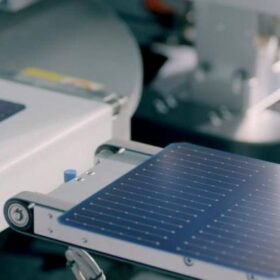
DAS Solar enters back-contact business with 5 GW cell factory
DAS Solar has filed an environmental-impact assessment (EIA) for a 5 GW back-contact (BC) solar cell plant in Guizhou, China, expanding its existing manufacturing operations to supply large-scale and building-integrated PV (BIPV) installations.
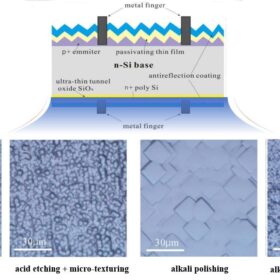
Improving TOPCon solar cell performance with rear treatment techniques
Researchers in China have investigated four strategies that minimize TOPCon solar cell surface recombination centers and improve light trapping performance. They identified alkali polishing with micro-texturing as the most suitable technique to improve TOPCon cell open-circuit voltage and fill factor and the overall device performance.

Dow releases new silicone gel for high voltage PV
The company said that its Dowsil EG-4175 Silicone Gel resists temperatures of up to 180 C in next-generation IGBT modules used in inverters.

Itoki, Hitachi, Tokuyama recycle solar glass for office furniture
The Japanese companies have used their unique technologies to demonstrate how glass from end-of-life PV panels can be used in office furniture components, specifically in an office privacy cabin.
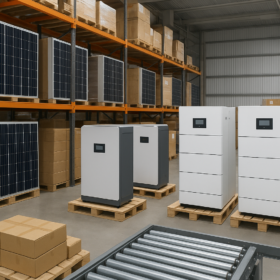
S&P Global unveils 2025 Tier 1 module, inverter, battery supplier list
S&P Global’s first 2025 Tier 1 Cleantech Companies list ranks 63 solar, wind, inverter, and battery suppliers by technology, financial health, and sustainability to guide investors and developers.
