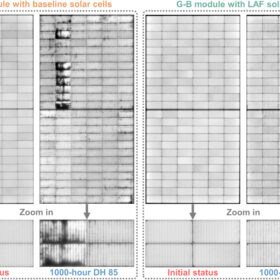
EVA-induced degradation has significant impact on power losses in TOPCon solar modules
New research from UNSW shows that EVA-encapsulated TOPCon solar modules under damp-heat testing can suffer significant power losses and fill factor drops. The study describes metallization degradation mechanisms driven by EVA-generated contaminants and demonstrates the effectiveness of metallization adjustments in reducing EVA-induced degradation rates

WorldOne Energies commissions 1.2 GW solar module line
WorldOne Energies has commissioned a 1.2 GW solar module manufacturing line that will produce its Supreme series n-type tunnel oxide passivated contact (TOPCon) panels.

U.S. Commerce Department slaps unexpectedly high tariffs on solar imports
Coalition trade lawyer says the U.S. Department of Commerce’s final tariffs on solar cells and modules from Cambodia, Malaysia, Thailand and Vietnam are among the highest rates he’s ever seen.
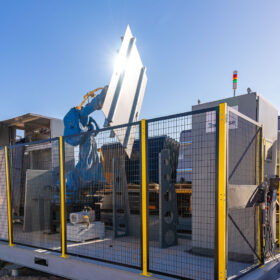
How robotics is reshaping solar module installation
With module sizes increasing, labor shortages worsening and workplace safety risks escalating, automation is a necessity.
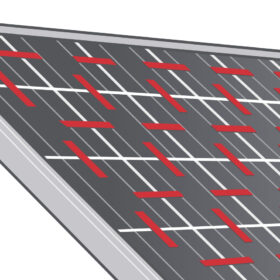
Avery Dennison debuts new pressure-sensitive tapes for PV modules
Avery Dennison has introduced a line of UV-resistant, pressure-sensitive adhesive tapes for PV modules. The new products support applications such as frame mounting, cell fixation, busbar bonding, and junction box installation.
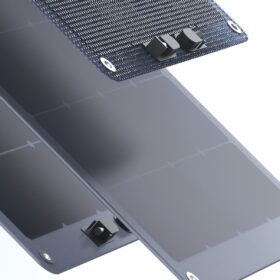
Italian startup debuts waterproof carbon fiber solar panels for off-grid applications
Levante, an Italian carbon fiber solar PV design and engineering company, has introduced 110 W and 55 W panels for offgrid recreational applications. The modules are lightweight, semi-rigid and made with recycled carbon fiber material.

Teledyne Flir presents new PV inspection products
Teledyne Flir, a US-based sensing solutions company, has launched new PV inspection tools – including a clamp meter, irradiance meter, and I-V curve tracer – alongside two product kits targeting solar installers, utilities, and PV manufacturers.

Australian researchers build 2D/3D tin halide perovskite solar cell with 16.65% efficiency
Researchers at the University of Queensland have developed a 2D/3D tin halide perovskite (THP) solar cell with a certified efficiency of 16.65% and peak performance of 17.13%, maintaining stable output under continuous illumination for over 1,500 hours.

PV-driven heating, cooling system for supermarkets
Scientists in China have developed a novel PV-powered cooling and heating system that combines a water-cooled gas cooler and an air-cooled gas cooler. The system went through a series of simulations and showed it can potentially achieve a coefficient of performance of up to 7.34.

Longi achieves 34.85% efficiency for two-terminal tandem perovskite solar cell
The result was confirmed by the U.S. Department of Energy’s National Renewable Energy Laboratory (NREL).
