
India adds 25.3 GW of module capacity, 11.6 GW of cells in 2024
Indian manufacturers built 25.3 GW of solar module manufacturing capacity in 2024, taking the nation’s panel capacity to 90.9 GW as of Dec. 31, 2024.
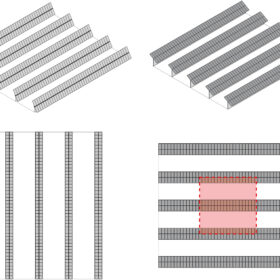
New simulation framework achieves higher dual land use efficiency in agrivoltaics
Researchers in Italy have conceived new agrivoltaic modeling for agrivoltaics that includes crop yield response curves for multiple crops. Once the electricity production coming from the PV modules is also assessed, the performance metrics for the agrivoltaic system as a whole are obtained.
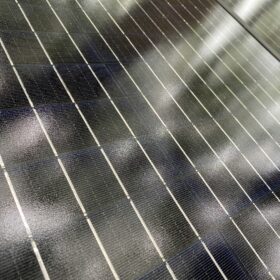
International PV module pricing may rise to $0.11/W by year end
International PV module prices, driven by Chinese averages, will likely rise from $0.08/W to $0.10/W today to $0.11/W by the end of 2025 and potentially $0.13/W by 2027, says Clean Energy Associates (CEA), noting that heterojunction and back-contact technologies now make up 12% of global module capacity.

Using laser processed glass as solar concentrators for BIPV
Researchers from Aalto University in Finland demonstrated a proof-of-concept of laser-processed glass to be used as a type of solar concentrator for building integrated PV (BIPV) applications. The treated glass enabled a 55-fold increase in photocurrent generation compared to unprocessed glass, with an estimated optical efficiency of 0.66 %. Additionally, a fluoropolymer coating was applied to create a self-cleaning surface.

Chinese PV Industry Brief: Solar stocks slide as US tariffs stoke concerns
Chinese solar stocks tumbled on April 7 after the US government announced new tariffs, with more than 120 PV-related shares falling and over 85 dropping more than 10%. Analysts downplayed the impact, citing the US market’s limited role in global solar demand.
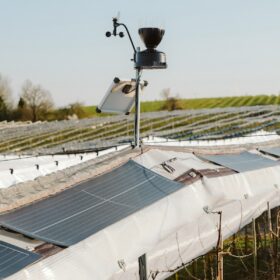
Fraunhofer ISE testing agrivoltaics on standard weather protection covers
Fraunhofer ISE and German weather protection specialist VOEN Vöhringer are testing an agrivoltaic system that uses existing crop cover structures to support solar modules, eliminating the need for a dedicated mounting system.
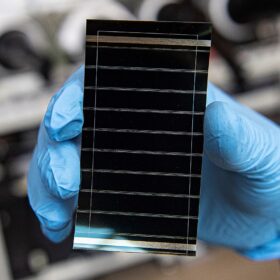
Caelux developing perovskite-silicon tandem solar with four-terminal configuration
While many perovskite developers pursue a 2-terminal format, which poses design and production constraints, Caelux uses a 4-terminal approach that can reportedly help bypass technical challenges.
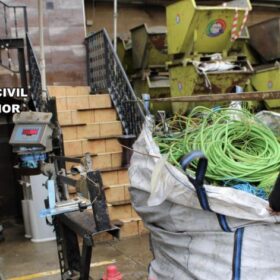
Spain arrests 23 people in copper theft ring targeting solar plants
The Spanish authorities have arrested 23 people and recovered 8.5 tons of stolen copper linked to a theft ring targeting PV plants in Andalusia, Extremadura and Ávila. The Civil Guard dismantled the network through Operation Kupfer, part of a broader crackdown on copper theft in the country’s solar sector.

How to reconfigure PV modules in degraded solar plants
Indian scientists have developed six different strategies to reconfigure solar modules in degraded PV assets. Their analysis showed which conditions make the reconfiguration of an underperforming solar plant profitable.
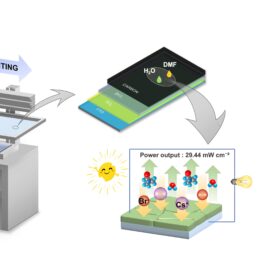
Chinese scientists improve carbon perovskite solar cell performance via dual-solvent process
A team of researchers in China has demonstrated a novel dual-solvent process in 4-terminal carbon CsPbBr3 perovskite solar cells that achieve 10.18% power conversion efficiency. They have also built a large area 17.88 cm2 device achieving an 8.72% efficiency while retaining 93.2% of the initial performance after 1,000 hours of operation at 150 C.
