
Energielenker releases ‘self-learning’ energy management system
Germany-based Energielenker has developed a “self-learning” energy management system that controls energy flows in buildings with PV systems, using AI algorithms to analyze data from all relevant components.
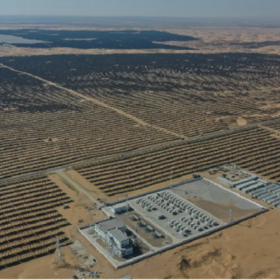
China Three Gorges to build 16 GW renewables cluster in Inner Mongolia
China Three Gorges has announced plans to build a 16 GW renewables cluster in China’s Inner Mongolia region, including 8 GW of solar, 4 GW of wind, a 200 MW solar thermal system, a 4 GW coal plant, and a 500 MWh energy storage system.
Desay Battery, Victory Giant Technology partner on China’s largest user-side energy storage project
The project, located in Victory Giant Technology Industrial Park in Huizhou, Guangdong Province, is designed to have a capacity of 121 MW/630 MWh, making it the largest commercial and industrial (C&I) energy storage station in China.

Growatt sees growth in Europe’s C&I solar, storage markets
At The Smarter E Europe event – recently held in Munich, Germany – Growatt shared insights on the European market. It reports a slowdown in the residential segment in Central Europe due to lower demand, but Growatt VP Lisa Zhang said she expects more growth in the commercial and industrial (C&I) solar and storage sectors.
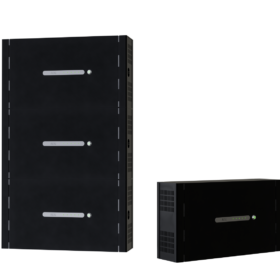
AEG unveils 5 KWh stackable high-voltage battery
Germany’s AEG is selling new stackable, high-voltage batteries with usable capacity of 5 kWh. They come with a 10-year warranty and reportedly have a lifecycle of more than 4,500 cycles.
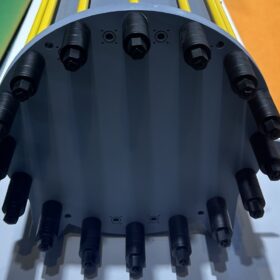
The Hydrogen Stream: Poland unveils hydrogen strategy
The Polish government has outlined its main objectives for the development of hydrogen, while Tyczka Hydrogen says a damaged compressor from Maximator Hydrogen caused a recent incident at one of its filling stations in Germany.
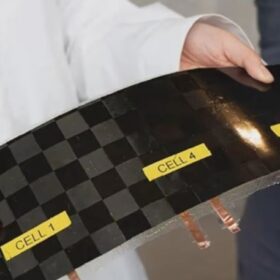
Energy-storing carbon fibre composites pave the way to weightless batteries
Building on research work at Sweden’s Chalmers University of Technology, Sinonus has developed carbon fiber-based structural batteries that not only store energy but also become an integral part of a product’s structure. Their possible span of energy density is said to be around 25-50% of a conventional lithium-ion battery at current technology level.

Grenergy secures financing for two phases of world’s biggest battery project
Madrid-headquartered independent power producer (IPP) Grenergy has reached financial close on the first two phases of its Oasis de Atacama solar and battery energy storage hybrid project in Chile.
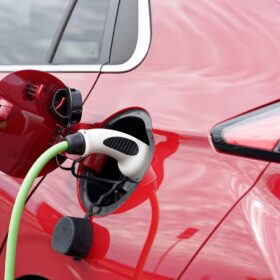
V2G tech can provide outage support, claim Australian researchers
Researchers at the Australian National University (ANU), Canberra, have shown that their response to a February 2024 grid emergency provides evidence that electric vehicles (EVs) equipped with vehicle-to-grid (V2G) systems could strengthen the grid during blackouts, marking a global first for such research.
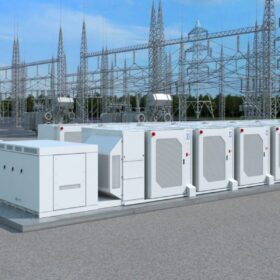
Bulgaria’s battery storage market gears up
Bulgaria has installed between 40 MWh and 50 MWh battery energy storage capacity to date. However, a new national legislation as well as funds provided through the European Union’s Recovery and Resilience Facility could see the country install another 1 GWh over the next two years.
