
Macquarie to invest in 20 GW pipeline of renewables
With hundreds of billions of dollars in assets and funds under management, Macquarie Group is seeking to amplify its considerable influence, bringing investment and reporting to bear on accelerating climate mitigation and adaptation.
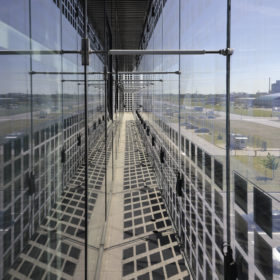
The weekend read: Establishing a cost-effective BIPV sector in Europe
Why hasn’t more building-integrated PV (BIPV) been installed throughout the world? The simplest answer is that a PV module does not architecture make. The nature of the building process – its methods and logic – are key factors affecting technological transfer, as seen in the steel and concrete industries, which have been the basis of modern architecture for the past century. In many cases, standardization would go against the case-by-case approach to design and the interdisciplinary nature of the field. Solar architecture therefore involves a synergic concept of constructive and functional correctness, while always engaging an “aesthetic intentionality.” So how can the market segment continue to drive down costs?

India prepares to embrace agrivoltaics
Take-up has been slow considering the nation’s mammoth agricultural industry but, as a packed session on the topic at the recent Renewable Energy India show illustrated, attitudes may be changing in a nation which is already installing solar greenhouses.

Turkey to introduce provisions for storage
The Turkish Energy Market Regulatory Authority has published draft guidelines for the integration of storage in the energy system. The new provisions are expected to come into force at the beginning of next year.

Taiwan wants 3.7 GW of new solar by 2021
Prime minister Su Tseng-chang announced the ambition and said the new solar plan for 2019-20 will bring investment and business opportunities of around US$7.5 billion.
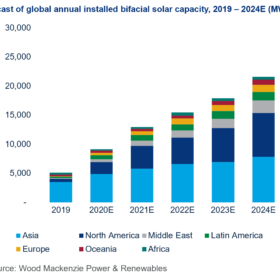
WoodMac: Bifacial module capacity will exceed 21 GW by 2024
Increasingly affordable and free from the Trump administration’s solar tariffs, bifacial modules are only set to get more popular in the years ahead. In its first report on bifacial PV, WoodMac predicted the technology will make up 17% of global installations five years hence, quadrupling the share it will have this year.

Australian tech billionaire to help fund 10 GW Sun Cable Project
Mike Cannon-Brookes, co-founder of software company Atlassian Corp, announced on the sidelines of the UN Climate Action Summit in New York he will help fund the ambitious 10 GW, AU$20 billion, Sun Cable Project in Australia’s Northern Territory.

Another 150 MW of solar comes online in Spain
The new generation capacity comes from three 50 MW solar projects Spanish energy company Naturgy secured in an auction by the Spanish government in 2017. The installations are near Ciudad Real, in the central-southern region of Castilla-La Mancha.

80 MW of Kenyan PV projects get €106m boost from Europe
The European Investment Bank and the Netherlands Development Finance Company have each provided €53 million for the Radiant and Eldosol solar projects.

Texas moves closer to merchant solar
Intersect Power has gone live with news the company has 1.7 GWdc ready for construction in Texas and California, including a project which holds a hedge and no power purchase agreement.
